Parterre Garden
Madrid, Spain
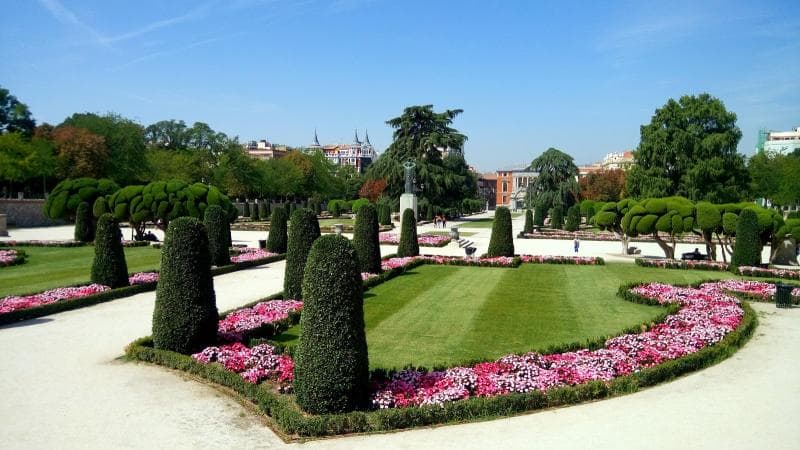
Explore Parterre Garden in Retiro Park, Madrid, Spain. Discover its French design, 18th-century history, and the ancient Ahuehuete tree.
Overview
Nestled within the expansive and verdant El Retiro Park in Madrid, Spain, lies the exquisite Parterre Garden, a historical jewel that transports visitors to the grandeur of 18th-century European horticulture. This meticulously designed space stands out with its formal French style, offering a serene and symmetrical contrast to some of the park's more naturalistic landscapes. It is one of the oldest and most historically significant sections of the park, renowned for its architectural precision and botanical treasures. The Parterre Garden is easily accessed through the majestic Puerta de Felipe IV, inviting curious travelers into a realm of carefully cultivated beauty.
As an integral part of El Retiro Park, the Parterre Garden contributes to the park's status as a UNESCO World Heritage Site, recognizing its outstanding universal value where culture, science, and nature coalesce. It's a place where history whispers through manicured hedges and ancient trees, making it a must-visit for anyone seeking both tranquility and a deeper understanding of Madrid's royal past.
History & Cultural Background
The origins of the Parterre Garden trace back to the early 18th century, specifically between 1716 and 1722, during the reign of King Felipe V, the first Bourbon monarch of Spain. Driven by a desire to emulate the magnificent French gardens of his grandfather, Louis XIV, at Versailles, Felipe V commissioned this area to reflect a sophisticated continental aesthetic. Initially, the site was occupied by a different layout known as the 'Jardín de las Ocho Calles' or 'Ochavado,' meaning 'Garden of the Eight Streets,' characterized by eight pathways converging in a circular square.
The garden, however, faced significant damage during the turbulent French invasion of Spain (Peninsular War, 1808-1814), leading to a period of abandonment. Its restoration and remodeling were later entrusted to Francisco Viet, the chief gardener of the Campo del Moro Gardens. Viet's work included raising the retaining wall that still exists today and constructing a viewpoint, along with adding stone and brick fountains. The impressive Puerta de Felipe IV, now a primary entrance, was installed in 1922. Further modifications to its botanical elements, such as ligustrums and boxwood hedges, occurred after the Spanish Civil War.
What Makes It Special
The defining characteristic of the Parterre Garden is its strict adherence to the classical French garden design. This style is evident in its symmetrical flowerbeds, often arranged in intricate 'broderie' patterns, harmoniously complemented by ornate water features and precisely trimmed hedges. The geometric layout and wide pathways create a sense of order and elegance, distinguishing it from other parts of El Retiro Park.
Undoubtedly, the garden's most celebrated feature is the Ahuehuete, or Mexican Cypress (Taxodium mucronatum), proudly standing as Madrid's oldest tree. This ancient conifer was planted around 1630-1633 and is estimated to be nearly 400 years old, reaching heights of up to 40 meters. Its unique candelabra-like silhouette, with thick branches emerging from its base, makes it a striking botanical spectacle. This remarkable tree famously survived the French invasion, having been used by artillery troops to support their equipment during the conflict.
Stories, Fun Facts & Local Details
The Ahuehuete of the Parterre Garden carries a rich tapestry of stories and cultural significance. Known as 'watery old man' by the Aztecs, this species is Mexico's national tree, symbolizing an enduring botanical link between Spain and Mexico. A fascinating legend suggests that Captain General Hernán Cortés himself brought a fragment or seed of this tree to Spain, rooting it here after the 'Sad Night' of July 1st, 1520, when he reportedly wept beneath a Montezuma cypress in Mexico after a military defeat. While perhaps more myth than fact, this tale adds a layer of poignant history to the venerable tree.
Unlike many other cypresses, the Ahuehuete is deciduous; its leaves transform into beautiful ocher tones before falling in autumn, offering a unique seasonal display. Beyond the ancient tree, the garden also hosts a monument dedicated to Jacinto Benavente, the Spanish playwright and Nobel laureate in Literature from 1922, honoring his cultural legacy. The Fountains of the Tritons and Dolphins also contribute to the garden's classical allure.
Visitor Perspective
For the curious traveler, the Parterre Garden offers a distinct and memorable experience within El Retiro Park. Upon entering through the Puerta de Felipe IV, visitors are immediately greeted by a sense of refined elegance and historical depth. The symmetrical design invites leisurely strolls along its wide, accessible pathways, allowing for full appreciation of the garden's perspective without barriers. It is a wonderfully photogenic area, particularly appealing to those who appreciate intricate landscaping and classical aesthetics.
The peaceful atmosphere provides a perfect respite from the bustling city, making it an ideal spot for quiet contemplation or a moment of calm. While much of El Retiro Park embraces a more naturalistic English style, the Parterre Garden stands as a testament to French formal gardening, providing a striking contrast and a unique historical window. It's a place where one can connect with centuries of royal history and admire the resilience of nature embodied by Madrid's oldest living sentinel, the Ahuehuete.
Coordinates: -3.68725, 40.4153
View on Google Maps💬 How Travelers Describe This Place
Based on community votes
Interesting
872Unique
846Photogenic
684Must See
121Beautiful
87
Traveler Stories
Discover memorable experiences shared by travelers who have visited this place.
No traveler stories yet.
Be the first traveler to share what made this place memorable.

Tour
By
Spot
Discover amazing places around the world. Your journey starts here.
Explore
© 2026 TourBySpot. All rights reserved.