Palais Eynard
Geneva, Switzerland
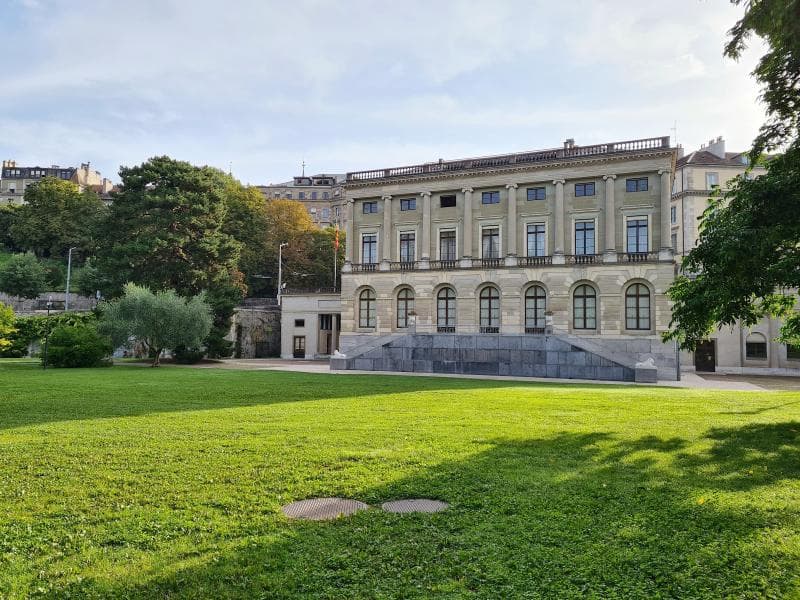
Discover Palais Anna et Jean-Gabriel Eynard in Geneva, Switzerland. Explore its neoclassical architecture, rich history, and role as a civic hub in Parc des Bastions.
Overview
Nestled within the serene greenery of Parc des Bastions in Geneva, Switzerland, stands the magnificent Palais Anna et Jean-Gabriel Eynard, often simply referred to as Palais Eynard. This neoclassical architectural gem, built between 1817 and 1821, was originally the private residence of the influential financier and diplomat Jean-Gabriel Eynard and his wife Anna Eynard-Lullin. Today, it serves as a significant civic building, housing the offices of Geneva's Administrative Council and municipal archives, making it a vibrant heart of the city's governance [4, 8, 13]. Its prominent location overlooking the Parc des Bastions makes it an unmissable landmark for anyone exploring Geneva's rich history and cultural heritage.
History & Cultural Background
The story of Palais Eynard begins with Jean-Gabriel Eynard, a Swiss financier and philhellene who returned to Geneva after making his fortune in Italy [3, 8, 19]. In 1816, he embarked on the ambitious project of constructing a grand residence, the first building in Geneva to officially bear the name 'palace' [8]. His wife, Anna Eynard-Lullin, hailing from one of Geneva's oldest patrician families, played a pivotal role in the architectural conception and artistic direction of their future home [4, 8, 10]. The land, a former marshy plot at the foot of the old city fortifications, presented a unique challenge, which was overcome by innovative design [4, 6].
Construction, which spanned from 1817 to 1821, involved a collaboration of talented architects, including the renowned Florentine Giovanni Salucci, with oversight by engineer Guillaume Henri Dufour [4, 6, 8]. The palace remained a private family residence until 1891 when it was acquired by the City of Geneva [3, 8]. Initially, it housed Swiss collections for the Museum of Natural History, but by 1921, it was classified as a historic monument [5, 8]. A significant renovation between 1981 and 1986 prepared it for its current role as the Hôtel municipal, accommodating weekly meetings of the Administrative Council and various municipal services [2, 5, 8]. In 2020, the administrative council formally modified its name to 'Palais Anna et Jean-Gabriel Eynard' to acknowledge Anna's profound influence on its design and social life [4, 10].
What Makes It Special
Palais Eynard stands out as a masterpiece of neoclassical architecture, a blend of Italian Palladian, English Neo-Palladian, and French classical influences, making it an imposing structure within Geneva's urban landscape [7]. Its monumental facade is particularly striking, featuring eight elegant Ionic columns and three large French windows that open onto a wide terrace [5, 6]. At the base of a double staircase ramp, gray marble lions add to its grandeur [5, 8].
The palace's interior is equally remarkable, characterized by richly decorated spaces. Tuscan artists like Giuseppe Vincenzo Lodovico Spampani and Santi Soldaini created exquisite grisaille trompe-l'œil paintings in the ground floor rooms, while Marco Antonio Trifoglio and Giuseppe Domenico Trolli adorned the upper floors with floral motifs and draperies [2, 4, 8]. Each salon retains its original parquet floors, composed of multiple wood essences [4]. An entry hall illuminated by a grand cupola features antique statues, leading to the stately reception rooms on the ground floor [8]. This meticulous attention to detail and a fusion of international artistic talents truly distinguish Palais Eynard.
Stories, Fun Facts & Local Details
Jean-Gabriel Eynard was not only a financier but also a passionate philhellene, advocating for Greek independence. His dedication to the Greek cause was so profound that he was awarded Greek citizenship in 1827 [19]. He was also a diplomat, attending the pivotal Congress of Vienna in 1815 as an ambassador for Geneva [10, 19]. His artistic inclinations extended to photography; Eynard was an early adopter of the daguerreotype process, using it to document his family, servants, and even his beloved palace, providing invaluable historical glimpses [2, 16, 17].
Anna Eynard-Lullin's contributions go beyond architectural inspiration. She was a dedicated philanthropist, founding nursery schools, a convalescence home for young women, and an asylum for the elderly [10]. Her active participation in the palace's design and social life underscores the partnership at the heart of this grand project [4, 10]. The palace was built on a site that was once a defensive wall and a promenade, showcasing how Geneva repurposed its historical urban fabric [2, 4]. A charming detail is the presence of five commissioned statues by sculptor Lorenzo Bartolini, which despite significant delays, eventually arrived to adorn the palace [6].
Visitor Perspective
For visitors to Geneva, Palais Eynard offers a fascinating glimpse into the city's past and present, even though its primary function is administrative. Situated within the sprawling Parc des Bastions, the palace is easily accessible and forms part of a broader cultural itinerary [9, 13, 14]. While direct public tours might not always be available due to its operational role, its exterior and surroundings are freely explorable. You can admire its impressive neoclassical facade from the park, reflecting its grandeur and historical significance [8].
The Parc des Bastions itself is a destination, featuring the famous Reformation Wall, the University of Geneva, and giant chess boards, all within walking distance [13, 14]. Visiting Palais Eynard allows you to appreciate a building that has transitioned from a lavish private home to a cornerstone of Geneva's civic life, embodying centuries of local and international history. Its location provides a serene escape in the city center, inviting contemplation of the influential figures and architectural styles that shaped Geneva.
Coordinates: 6.147222, 46.199167
View on Google Maps💬 How Travelers Describe This Place
Based on community votes
Beautiful
791Photogenic
613Unique
514Must See
457Interesting
207
Traveler Stories
Discover memorable experiences shared by travelers who have visited this place.
No traveler stories yet.
Be the first traveler to share what made this place memorable.

Tour
By
Spot
Discover amazing places around the world. Your journey starts here.
Explore
© 2026 TourBySpot. All rights reserved.