Palace Of The Shirvanshahs
Baku, Azerbaijan
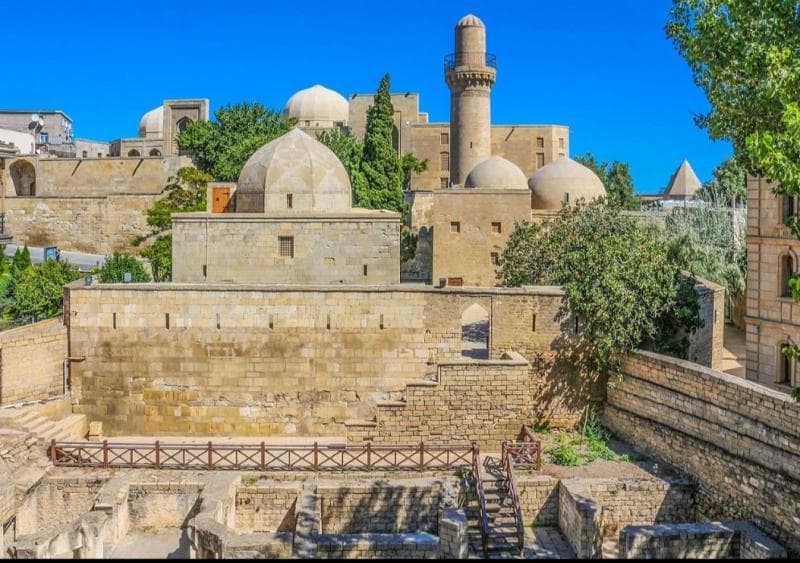
Discover the Palace Of The Shirvanshahs, a 15th-century UNESCO World Heritage site in Baku, Azerbaijan, and uncover its rich history, unique architecture, and captivating stories.
Overview
The Palace of the Shirvanshahs, nestled within Baku's historic Icherisheher (Old City), stands as a magnificent testament to Azerbaijan's rich medieval past and architectural prowess. This remarkable 15th-century complex served as the residence of the Shirvanshah dynasty, who ruled for centuries, profoundly shaping the region's cultural and political landscape. Together with the iconic Maiden Tower, it forms a UNESCO World Heritage Site, acknowledged as 'one of the pearls of Azerbaijan's architecture'. [3, 4, 7, 9, 17, 20, 21] Perched on a hill, its honey-colored limestone structures offer a captivating silhouette against the Caspian sky, inviting curious travelers to step back in time. [14]
History & Cultural Background
The Shirvanshah dynasty, an ancient Persian lineage, held sway over Azerbaijan from the 9th to the 16th century, making Shirvan a pivotal land within modern Azerbaijan. [5] In the 15th century, a devastating earthquake prompted Shirvanshah Ibrahim I to relocate the capital from Shemakha to Baku. [3, 4, 6, 13] This strategic move initiated the construction of the palace complex, which evolved over several reigns, including that of Shirvanshah Khalilullah I. [4, 6, 13, 18] Historians suggest the site may have initially been a sacred place, possibly built around the tomb of Seyyid Yahya Bakuvi, a Helwati Sufi saint, reflecting the Shirvanshahs' patronage of the Sufi order. [3, 4, 6]
The palace complex was not a single, grand structure but a collection of distinct buildings erected at various times, showcasing a blend of Islamic geometric patterns and intricate craftsmanship. [5, 14] Over the centuries, the palace witnessed periods of glory, neglect, and conflict, including occupations by the Safavids and Ottomans, and damage during the Russian invasion of 1723. [4, 6] Despite these challenges, it has undergone significant restoration efforts, notably in the 18th and 20th centuries, and was declared a museum-reserve in 1964, subsequently becoming a UNESCO World Heritage Site in 2000. [6, 9, 13, 18]
What Makes It Special
The Palace of the Shirvanshahs is distinguished by its unique architectural composition and its seamless integration into the ancient fabric of Icherisheher. It comprises several key structures: the main palace building, the Divankhane (a grand reception hall or possibly a place of worship with an intricately carved portal), the burial-vaults, the Shah's mosque with its slender minaret, Seyid Yahya Bakuvi's mausoleum, and remnants of a bathhouse and cistern. [3, 4, 5, 8, 12, 14, 19] The entire complex is constructed from local Badamdar stone, a golden limestone, with some structures built without the use of mortar, demonstrating advanced construction techniques of the era. [5, 11, 14, 18] The restraint in its ornamentation, favoring worked stone, precise proportions, and the interplay of light and shadow over excessive gilding, truly highlights the artistry of medieval Azerbaijani architecture. [14] The complex's design, divided into multiple courtyards at different levels, makes it a fascinating architectural journey. [12, 13]
Stories, Fun Facts & Local Details
Beyond its architectural grandeur, the palace is steeped in local folklore and intriguing details. One popular legend speaks of a hidden treasure belonging to the Shirvanshahs, believed to be buried somewhere within the complex, awaiting discovery. [5] Another fascinating aspect is the debate among historians regarding its original primary function: some believe it was solely a royal residence, while others contend it was primarily a memorial complex built around the Sufi saint's tomb. [3] The palace's wells were even thought to possess healing properties. [4] A particularly unique feature found in the middle courtyard are the stone slabs inscribed with images and texts, which are actually remnants of the submerged Bayil Fortress, retrieved from the Baku Bay and now preserved here. [4, 5, 12] These elements weave a rich tapestry of history and mystery around the site, offering glimpses into the beliefs and daily life of the Shirvanshah era.
Visitor Perspective
A visit to the Palace of the Shirvanshahs offers a profound immersion into Azerbaijan's royal past. Upon entering, visitors typically find themselves in a central courtyard, which serves as a gateway to the residential parts of the palace. [4, 8] Exploring the complex reveals various rooms, intricately carved walls, and ornate ceilings that transport one back to the 15th century. [5] Key areas to explore include the Divankhane, the palace mosque, the mausoleum of the Shirvanshahs, and the mausoleum of Seyid Yahya Bakuvi. [4, 5, 11, 12] The palace now functions as a museum, often featuring digital displays that help reconstruct the palace's past, including animated miniatures and reflections of medieval court life. [11, 18] Visitors typically spend between 1.5 to 2 hours exploring the complex. [15] It is easily accessible within Icherisheher, just a short walk from the Icherisheher metro station. [14, 17] This captivating site allows for a deep appreciation of Azerbaijan's enduring cultural heritage.
Coordinates: 49.83342870762865, 40.366053857630185
View on Google Maps💬 How Travelers Describe This Place
Based on community votes
Interesting
912Unique
601Photogenic
506Beautiful
448Must See
210
Traveler Stories
Discover memorable experiences shared by travelers who have visited this place.
No traveler stories yet.
Be the first traveler to share what made this place memorable.

Tour
By
Spot
Discover amazing places around the world. Your journey starts here.
Explore
© 2026 TourBySpot. All rights reserved.