Palace Arcades
Split, Croatia
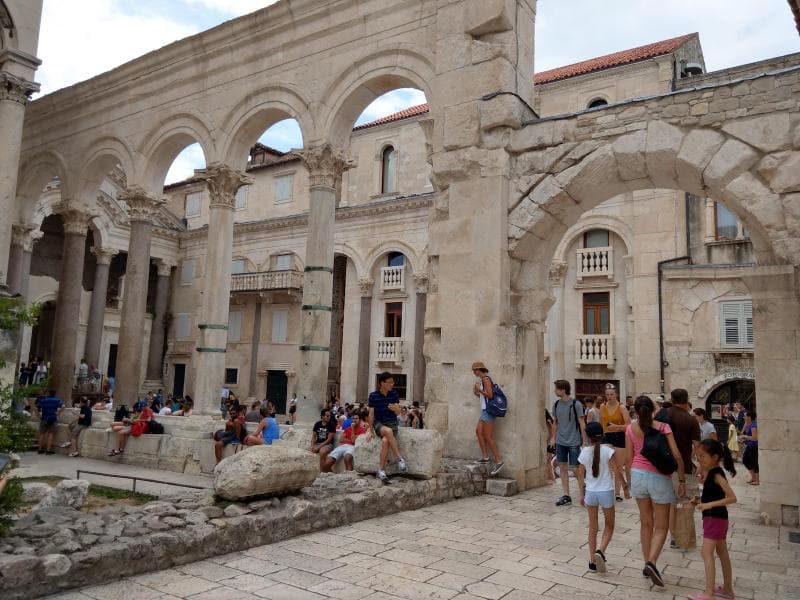
Explore the majestic Palace Arcades within Peristyle Square in Split, Croatia, the historic heart of Diocletian's Palace and a UNESCO World Heritage site.
Overview
The Palace Arcades, an intrinsic part of the majestic Peristyle Square in Split, Croatia, stand as the ceremonial heart of Diocletian's Palace. This grand central courtyard, a UNESCO World Heritage site, is where the ancient Roman past seamlessly blends with the vibrant pulse of modern city life. It is not merely an archaeological ruin but a living, breathing public space, continuously inhabited for over 1,700 years. The arcades, formed by monumental columns, create a captivating architectural backdrop that has witnessed centuries of history unfold, from imperial pronouncements to contemporary cultural events.
As you step into Peristyle Square, the sheer grandeur of the arcaded colonnades immediately transports you to a bygone era. These red granite columns, imported from Egypt, frame the square, drawing the eye towards significant structures like the Vestibule and the Cathedral of St. Domnius. This area once served as the formal entrance to Emperor Diocletian's private quarters, a grand and intimidating display of imperial power.
History & Cultural Background
Emperor Diocletian, a Roman ruler of humble origins, commissioned the construction of his sprawling retirement palace between 295 and 305 AD. The Peristyle, with its impressive arcades, was conceived as a central ceremonial court, embodying the emperor's divine status as the 'living son of Jupiter'. Here, Diocletian would make public appearances, with his subjects approaching him in reverence, kneeling and kissing the hem of his scarlet cloak.
Following Diocletian's death around 311–313 AD, the palace continued to function as an administrative center. A pivotal moment in its history occurred in the 7th century when refugees from the destroyed nearby Roman capital of Salona sought refuge within the palace walls. This influx transformed the imperial complex into a living city. Over the centuries, medieval houses, churches, and later architectural styles were integrated directly into the original Roman structures, including the arcades, creating the unique urban tapestry seen today.
What Makes It Special
The Palace Arcades are special due to their architectural integrity and their dynamic role in Split's daily life. The colossal red granite columns supporting the arches, sourced from distant Egypt, are a testament to Roman engineering and imperial reach. Unlike many ancient sites that exist as static ruins, these arcades are an active part of the city's fabric. Modern buildings, including the palaces of noble Split families like Grisogono, Cipci, and Skočibušić, lean against these authentic columns and arches, showcasing a remarkable continuity of habitation and adaptation.
The square's extraordinary acoustics, enhanced by the surrounding arcades, make it an ideal open-air venue. It frequently hosts cultural events, from opera classics to theatrical performances, especially during the Split Summer Festival. This blend of ancient architecture and vibrant cultural expression gives the Peristyle a truly unique character, allowing visitors to experience history not just by observing, but by participating in its ongoing story.
Stories, Fun Facts & Local Details
One of the most striking features near the Palace Arcades is the 3,500-year-old Egyptian sphinx, brought to Split by Diocletian himself. This ancient artifact silently watches over the square, adding an exotic layer to its Roman heritage. Legend suggests that touching its ancient paws brings good luck. The red color of the granite columns was deliberately chosen to emphasize the ceremonial function of the Peristyle, as purple became the imperial color during Diocletian's reign.
Locals and visitors alike find immense pleasure in sitting on the steps surrounding the Peristyle, often on cushions provided by nearby cafes, to soak in the atmosphere. This tradition offers a unique connection between modern life and ancient heritage. Pope John Paul II, upon witnessing this site, reportedly exclaimed, 'Dear God, how many feet have stepped through here!', capturing the profound sense of history that permeates the square. Indeed, for the citizens of Split, the Peristyle is often considered the very center of their city, and perhaps even the world.
Visitor Perspective
Visiting the Palace Arcades within Peristyle Square is an essential experience for any traveler to Split. The entire Diocletian's Palace complex is free to enter and open 24/7, making it incredibly accessible. To fully appreciate the arcades and the square's ancient charm, an early morning visit is highly recommended to avoid crowds and experience the tranquil beauty as the sun casts long shadows across the original Roman flagstones. Alternatively, evenings offer a magical ambiance, often filled with spontaneous music or performances.
While the Peristyle is mostly flat, the ancient Roman paving stones can be uneven, so comfortable footwear is advised. The square serves as a natural starting point for exploring other parts of Diocletian's Palace, including the Vestibule, the Cathedral of St. Domnius, and the palace cellars (substructures). Guides often start tours here, providing rich historical context that brings the arcades and the entire palace to life.
Coordinates: 16.440176, 43.508369
View on Google Maps💬 How Travelers Describe This Place
Based on community votes
Beautiful
545Must See
343Interesting
211Photogenic
74Unique
20
Traveler Stories
Discover memorable experiences shared by travelers who have visited this place.
No traveler stories yet.
Be the first traveler to share what made this place memorable.

Tour
By
Spot
Discover amazing places around the world. Your journey starts here.
Explore
© 2026 TourBySpot. All rights reserved.