North Tower
Antalya, Turkey
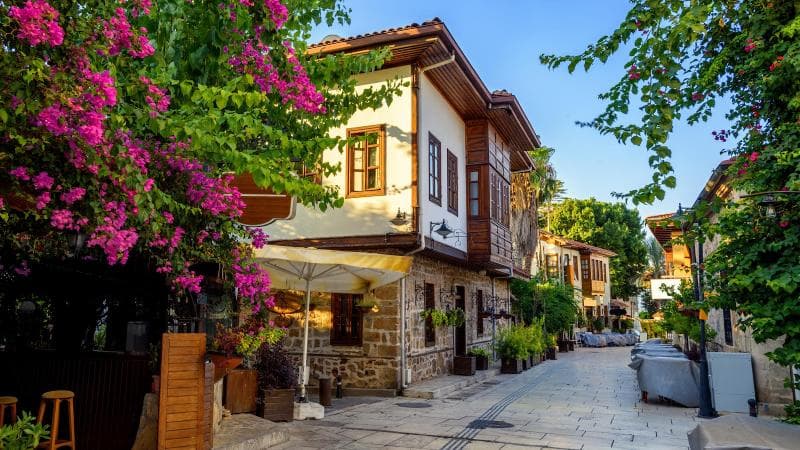
Explore the North Tower of Hadrian's Gate in Antalya, Turkey. Discover its Roman foundations and unique Seljuk-era reconstruction.
Overview
As you approach Hadrian's Gate, a monumental Roman triumphal arch nestled in the heart of Antalya, Turkey, your eyes are drawn to its intricate details and the two distinct towers flanking its elegant triple arches. Among these, the North Tower stands as a fascinating testament to the city's layered past. Positioned on the right side when viewed from Atatürk Boulevard, this tower tells a story not just of Roman antiquity, but also of a later, equally significant era in Anatolian history. While its base firmly roots it in Roman times, its upper sections proudly display the architectural and cultural imprints of the Seljuk period.
Unlike its southern counterpart, the Julia Sancta Tower, the North Tower reveals a captivating blend of construction phases, offering a tangible connection to the different civilizations that have shaped Antalya. It serves as a guardian of the ancient city, leading directly into Kaleiçi, Antalya's charming old town, where cobbled streets and historic houses await.
History & Cultural Background
Hadrian's Gate itself was erected in 130 CE to honor the visit of the Roman Emperor Hadrian to Attaleia, as Antalya was then known. While the main gate is a masterpiece of Roman design, featuring white marble, granite columns, and richly decorated friezes, the towers have their own complex histories.
The North Tower's story is particularly compelling. Its foundational courses date back to the Roman period, coexisting with the initial construction of Hadrian's Gate or perhaps added shortly thereafter as part of the evolving city defenses. However, its most distinctive feature comes from a later era. In the first half of the 13th century CE, during the reign of the powerful Seljuk Sultan Alaeddin Keykubat I, the upper part of the North Tower was extensively rebuilt and reinforced. This Seljuk intervention is clearly marked by an inscription on the tower, written in Old Turkish language using Arabic script, a poignant reminder of the cultural shifts and successive empires that held sway over this strategic Mediterranean city.
What Makes It Special
The North Tower's unique charm lies in its architectural duality. Standing beside the purely Roman Southern Tower, it creates a striking visual contrast, where one can literally see two millennia of history layered upon each other. The Roman base provides a sense of ancient gravitas, hinting at the empire's vast reach, while the Seljuk additions speak to the flourishing Islamic cultures that later dominated the region. This architectural fusion makes the North Tower more than just a defensive structure; it's a historical palimpsest, a living record of different epochs.
Its inscription, a rare artifact of Old Turkish in Arabic script, offers invaluable insight into the Seljuk period's administrative and cultural practices. This detail provides a deeper historical narrative than the gate alone, inviting visitors to ponder the successive guardians of this significant entryway.
Stories, Fun Facts & Local Details
While specific legends about the North Tower are less common than those concerning the gate itself (like the unverified tale of the Queen of Sheba passing through), its reconstruction by Sultan Alaeddin Keykubat I connects it to a golden age of Seljuk rule. Sultan Alaeddin Keykubat I is a revered figure in Turkish history, known for his significant architectural projects, including the iconic fluted minaret (Yivli Minare) nearby in Kaleiçi. The presence of his work on the North Tower signifies its continued importance as a gateway and a defensive point even centuries after its Roman inception.
The gate and its towers were once largely hidden, incorporated into the city walls. It was only when these outer walls collapsed, particularly during restoration efforts in the 1950s, that the true beauty and historical significance of Hadrian's Gate, including its distinct towers, were fully revealed and appreciated by the wider world.
Visitor Perspective
Walking through Hadrian's Gate today, you pass directly between these two historical sentinels. The North Tower, with its visible blend of Roman and Seljuk craftsmanship, offers a unique opportunity for contemplation. It's a place where you can pause and feel the weight of centuries, imagining the countless people, from Roman dignitaries to Seljuk traders, who passed beneath its shadow. Looking up at the Seljuk inscription, you connect with a vibrant medieval past, while the Roman foundations ground you in classical antiquity.
The North Tower serves as a profound reminder that Antalya has always been a crossroads of civilizations, each leaving an indelible mark. It’s an essential part of the experience, inviting you to delve deeper into the rich tapestry of history that defines this beautiful Turkish city before you step into the bustling modern-day life of Kaleiçi.
Coordinates: 30.70855, 36.88527
View on Google Maps💬 How Travelers Describe This Place
Based on community votes
Must See
491Photogenic
443Beautiful
414Interesting
310Unique
277
Traveler Stories
Discover memorable experiences shared by travelers who have visited this place.
No traveler stories yet.
Be the first traveler to share what made this place memorable.

Tour
By
Spot
Discover amazing places around the world. Your journey starts here.
Explore
© 2026 TourBySpot. All rights reserved.