Ngoc Son Temple
Hanoi, Vietnam
Explore Ngoc Son Temple, a historic gem on Ngoc Island in Hanoi's Hoan Kiem Lake. Discover its rich history, iconic red bridge, and legendary turtle.
Overview
Ngoc Son Temple, also known as the Temple of the Jade Mountain, is a captivating cultural and spiritual landmark nestled on Ngoc Island (Jade Islet) within the tranquil waters of Hoan Kiem Lake in Hanoi, Vietnam. Connected to the bustling city by the iconic bright red The Huc Bridge, this temple complex offers a serene escape and a profound glimpse into Vietnam's rich history and spiritual traditions. It stands as a harmonious blend of nature and ancient architecture, attracting both locals and international travelers seeking a deeper understanding of Hanoi's heritage.
History & Cultural Background
The origins of Ngoc Son Temple trace back to the 19th century, though some accounts suggest an 18th-century foundation. Initially known as Ngoc Son Pagoda, it was later renamed Ngoc Son Temple, signifying its dedication to historical figures and deities rather than solely Buddhist worship. A significant turning point in its history was the major restoration undertaken in 1865 by the esteemed Confucian scholar Nguyen Van Sieu. Under his guidance, key structures that define the temple today were added or refined, including the picturesque The Huc Bridge, the Pen Tower, the Inkstone Platform, and the Tran Ba Pavilion. The temple is primarily dedicated to Van Xuong De Quan, the revered star of literature and examinations, and Tran Hung Dao, a national hero who famously repelled Mongol invaders in the 13th century. This dual dedication underscores the temple's significance as a place honoring both intellectual pursuits and patriotic valor. Recognized for its enduring historical and cultural value, Ngoc Son Temple was formally ranked as a special national monument in 2013.
What Makes It Special
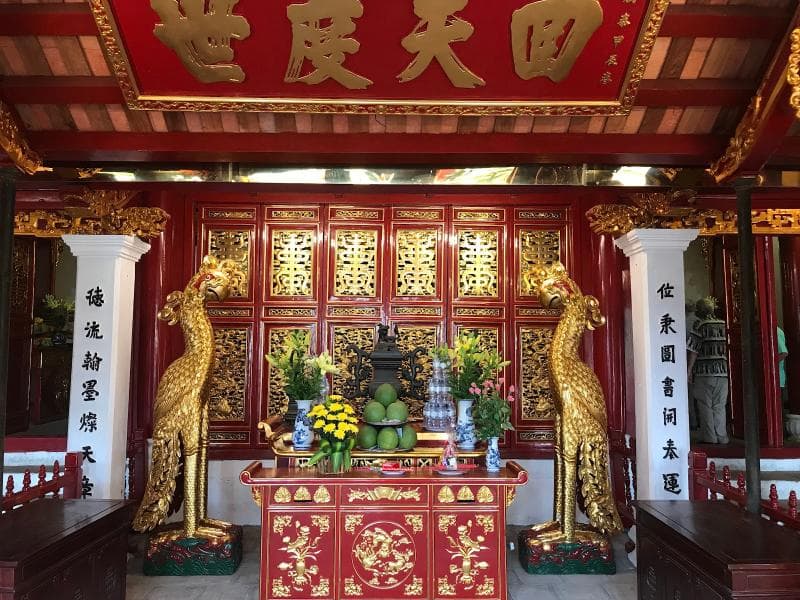
Ngoc Son Temple's special allure lies in its distinctive architectural components and its deep connection to the legend of Hoan Kiem Lake. The most striking feature is undoubtedly The Huc Bridge, whose name translates to 'Bridge of the Rising Sun' or 'Morning Sunlight Bridge'. This elegant, curved wooden bridge, painted in a vibrant scarlet, gracefully spans the water, creating an iconic visual that is synonymous with Hanoi. Before crossing the bridge, visitors encounter the Pen Tower (Thap But) and the Inkstone Platform (Dai Nghien). The Pen Tower is a five-story stone obelisk, shaped like a writing brush, with its tip pointed skyward. Adjacent to it, the Inkstone Platform is a large, carved stone ink pot resting on three stone toads. These structures symbolize the temple's reverence for education and literature. Inside the temple complex, the Tran Ba Pavilion, meaning 'Tidal Wave Guarding', adds to the architectural charm. Another profoundly special element is the preserved specimen of a giant soft-shell turtle, displayed within the temple. This revered relic is intimately linked to the sacred legend of Hoan Kiem Lake, further cementing the temple's mystical connection to its natural surroundings.
Stories, Fun Facts & Local Details
The narrative of Ngoc Son Temple is intricately woven with the legendary tale of Hoan Kiem Lake itself, the 'Lake of the Returned Sword'. The legend recounts how King Le Thai To received a magical sword from a Golden Turtle God to defeat Ming invaders. After his victory, he returned the sword to the turtle in the lake. The preserved turtle specimen in the temple is a powerful physical embodiment of this ancient legend, symbolizing longevity, wisdom, and sacred protection in Vietnamese culture. The Pen Tower is not just a striking monument; its tip is said to point towards the 'Ta Thanh Thien' – 'Writing on the clear blue Sky', an inscription carved on its body, signifying monumental intellectual endeavors. The Inkstone Platform even has a poem by Nguyen Van Sieu inscribed on it, and local lore suggests that on the morning of the fifth day of the fifth lunar month, the shadow of the Pen Tower's quill perfectly falls upon this ink pot. For locals, Ngoc Son Temple is more than a historical site; it's a living spiritual center. Students often visit to pray for success in examinations, while families come to offer incense and seek blessings for peace and harmony. The blend of Confucian, Taoist, and local beliefs creates a rich tapestry of cultural expression.
Visitor Perspective
Visiting Ngoc Son Temple offers a truly immersive cultural experience. The journey begins with a pleasant stroll across The Huc Bridge, providing picturesque views of Hoan Kiem Lake, especially beautiful during the early morning or late afternoon when the light is soft. Once inside, travelers can explore the traditional Vietnamese architecture, admire intricate wooden carvings, and experience the peaceful courtyards. The opportunity to see the preserved turtle specimen offers a tangible connection to Hanoi's most cherished legend. While it is a significant tourist attraction, it remains a sacred space. Visitors are encouraged to dress respectfully, speak softly, and be mindful when taking photographs, especially within worship areas. For a more serene visit, consider arriving early in the morning or later in the afternoon to avoid peak crowds, particularly on the first and fifteenth days of the lunar month, which are popular for local worship. A visit to Ngoc Son Temple typically lasts between 30 to 60 minutes, offering enough time to appreciate its beauty, history, and spiritual ambiance, making it an essential stop for anyone exploring Hanoi.
Coordinates: 105.85238, 21.03073
View on Google Maps💬 How Travelers Describe This Place
Based on community votes
Unique
981Interesting
617Must See
565Photogenic
357Beautiful
28
Traveler Stories
Discover memorable experiences shared by travelers who have visited this place.
No traveler stories yet.
Be the first traveler to share what made this place memorable.

Tour
By
Spot
Discover amazing places around the world. Your journey starts here.
Explore
© 2026 TourBySpot. All rights reserved.