National Library Of Belarus
Minsk, Belarus
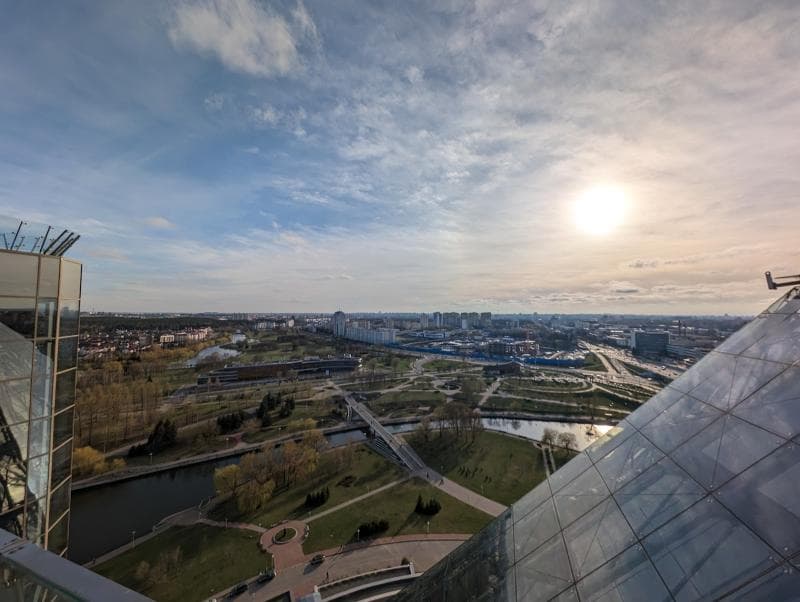
Explore the National Library of Belarus in Minsk, a stunning rhombicuboctahedron-shaped landmark. Discover its vast collections and panoramic observation deck.
Overview
The National Library of Belarus, majestically situated in Minsk, is more than just a repository of books; it's a profound symbol of knowledge, culture, and modern architectural ingenuity. Its striking design, a colossal rhombicuboctahedron, immediately captivates the eye and has earned it the affectionate nickname 'The Diamond of Knowledge'. Standing at approximately 73.6 meters (241.5 feet) tall with 23 floors, this impressive structure houses an immense collection of printed and digital materials. Since its grand opening in 2006, it has transformed into a multi-functional hub, offering not only extensive research facilities but also a vibrant cultural center and a popular tourist attraction, complete with a panoramic observation deck overlooking the Belarusian capital.
History & Cultural Background
The journey of the National Library of Belarus began on September 15, 1922, initially established as the Belarusian State and University Library. In its nascent years, it housed around 60,000 books, serving a modest community of about 1,000 users. It gained independence as an institution in 1926 and was later renamed the National Library of Belarus in 1992, reflecting the country's sovereignty. The library faced significant challenges during the Great Patriotic War, losing approximately 83% of its collections and equipment. However, dedicated efforts ensured the safe evacuation of rare and early printed books, and the institution was revitalized post-war, expanding its collections and international ties.
The concept for the library's modern edifice emerged from a USSR-wide architectural contest in 1989. The winning design, conceived by architects Viktor Kramarenko and Mikhail Vinogradov, proposed the distinctive rhombicuboctahedron shape. Construction of this ambitious project commenced in 2002 and was completed in January 2006, with the official inauguration by the Belarusian President occurring on June 16, 2006. Notably, a bronze sculpture of Francysk Skaryna, Belarus's pioneering printer from the early 16th century, stands proudly in front of the building, honoring the nation's rich literary heritage.
What Makes It Special
The National Library of Belarus stands out primarily due to its breathtaking and unconventional architecture. Its main component, shaped like a geometric diamond, is clad in glass panels that shimmer during the day and transform into a colossal, dynamic light display at night. This nightly spectacle is made possible by 4,646 color-changing LED fixtures, creating a mesmerizing 'media facade' that makes the building visible for miles around.
Beyond its exterior, the library is an intellectual powerhouse, housing around 10 million items across various media, including printed editions, manuscripts, microcopies, and digital resources in over 80 languages. It boasts the largest collection of Belarusian printed materials and holds the distinction of having the third-largest collection of Russian books globally. Visitors can access a wealth of digital information resources, including over 150 national and foreign databases, making it a cutting-edge scientific and educational center.
Stories, Fun Facts & Local Details
Locals and travelers alike often refer to the building as 'The Diamond of Knowledge,' a fitting moniker that captures its symbolic essence and radiant appearance. The design's symbolic intent was to represent the immense value of knowledge and the infinite nature of the perceptible world. The construction itself was a monumental undertaking, involving approximately 5,000 people and 200 enterprises, with up to 3,000 workers on-site daily during peak times. Such is its scale that its total area is roughly one-fourth the size of Vatican City, and with its full contents, it weighs approximately 14 times as much as the Eiffel Tower.
Despite its architectural innovation, the building's striking appearance has sometimes elicited varied public opinions, with some dubbing it one of the world's most unusual or even 'ugliest' structures, highlighting its undeniable ability to provoke strong reactions and discussions. This lively debate only adds to its unique character, ensuring it remains a memorable landmark on Minsk's skyline.
Visitor Perspective
For the curious traveler, the National Library of Belarus offers an unforgettable experience. A definite highlight is the observation deck, located on the 23rd floor, which provides breathtaking panoramic views of Minsk and its surrounding landscape. Access to the observation deck is easily arranged, and it's a prime spot for capturing stunning photographs. Inside, the library hosts a fascinating Book Museum, showcasing rare and ancient manuscripts, some dating back to the 14th-15th centuries, including early editions by Francysk Skaryna.
The library is also a vibrant cultural center, regularly hosting art exhibitions, concerts, and various events that delve into Belarusian literature, history, and art. Visitors can explore several reading halls, which offer a quiet atmosphere for study and reflection, equipped with modern amenities for digital research. Getting to the library is convenient, with the Minsk Metro's Vostok station situated right next to the impressive building, and numerous bus and trolleybus routes also serving the area. Guided tours are available, providing deeper insights into the library's history, architecture, and extensive collections, ensuring an enriching visit for everyone.
Coordinates: 27.6460648, 53.9315211
View on Google Maps💬 How Travelers Describe This Place
Based on community votes
Beautiful
912Must See
820Photogenic
771Unique
479Interesting
181
Traveler Stories
Discover memorable experiences shared by travelers who have visited this place.
No traveler stories yet.
Be the first traveler to share what made this place memorable.
Things to see at National Library Of Belarus



Tour
By
Spot
Discover amazing places around the world. Your journey starts here.
Explore
© 2026 TourBySpot. All rights reserved.