Mirror Hall
Dushanbe, Tajikistan
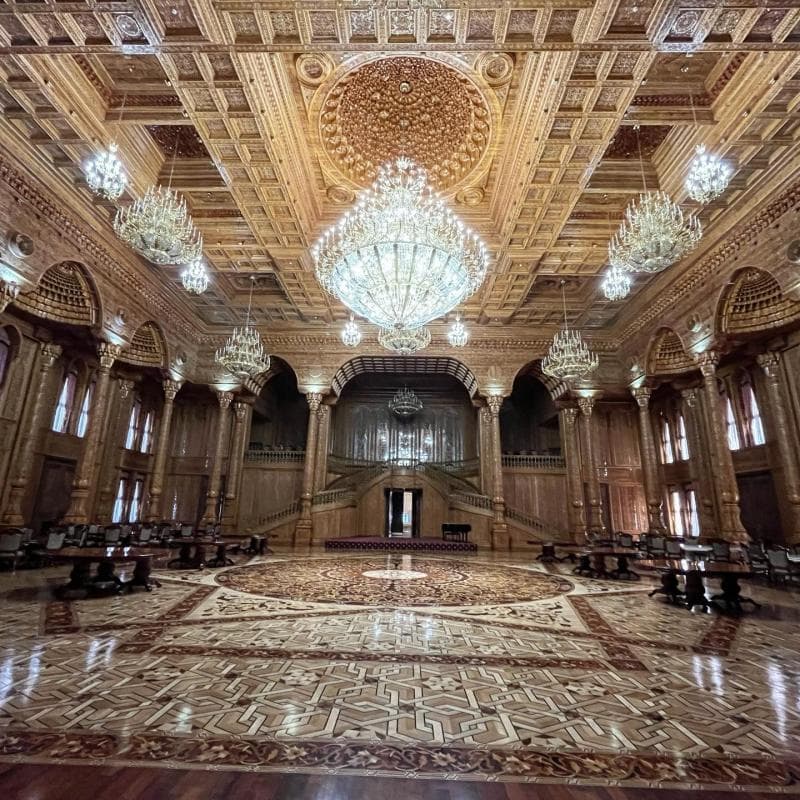
Discover the enchanting Mirror Hall within Kokhi Navruz, Dushanbe, Tajikistan – a masterpiece of reflective Tajik artistry and cultural heritage.
Overview
Deep within the magnificent Kokhi Navruz complex in Dushanbe, Tajikistan, lies an enchanting space often referred to as the Mirror Hall. While not always formally given this name in official descriptions of the palace's numerous halls, its striking use of reflective surfaces has led to this apt designation. Kokhi Navruz itself, completed in 2014, was originally envisioned as the world's largest teahouse but evolved into a grand five-story palace, serving as a prominent venue for both international and national events and a stunning showcase of modern Tajik architecture blended with traditional motifs.
This sprawling cultural and entertainment complex spans approximately 40,000 square meters and was brought to life by the hands of thousands of skilled Tajik craftsmen. Their dedication is evident in every meticulously adorned interior, including the hall famed for its mirrored embellishments. The Mirror Hall captivates visitors with its unique interplay of light and reflection, offering a breathtaking visual experience that beautifully echoes the opulence and artisanal skill deeply embedded in Tajik culture. It stands as a testament to the nation's rich artistic heritage.
History & Cultural Background
The story of Kokhi Navruz, and by extension its Mirror Hall, began with an ambitious vision in the early 21st century to create a modern center embodying Tajikistan's rich history and folk art. Construction commenced in 2010 and concluded in 2014. The project, initiated by President Emomali Rahmon, aimed to preserve and showcase the nation's artistic traditions for centuries to come.
The name 'Navruz' itself holds profound cultural significance, meaning 'New Day' in Tajik. It symbolizes the spring equinox, celebrated on March 21st, a deeply rooted ancient tradition representing renewal, prosperity, and the vibrant spirit of Tajikistan. The palace quickly became a symbol of the country's independence era, hosting significant international gatherings such as Shanghai Cooperation Organization (SCO) summits, underscoring its role as both a cultural landmark and a diplomatic hub. The involvement of approximately 4,000 craftsmen from across Tajikistan in its construction highlights a national effort to revive and celebrate traditional crafts, making each of the palace's 12 to 15 halls, including the mirrored one, a living museum of Tajik artistry.
What Makes It Special
What truly sets the Mirror Hall apart within Kokhi Navruz is its extraordinary and deliberate use of mirrors and reflective surfaces, masterfully integrated with traditional Tajik decorative arts. This space is not merely adorned with mirrors; it is designed to utilize their properties to create an immersive experience. The effect is one of boundless space and dazzling light, which amplifies the intricate patterns and vibrant colors characteristic of Tajik design.
Artisans employed various traditional techniques, including gypsum molding, Florentine mosaics, and possibly gilding, utilizing a wealth of local materials like precious gems, wood, and stone. The reflective quality of the hall magnifies these elements, allowing visitors to appreciate the minute details of the hand-painted ceilings, ornate plasterwork, and embedded semi-precious stones in a multidimensional way. It is a space that doesn't just display art; it transforms it through reflection, creating an almost dreamlike atmosphere that distinguishes it from the palace's other uniquely themed halls.
Stories, Fun Facts & Local Details
Kokhi Navruz, housing the Mirror Hall, is often considered a modern marvel and was even presented as one of the '8 wonders of the SCO'. The entire complex was a monumental undertaking, showcasing the dedication of thousands of Tajik artisans over four to five years. This colossal effort meant that almost every decorative element – from the grand facade to the intricate wood carvings and plasterwork – was meticulously handcrafted, bringing together a vast array of national artistic expertise under one roof.
While the Mirror Hall's specific name might vary in official documentation, the descriptive moniker emerged organically due to its most striking feature: the captivating mirror work. This subtle detail speaks volumes about the impact this particular space has on visitors, who immediately recognize and remember its unique visual charm. The palace complex also features a range of modern amenities, including a cinema, bowling alleys, billiard rooms, and restaurants, demonstrating its dual purpose as both a cultural institution and a modern entertainment hub for locals and visitors alike.
Visitor Perspective
Visiting the Mirror Hall within Kokhi Navruz is an experience that resonates deeply with curious travelers. As one steps into this space, the reflections immediately multiply the beauty around, creating an almost infinite display of Tajik craftsmanship. The deliberate use of mirrors alongside traditional plasterwork offers a dynamic visual spectacle that truly immerses you in the artistry.
The hall's ability to capture and refract light amplifies the intricate details of the ceiling and walls, offering different perspectives with every turn. It is a place where light dances, patterns repeat in mesmerizing ways, and the rich cultural narrative of Tajikistan unfolds through its reflective surfaces. Travelers often leave feeling a sense of wonder and a deeper appreciation for the intricate beauty and dedicated skill of the Tajik artisans who created such a magnificent and optically engaging environment.
Coordinates: 68.76855, 38.58277
View on Google Maps💬 How Travelers Describe This Place
Based on community votes
Photogenic
551Interesting
547Unique
336Beautiful
219Must See
186
Traveler Stories
Discover memorable experiences shared by travelers who have visited this place.
No traveler stories yet.
Be the first traveler to share what made this place memorable.

Tour
By
Spot
Discover amazing places around the world. Your journey starts here.
Explore
© 2026 TourBySpot. All rights reserved.