Ministry Buildings
Yerevan, Armenia
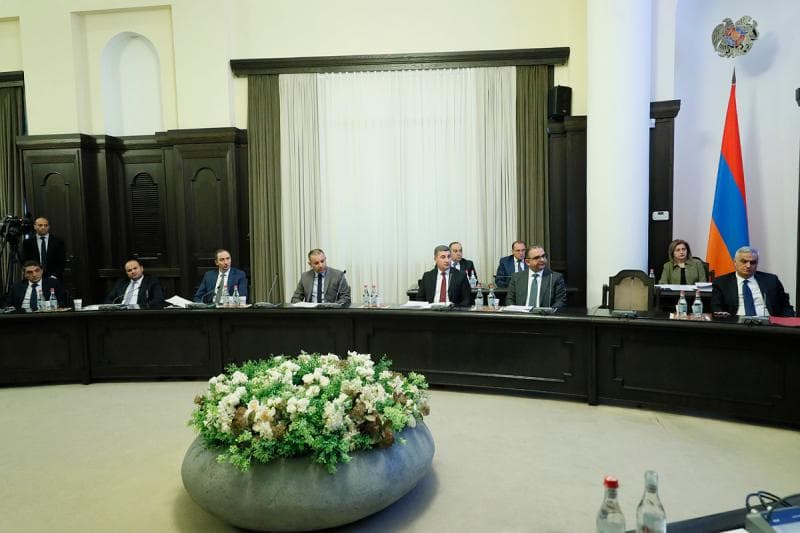
Explore Republic Square's Ministry Buildings in Yerevan, Armenia. Discover neoclassical Armenian architecture, history, and the famed singing fountains.
Overview
Republic Square, or Hanrapetutyan Hraparak, stands as the vibrant heart and architectural masterpiece of Yerevan, Armenia. This grand central plaza is more than just a public space; it is a meticulously designed ensemble of monumental buildings that tell the story of the nation's past and present. Dominated by a unique architectural style that blends neoclassical grandeur with rich Armenian motifs, the square and its surrounding structures, often referred to collectively as the 'Ministry Buildings' due to their administrative and cultural significance, are a testament to the vision of architect Alexander Tamanian.
The square itself is a spectacle, featuring an oval roundabout adorned with a stone pattern reminiscent of a traditional Armenian rug when viewed from above, and a trapezoid-shaped section housing the famous musical fountains. These buildings, constructed primarily from pink and yellow volcanic tuff stone, bestow upon Yerevan its affectionate moniker, 'the Pink City'. The architectural coherence and the striking visual impact of these structures make Republic Square a must-visit destination for any traveler to the Armenian capital.
History & Cultural Background
The origins of Republic Square trace back to the ambitious master plan for Yerevan designed by Alexander Tamanian in 1924. Tamanian envisioned a semicircular square of monumental public buildings that would embody both Soviet modernism and deeply rooted Armenian identity. Construction commenced in 1926 with the first of these significant structures, the Government House.
Throughout the Soviet era, from 1940 to 1990, the square was known as Lenin Square, and for many years, it featured a prominent statue of Vladimir Lenin. Following Armenia's independence in 1991, the statue was removed, and the square was officially renamed Republic Square, symbolizing a new chapter for the nation. The construction spanned several decades, with most buildings completed by the 1950s and the final structure, the National Gallery, finished in 1977. Tamanian and his collaborators, including his son Gevorg Tamanian, Mark Grigorian, Eduard Sarapian, Samvel Safarian, Rafayel Israyelian, and Varazdat Arevshatian, skillfully integrated elements of medieval Armenian architecture, such as ornate carvings, arched colonnades, and traditional geometric forms, ensuring that the ensemble remained distinctly Armenian in character despite its Soviet-era construction.
What Makes It Special
The true magic of Republic Square lies in its remarkable architectural unity and the thoughtful integration of its constituent buildings. The ensemble comprises five main structures: the Government House No. 1, which houses the Prime Minister's office and features a prominent clock tower; the impressive building shared by the History Museum of Armenia and the National Gallery of Armenia; the luxurious Armenia Marriott Hotel (formerly Hotel Armenia); and two buildings that once housed the Ministry of Foreign Affairs and the Ministry of Transport and Communications (often referred to as the Post Office building or House of Trade Unions).
Each edifice is faced with the distinctive pink and yellow volcanic tuff stone, giving the square a warm, inviting glow that shifts beautifully with the changing daylight. The meticulous detailing, from the ornamental friezes and arches to the proportional rhythms inspired by ancient Armenian monasteries, showcases a profound respect for national heritage. At the heart of the square, the singing fountains come alive in the evenings during warmer months, offering a captivating show of water, light, and music, drawing both locals and visitors into its enchanting embrace.
Stories, Fun Facts & Local Details
Yerevan's Republic Square is rich with intriguing details and cultural nuances. The nickname 'the Pink City' for Yerevan originates directly from the unique coloration of the tuff stone used extensively in the square's buildings. A fascinating feature on the square's oval roundabout is the intricate stone mosaic pattern on the ground, which observers from above often note resembles a traditional Armenian carpet, a subtle nod to the country's rich artistic traditions.
Another local gem is the 'Yotnaghbyur' (Seven Springs) drinking fountain, located near the museum buildings. Built in 1965, this 'pulpulak' is not just a source of refreshing water but also functions as a sundial, with a compass marking the cardinal directions. The history of the Lenin statue, erected in 1940 and removed in 1991, reflects Armenia's journey through its Soviet past to its independent present, a powerful symbolic transition for the nation.
Visitor Perspective
Visiting Republic Square offers an immersive experience into the heart of Yerevan. It serves as a natural starting point for exploring the city, easily accessible via the Hanrapetakan Hraparak metro station. For photographers, the early morning hours are ideal, when the low sunlight illuminates the pink tuff, casting a warm, golden hue across the facades. Evenings, especially during the warmer months from late May to September, are perfect for witnessing the spectacular musical fountain show, a free event that gathers crowds to enjoy the synchronized display of water and light set to diverse musical selections.
While the government buildings themselves have restricted access due to their active administrative functions, their exteriors offer ample architectural beauty to admire. Travelers can spend anywhere from 20-30 minutes appreciating the square's design to several hours if they choose to explore the History Museum of Armenia or the National Gallery, both housed within one of the square's grand buildings. Republic Square is truly the city's living room, a place where history resonates with modern life, offering a memorable cultural and visual feast.
Coordinates: 44.5075, 40.1732
View on Google Maps💬 How Travelers Describe This Place
Based on community votes
Must See
722Interesting
595Unique
358Photogenic
196Beautiful
19
Traveler Stories
Discover memorable experiences shared by travelers who have visited this place.
No traveler stories yet.
Be the first traveler to share what made this place memorable.

Tour
By
Spot
Discover amazing places around the world. Your journey starts here.
Explore
© 2026 TourBySpot. All rights reserved.