Michelangelo’s Tomb
Florence, Italy
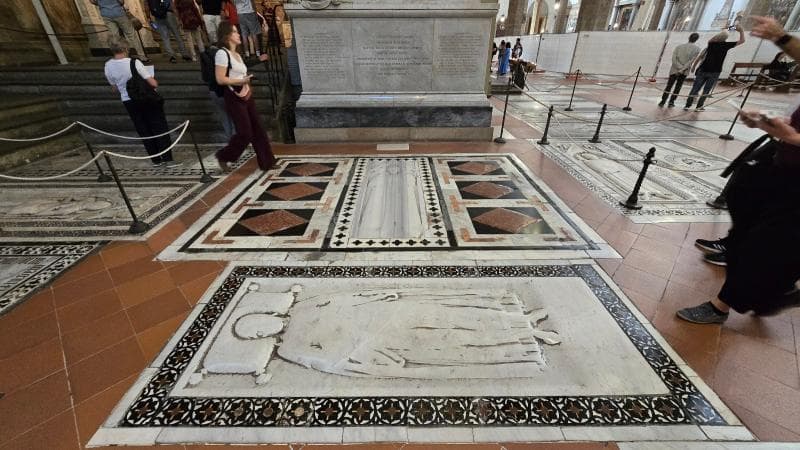
Explore Michelangelo's Tomb in Florence, Italy, located within the Basilica di Santa Croce. Discover its history, design by Vasari, and cultural significance.
Overview
Deep within the revered Basilica di Santa Croce in Florence, Italy, lies a monumental tribute to one of humanity's most extraordinary talents: Michelangelo’s Tomb. This sacred space is not merely a burial site but a profound homage to the Renaissance master, encapsulating his genius and the enduring legacy he left upon the world. Situated in the ‘Temple of Italian Glories’, as the basilica is often called, Michelangelo’s final resting place is a cornerstone for any journey into Florence’s rich artistic and historical tapestry.
Designed by his contemporary and biographer, Giorgio Vasari, the tomb is a striking work of art in itself, completed between 1564 and 1576. It draws visitors into a narrative of ambition, artistry, and the fervent desire of a city to reclaim its greatest son. As you approach, you'll witness a marble testament to a man who sculpted David, painted the Sistine Chapel ceiling, and revolutionized architecture.
History & Cultural Background
Michelangelo Buonarroti, the prolific artist of the High Renaissance, passed away in Rome on February 18, 1564. He was initially interred in the Church of Santi Apostoli in Rome. However, Florence, his beloved hometown, harbored a deep desire for his remains to rest within its walls. It was Michelangelo's nephew, Leonardo Buonarroti, who orchestrated the clandestine transfer of his uncle's body. Legend has it, the maestro's body was smuggled out of Rome 'secretly in a bale, under the title of merchandise', a daring act that underscored Florence's fierce pride.
Upon its arrival in Florence on March 11, the news spread rapidly, leading to an impromptu public viewing in the sacristy of Santa Croce. While a solemn funeral was held at the Basilica of San Lorenzo, Duke Cosimo I de' Medici decreed that Michelangelo should have an honorable burial place in Santa Croce, a church where his ancestors were interred and where he himself had wished to be laid to rest. This decision solidified Santa Croce’s role as the ‘Pantheon of the Italian nation’, a repository for Italy's most illustrious figures, a tradition that had begun with earlier monumental tombs like those of Leonardo Bruni and Carlo Marsuppini.
What Makes It Special
Michelangelo’s Tomb stands out not only for the person it commemorates but also for its artistic significance and poignant backstory. The monument, designed by Giorgio Vasari, is a complex composition featuring allegorical figures representing Sculpture, Painting, and Architecture – the three disciplines in which Michelangelo excelled. These figures, sculpted by Giovanni Battista Lorenzi, Valerio Cioli, and Giovanni Bandini respectively, mourn the loss of the master. The central bust of Michelangelo, created by Battista Lorenzi, gazes out, overseeing his eternal resting place.
Interestingly, the tomb's design carries a touch of irony. Michelangelo was known for his strong preference for sculpture, often viewing painting and architecture as lesser arts or at least distinctly separate. Yet, his own tomb grandly unites these three art forms, a detail that some interpret as an unintended, posthumous commentary on his own artistic philosophy. This irony adds a layer of depth to the monument, inviting reflection on the artist's multifaceted legacy.
Stories, Fun Facts & Local Details
One of the most compelling stories surrounding Michelangelo’s Tomb is the dramatic tale of how his body was brought to Florence. The 'smuggling' operation by his nephew speaks volumes about the intense civic rivalry between Rome and Florence during the Renaissance, each city vying for the prestige associated with such a monumental figure.
The tomb itself, completed years after Michelangelo's death, became a benchmark for other grand memorials within Santa Croce. It directly influenced the design of tombs for other luminaries like Galileo Galilei, who was interred in Santa Croce much later, illustrating the basilica's evolving role as a civic pantheon.
The physical tombstone, located opposite the grand monument, also has its own history. Made of intricate marble inlay with various Tuscan stones, it suffered damage over centuries, including from the devastating 1966 Florence flood. In a testament to ongoing preservation efforts, the tombstone underwent significant restoration, with its details, including the Buonarroti family coats of arms, being carefully revived.
Visitor Perspective
Visiting Michelangelo’s Tomb offers a deeply moving experience, connecting you directly to the grandeur of the Renaissance. Located in the south aisle of the Basilica di Santa Croce, between the first and second bays, it is easily accessible for contemplation. The sheer scale and artistic detail of the monument command attention, inviting visitors to pause and reflect on the life and work of a true genius.
When planning your visit, remember that Santa Croce is an active basilica and a sacred space. Appropriate attire is required, meaning shoulders and legs should be covered. While photography is generally permitted for private use, flashes and tripods are not. Allow ample time, perhaps 1 to 2 hours for the entire monumental complex, to truly absorb not just Michelangelo's tomb but also the countless other artistic and historical treasures within this magnificent Florentine landmark. The Basilica di Santa Croce is more than just a church; it is a repository of Italian greatness, and Michelangelo’s Tomb is undoubtedly one of its brightest stars.
Coordinates: 11.26289, 43.76836
View on Google Maps💬 How Travelers Describe This Place
Based on community votes
Interesting
826Beautiful
800Unique
387Photogenic
242Must See
90
Traveler Stories
Discover memorable experiences shared by travelers who have visited this place.
No traveler stories yet.
Be the first traveler to share what made this place memorable.

Tour
By
Spot
Discover amazing places around the world. Your journey starts here.
Explore
© 2026 TourBySpot. All rights reserved.