Marble Corridors
Dushanbe, Tajikistan
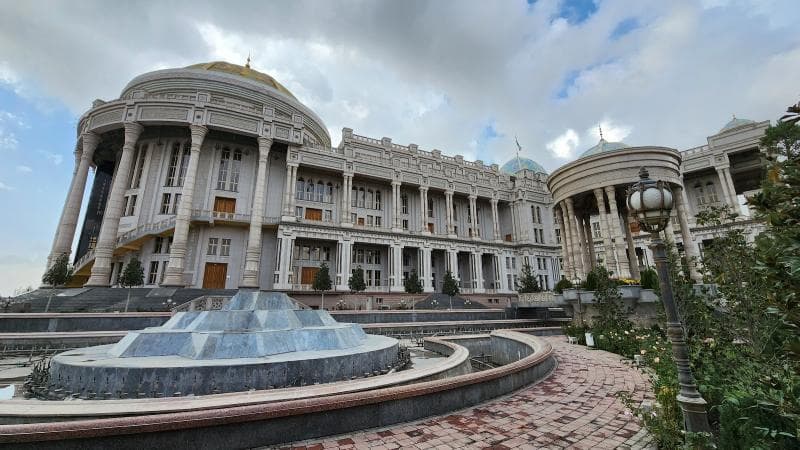
Discover the exquisite 'Marble Corridors' of Kokhi Navruz in Dushanbe, Tajikistan, showcasing breathtaking Tajik craftsmanship, semi-precious gems, and intricate stonework.
Overview
Nestled within the grand Kokhi Navruz complex in Dushanbe, Tajikistan, the 'Marble Corridors' refer to the palace's exquisitely adorned passageways and halls, showcasing a breathtaking fusion of traditional Tajik artistry and opulent materials. While not a singular, officially named section, this descriptive term perfectly captures the essence of the palace's interior, where stone, including fine marbles and a dazzling array of semi-precious gems, defines the aesthetic. This cultural and entertainment complex, inaugurated in 2014, is a vibrant testament to modern Tajik craftsmanship, originally conceived as the largest national teahouse in Central Asia before evolving into a monumental museum of national artisanry.
Kokhi Navruz stands as a multi-story edifice covering approximately 40,000 square meters, where every detail is the handiwork of thousands of Tajik artisans. Its interior boasts an array of distinct halls, each with its own unique decorative style, but all contributing to an overwhelming sense of splendor through intricate stonework, wood carvings, and vibrant mosaics. The sheer scale and meticulous detail of the stone-decorated areas are what truly embody the spirit of the 'Marble Corridors,' inviting visitors to wander through a living gallery of national heritage.
History & Cultural Background
The genesis of Kokhi Navruz dates back to the early 21st century, with construction commencing in 2010 and concluding in 2014. The vision behind this colossal project, championed by the President of Tajikistan, Emomali Rahmon, was to create a modern center that would also serve as a profound expression of the rich history, civilization, and folk art of the Tajik people. What began as a plan for a grand teahouse transformed into a magnificent palace, symbolizing the nation's independence and its commitment to preserving and developing its cultural identity.
The palace is a modern architectural marvel that seamlessly blends Eastern motifs with contemporary solutions. It was brought to life by the collective efforts of approximately 4,000 craftsmen from across Tajikistan, who meticulously crafted everything from its towering chandeliers to its parquetry floors. This collaborative endeavor ensured that the palace not only served as a functional space for national and international events but also as a powerful educational tool, showcasing the profound artistic traditions of the Tajik people, including painting, carving, woodworking, plasterwork, mirror making, and stone carving.
What Makes It Special
The 'Marble Corridors' of Kokhi Navruz are special for their unparalleled display of Tajik stone craftsmanship. A prime example is the Arzhang Hall, often referred to as the 'Stone Hall,' which is fashioned from 29 different types of semi-precious gems, all locally sourced from Tajikistan. The walls of this hall feature stunning mosaics, some inspired by the works of renowned Persian miniature artists, turning each corridor and room into an artistic journey.
Beyond the Arzhang Hall, other areas within the palace feature walls adorned with colorful gypsum and crystalline masterpieces, reflecting national motifs and adding to the marble-like allure. The grandiosity is further accentuated by thoughtful lighting and large panoramic windows, which enhance the visual impact of the natural stone and intricate details. This elaborate use of natural stone, combined with other traditional crafts, makes the 'Marble Corridors' a unique and captivating experience, truly setting Kokhi Navruz apart as a cultural landmark.
Stories, Fun Facts & Local Details
A fascinating aspect of Kokhi Navruz is its evolution from a planned teahouse to a magnificent palace that now hosts significant international and regional events, welcoming world leaders and dignitaries. The complex proudly holds the distinction of being recognized as one of the '8 Wonders of the Shanghai Cooperation Organization,' highlighting its global cultural significance.
The design of the palace incorporates symbolic elements; for instance, some halls feature 16 columns of significant height and 16 semi-domes, reflecting the historic 16th session of Tajikistan's Supreme Council in 1992, a pivotal moment in the nation's modern history. Visitors are often struck by the sheer scale of the artisan involvement, with thousands of craftsmen contributing their expertise, resulting in over 6,000 square meters of intricate wood carvings in halls like Guliston. This dedication to preserving and celebrating Tajik traditional arts ensures that every inch of the 'Marble Corridors' tells a story of heritage and national pride.
Visitor Perspective
For a curious traveler, exploring the 'Marble Corridors' of Kokhi Navruz is an immersive journey into the heart of Tajik culture and artistry. As you walk through these opulent spaces, you'll feel guided by the legacy of generations of craftsmen whose hands shaped every detail. The experience transcends mere sightseeing, offering a deep appreciation for the dedication to preserving national traditions. The interplay of light on the polished stone surfaces, the vibrant mosaics, and the sheer artistry embedded in the walls and columns create an unforgettable visual symphony. It's an opportunity to witness firsthand how ancient artistic traditions are kept alive and celebrated in a contemporary context, making the 'Marble Corridors' a truly inspiring and enriching part of any visit to Dushanbe.
Coordinates: 68.76855, 38.58277
View on Google Maps💬 How Travelers Describe This Place
Based on community votes
Photogenic
551Interesting
547Unique
336Beautiful
219Must See
186
Traveler Stories
Discover memorable experiences shared by travelers who have visited this place.
No traveler stories yet.
Be the first traveler to share what made this place memorable.

Tour
By
Spot
Discover amazing places around the world. Your journey starts here.
Explore
© 2026 TourBySpot. All rights reserved.