Main Monastery Church
Pristina, Kosovo
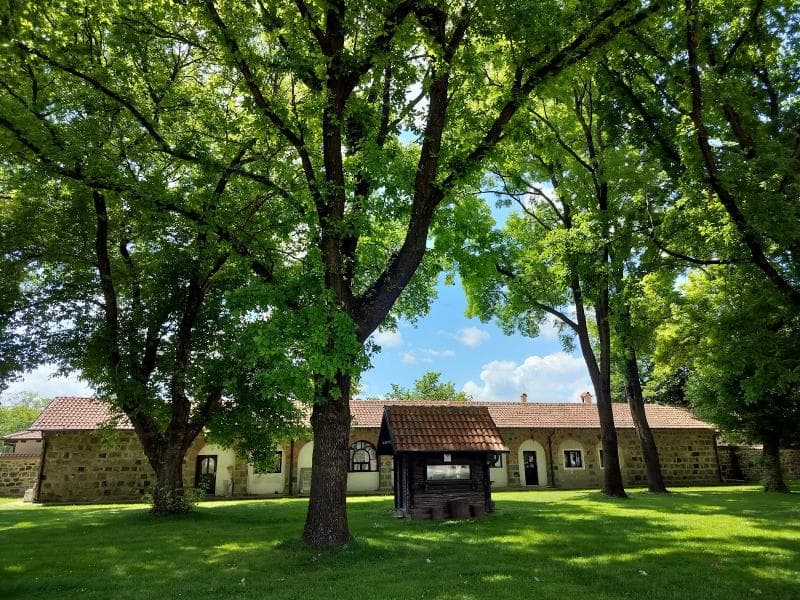
Explore the Main Monastery Church at Gracanica Monastery in Pristina, Kosovo. Discover its history, stunning frescoes, and Byzantine architecture.
Overview
Nestled in the heart of Kosovo, just a short distance from Pristina, stands the magnificent Gracanica Monastery, a jewel of Serbian Orthodox heritage. At its core lies the Main Monastery Church, primarily dedicated to the Dormition of the Holy Virgin, though originally conceived for the Annunciation. This sacred structure, a UNESCO World Heritage site, is not merely a building but a vibrant testament to centuries of faith, art, and resilience. It serves as a spiritual beacon and a profound cultural center for the local Serbian community, drawing pilgrims and art enthusiasts alike to its hallowed grounds.
The church's striking architecture, with its distinctive five domes, rises majestically against the landscape, signaling its importance long before one steps inside. Once within its walls, visitors are enveloped by a world of intricate frescoes, depicting biblical narratives and historical figures with remarkable vividness. This is a living monastery, currently a nunnery, where ancient traditions are preserved and spiritual life thrives.
History & Cultural Background
The history of the Main Monastery Church at Gracanica dates back to 1321 when it was erected by the Serbian King Stefan Milutin, one of the last monumental endowments of his reign. King Milutin's own words, inscribed on a charter, tell of his commitment to rebuild the 'Holy Virgin's temple of Gracanica,' which he found in ruins and decay. This indicates that the current church stands upon the foundations of an older 13th-century cathedral and even an earlier 6th-century Byzantine basilica.
Over its long history, the monastery has witnessed tumultuous periods, enduring damage from various conflicts, including attacks by the Turks in the 14th century and unrest in the late 20th century. Despite these challenges, it has consistently served as a vital spiritual and national center. In 1990, it was recognized as a Monument of Culture of Exceptional Importance, and in 2006, it earned its place on UNESCO's World Heritage List as part of the 'Medieval Monuments in Kosovo,' a testament to its universal value. Following the Kosovo War, it also became the official seat of the Bishop of Raška and Prizren, further solidifying its central role in the region.
What Makes It Special
The Main Monastery Church is a remarkable example of Serbo-Byzantine architecture, renowned for its 'double inscribed cross' plan and a unique pyramidal composition of five domes. The central dome, believed by some to represent Christ, is surrounded by four smaller domes, thought to symbolize the Apostles, creating a harmonious and uplifting verticality that was innovative for its time. The exterior, with its alternating courses of red brick and stone, offers a rich visual texture.
However, it is the interior frescoes that truly distinguish Gracanica. Painted primarily between 1321 and 1322, these vibrant murals are considered masterpieces of the Palaeologan Renaissance style, reflecting the peak of Byzantine monumental art. They cover every available surface, depicting scenes from the earthly life of Jesus, the ecclesiastical calendar, the Festival Cycle, and the Passion. Notable among them are the portraits of King Milutin and Queen Simonida, his mother Queen Helen depicted as a nun, and Milutin himself as a monk. Later additions, like the frescoes in the exonarthex commissioned in 1570 by Patriarch Makarije Sokolovic, further enrich the artistic tapestry, showcasing the evolution of artistic styles.
Stories, Fun Facts & Local Details
One fascinating aspect of Gracanica's frescoes is the depth of emotion and detail conveyed. Visitors often note the expressive faces and vivid storytelling within the biblical scenes. The church's artistic program was carefully planned, with themes emphasizing its dedication to the Virgin and its function as an episcopal center. It also glorifies the royal lineage, with the 'Nemanjić Family Tree' appearing here for the first time in such a dynastic composition.
A curious fun fact is that the monastery's enduring legacy is so profound that it inspired the architectural replica of the New Gracanica Serbian Orthodox Monastery in Illinois, USA, built on an 18% larger scale. This demonstrates the original's significant influence and architectural beauty. Locally, the monastery is not just a historical site but a living spiritual community. The nuns continue to engage in traditional activities like icon painting and beekeeping, keeping the monastery's rich heritage alive. It's a place where time-honored traditions meet daily life, offering a glimpse into a deeply rooted cultural identity.
Visitor Perspective
Visiting the Main Monastery Church at Gracanica Monastery offers a deeply immersive experience. As an active place of worship, respect for its sacred atmosphere is paramount. Visitors are required to dress modestly, meaning long pants or skirts, covered shoulders, and women should bring a headscarf for entry into the church. While the exterior and grounds can be photographed freely, photography inside the church is strictly forbidden to protect the fragile frescoes and maintain the sanctity of the space.
The tranquil grounds offer a serene environment for reflection, while the interior provides a powerful encounter with medieval art and spirituality. Professional guided tours are often available, enriching the visit with detailed explanations of the frescoes and the church's history. These guides can highlight intriguing details, like the artistic techniques used to create illusions on concave ceilings. A visit here is an opportunity to connect with a profound spiritual and artistic legacy that has shaped the region for centuries.
Coordinates: 21.1935, 42.5985
View on Google Maps💬 How Travelers Describe This Place
Based on community votes
Unique
958Must See
743Photogenic
728Beautiful
719Interesting
382
Traveler Stories
Discover memorable experiences shared by travelers who have visited this place.
No traveler stories yet.
Be the first traveler to share what made this place memorable.

Tour
By
Spot
Discover amazing places around the world. Your journey starts here.
Explore
© 2026 TourBySpot. All rights reserved.