Main Fortress Gate
Split, Croatia
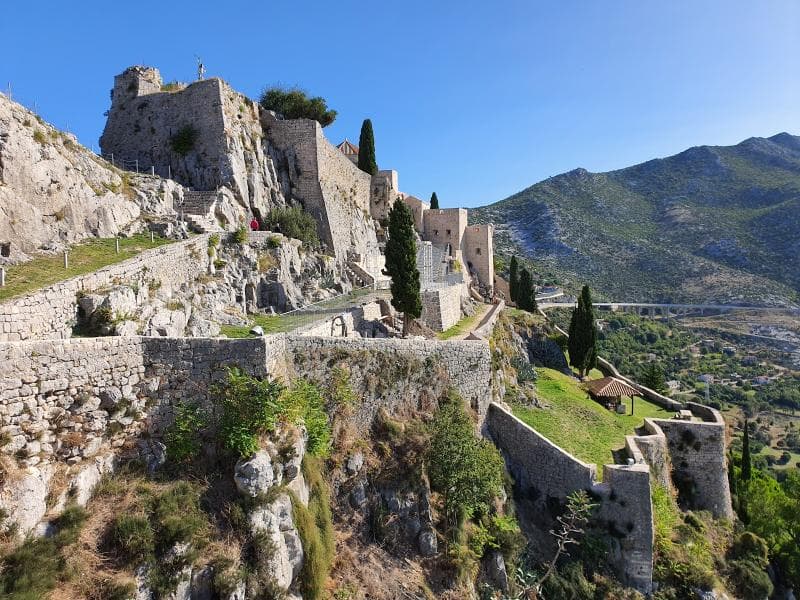
Overview
The Main Fortress Gate serves as the venerable entrance to the historic Klis Fortress, a formidable stronghold perched on a limestone ridge just north of Split, Croatia. This initial gateway is not merely an entry point but the beginning of an immersive journey into centuries of Dalmatian history. As visitors step through its imposing structure, they are immediately confronted with the strategic genius and architectural evolution that defines Klis Fortress. It is here that the ticketing office is often located, marking the official start of exploration into one of Croatia's most significant cultural monuments.
Standing between the Kozjak and Mosor mountains, Klis Fortress has long been revered as the 'Key to Dalmatia' due to its commanding position. The Main Fortress Gate, specifically rebuilt by the Austrians in the 1820s, represents the outermost layer of a multi-tiered defensive system, which includes two more gates that twist and turn deeper into the heart of the fortress.
History & Cultural Background
The history of the Klis Fortress and its main entrance is deeply interwoven with the numerous empires and cultures that vied for control over this crucial mountain pass. While the current Main Fortress Gate was constructed by the Austrians, its location has been a defensive entry point for millennia.
Klis was first fortified by the ancient Illyrians, later becoming a Roman stronghold. Through the Middle Ages, it served as a royal castle for Croatian kings, protecting the medieval Croatian state. Its strategic value remained paramount through periods of conflict with the Ottoman Empire and the Venetian Republic, each leaving their architectural and historical imprints on the fortress and its entryways. The successive layers of construction, evident even at the first gate, tell a story of constant adaptation and resilience against invaders. The original medieval main entrance, now the second gate, also bears the mark of Austrian reconstruction, highlighting the continuous evolution of the fortress's defenses.
What Makes It Special
What makes the Main Fortress Gate particularly special is its role as the initial segment of a brilliant defensive system. It is the first of three distinct gates that visitors must navigate, each designed to impede and funnel attacking forces. This multi-gate approach was a common defensive strategy in medieval architecture, but at Klis, it's expertly integrated into the natural topography.
The engineering of this entrance, even in its later Austrian iteration, showcases a deliberate intent to maximize defensive capabilities. The path leading up to and through the gate is not direct; it forces attackers into vulnerable positions, making it harder for them to gain momentum. The robust stone construction, visible in the gate's thick walls, speaks to its enduring strength and purpose as the primary guardian of the fortress.
Stories, Fun Facts & Local Details
One fascinating detail about the design of the fortress's entrance path, which begins at the Main Fortress Gate, is that it was intentionally built to keep invading armies focused on their footing rather than their surroundings. This clever design meant that soldiers would be looking down, making them less aware of their environment and more susceptible to ambushes from the fortress walls above.
Historically, the first gates of Klis were equipped with double doors and could be reinforced further during a siege by filling the interspace with earth, creating an even more impenetrable barrier against cannon fire. These details underscore the ingenuity and grim realities of medieval warfare that shaped every inch of Klis Fortress. While Klis is now famous for its role in 'Game of Thrones' as the city of Meereen, the Main Fortress Gate itself is a tangible link to real historical struggles and strategic brilliance, long before any fictional dragons soared over its walls.
Visitor Perspective
For the modern visitor, approaching the Main Fortress Gate is an exciting first step into the Klis Fortress experience. Upon arrival, the ticket office is conveniently located right at this entrance, simplifying the start of your exploration. The ascent to the fortress involves a rocky path, but it is manageable, setting the stage for the dramatic historical journey ahead.
Passing through the Main Fortress Gate provides a visceral sense of entering a bygone era, leading one to the subsequent gates and the many levels of the fortress. It's a moment of transition from the contemporary world to a place steeped in history, offering panoramic views of Split and the Adriatic islands as a reward for those who venture within.
Coordinates: 16.5226, 43.5596
View on Google Maps💬 How Travelers Describe This Place
Based on community votes
Unique
958Must See
743Photogenic
728Beautiful
719Interesting
382
Traveler Stories
Discover memorable experiences shared by travelers who have visited this place.
No traveler stories yet.
Be the first traveler to share what made this place memorable.

Tour
By
Spot
Discover amazing places around the world. Your journey starts here.
Explore
© 2026 TourBySpot. All rights reserved.