Main Chedi
Chiang Mai, Thailand
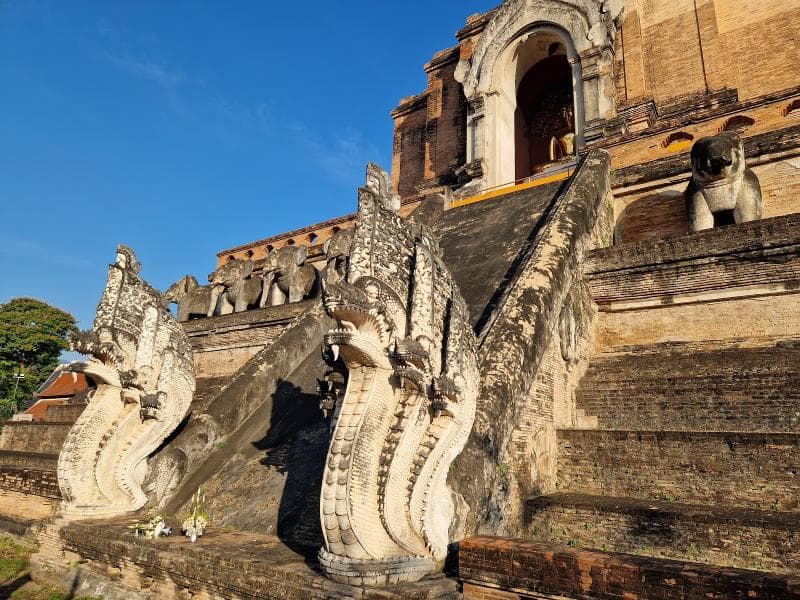
Explore the Main Chedi of Wat Chedi Luang in Chiang Mai, Thailand, a historic Lanna marvel and former home of the Emerald Buddha.
Overview
Deep within the ancient walled city of Chiang Mai, Thailand, stands Wat Chedi Luang, a Buddhist temple complex renowned for its magnificent and imposing central structure, often referred to simply as the Main Chedi. Its name, 'Wat Chedi Luang', translates to 'Temple of the Great Stupa', a clear testament to the monumental scale and significance of this revered monument. This temple, a cornerstone of Chiang Mai's historical and spiritual landscape, continues to draw visitors with its profound sense of history and spiritual tranquility, despite the passage of centuries and the ravages of nature.
The Main Chedi, though partially ruined, remains an awe-inspiring presence, embodying the grandeur of the Lanna Kingdom's past. It is not merely an architectural marvel but a powerful symbol of faith and cultural identity, deeply intertwined with the city's heritage.
History & Cultural Background
The construction of Wat Chedi Luang commenced in the late 14th century, around 1391, under the patronage of King Saen Muang Ma, who intended it to be the final resting place for his father's ashes. The ambitious project, however, stretched over many decades and was eventually completed in the mid-15th century during the reign of King Tilokaraj. Upon its completion, the chedi was a colossal achievement, reaching an impressive height of approximately 82 to 85 meters and boasting a base diameter of 54 meters, making it the tallest structure in the entire Lanna Kingdom at that time.
For nearly a century, from 1468, the Main Chedi held immense national significance as it housed the revered Emerald Buddha, Thailand's most sacred Buddhist image, within its eastern niche. However, fate intervened in 1545 when a powerful earthquake struck Chiang Mai, causing the upper 30 meters of the chedi to collapse, leaving it in its present truncated state. Following this damage, the Emerald Buddha was moved, eventually finding its permanent home in Wat Phra Kaew in Bangkok.
Despite its ruined upper section, the chedi continued to be a focal point of worship. In the early 1990s, restoration efforts, supported by UNESCO and the Japanese government, aimed to stabilize the structure. While these efforts were crucial for preservation, some scholars note that elements of the restoration may have introduced Central Thai stylistic influences rather than strictly adhering to the original Lanna design.
What Makes It Special
The Main Chedi's enduring appeal lies in its monumental scale and the palpable sense of history it conveys. Even in its weathered form, it stands as a testament to the advanced architectural and engineering skills of the Lanna period. The intricate stone elephant sculptures that adorn its base are particularly striking, emerging from the brickwork and symbolizing strength and protection.
Today, a black jade replica of the Emerald Buddha, known as Phra Phut Chaloem Sirirat or Phra Yok, occupies the reconstructed eastern niche. This replica, placed there in 1995 to commemorate the chedi's 600th anniversary, serves as a powerful reminder of the temple's past glory and its spiritual heritage.
The blend of ancient ruins with meticulous Lanna-style details, such as the naga serpents guarding the staircases on each of the chedi's four sides, creates a visually captivating and spiritually resonant atmosphere.
Stories, Fun Facts & Local Details
One fascinating aspect of the Wat Chedi Luang complex is the Sao Inthakin, or City Pillar of Chiang Mai, which is housed within a small building on the temple grounds. Moved to this location in 1800, this wooden pillar is considered sacred and is believed to protect the city and its people. An annual festival, the Inthakhin Festival, is held every May to honor the pillar, involving flower offerings, candlelight processions, and chants, invoking blessings for the community.
Adjacent to the City Pillar shrine are three significant resin trees, planted by King Kawila around 1800. Local belief holds that if one of these trees were to fall, a great catastrophe would befall Chiang Mai, underscoring the deep connection between nature, spirituality, and the city's well-being.
For curious travelers, Wat Chedi Luang also offers a 'Monk Chat' program, providing a unique opportunity to engage in conversations with resident monks. These informal discussions allow visitors to learn about Buddhist philosophy, daily monastic life, and Thai culture directly from those who practice it, fostering a deeper understanding and connection.
Visitor Perspective
Visiting the Main Chedi of Wat Chedi Luang is an experience that transcends mere sightseeing; it's a journey into the heart of Chiang Mai's spiritual past. The sheer scale of the chedi, even in its incomplete state, evokes a profound sense of awe. Walking around its base, observing the weathered elephant carvings and the intricate details, one can almost hear the echoes of centuries past.
Despite its central location in a bustling city, the temple grounds maintain a remarkable sense of peace and tranquility, inviting quiet contemplation. The atmosphere shifts subtly throughout the day; a morning visit offers serene quietude, while evenings can be particularly enchanting when the chedi is illuminated, sometimes even with laser light shows that highlight its ancient textures. Whether marveling at the Lanna architecture, reflecting on the historical journey of the Emerald Buddha, or engaging in a 'Monk Chat', the Main Chedi provides a powerful and memorable connection to the rich cultural and spiritual tapestry of Northern Thailand. It stands as a silent, majestic guardian of Chiang Mai's heritage, inviting all to pause and reflect.
Coordinates: 98.98651602444616, 18.78692357971049
View on Google Maps💬 How Travelers Describe This Place
Based on community votes
Interesting
954Must See
946Photogenic
514Beautiful
92Unique
66
Traveler Stories
Discover memorable experiences shared by travelers who have visited this place.
No traveler stories yet.
Be the first traveler to share what made this place memorable.

Tour
By
Spot
Discover amazing places around the world. Your journey starts here.
Explore
© 2026 TourBySpot. All rights reserved.