Maiden Tower
Baku, Azerbaijan
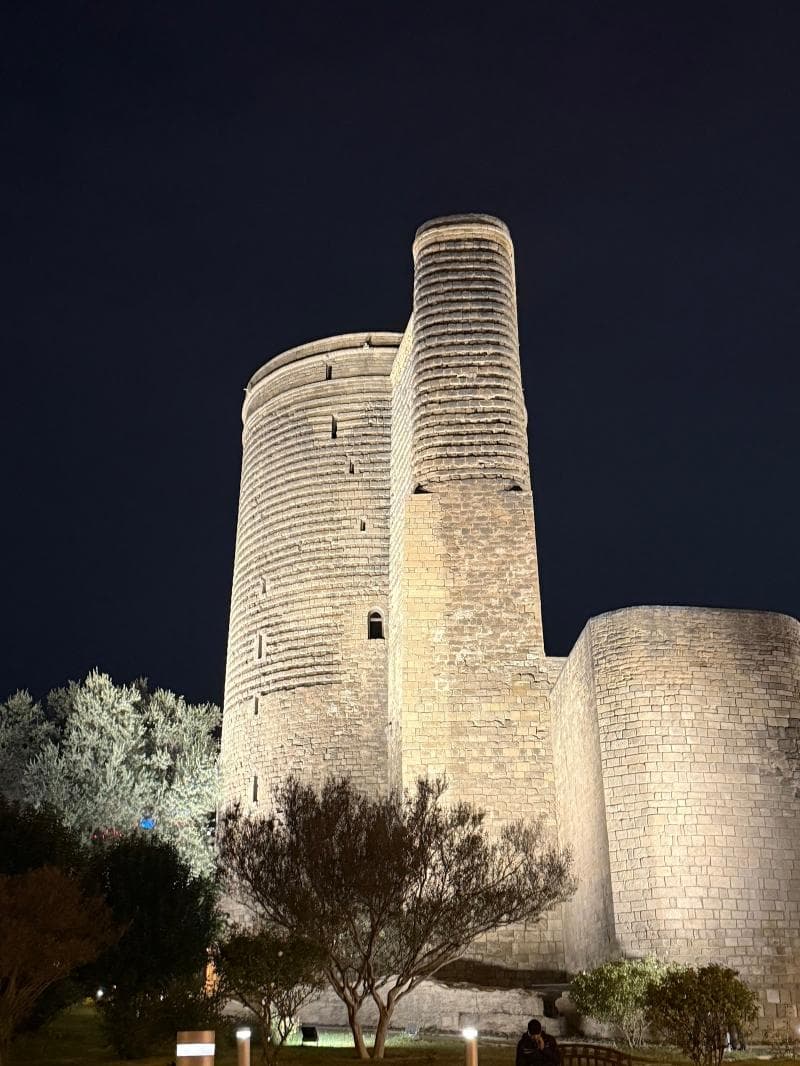
Discover Baku's mysterious Maiden Tower (Qız Qalası) in Icherisheher, Azerbaijan. Explore its ancient history, captivating legends, and panoramic city views from this iconic UNESCO World Heritage Site.
Overview
Rising majestically within the ancient walls of Icherisheher, Baku's Old City, the Maiden Tower, known locally as Qız Qalası, stands as an enduring symbol of Azerbaijan's rich history and cultural heritage. This enigmatic monument, a UNESCO World Heritage Site since 2000, captivates visitors with its mysterious origins and imposing presence. The tower is a cylindrical, eight-story structure, approximately 29.5 meters (97 feet) tall with a base diameter of 16.5 meters (54 feet). Its walls are remarkably thick, measuring up to 5 meters (16 feet) at the base and gradually narrowing as they ascend. Perched on a rocky outcrop that once touched the Caspian Sea, it offers panoramic views of the Old City, the Baku Boulevard, and the expansive bay.
History & Cultural Background
The true age and original purpose of the Maiden Tower remain subjects of intense debate among historians and archaeologists, adding to its mystique. While its current form largely dates back to the 12th century, likely under the Iranian Shirvanshahs, some researchers propose that its foundations and lower sections are far older, possibly from the 6th-7th centuries AD, or even as far back as 600 BC. This suggests a construction in two main phases.
Various theories attempt to explain its initial function. One prominent hypothesis suggests it began as a Zoroastrian fire temple, given Azerbaijan's historical ties to fire worship and the discovery of an ancient fire altar within its structure during excavations. Other theories posit it served as an astronomical observatory, with specific stone protrusions correlating to lunar cycles, or primarily as a formidable defensive fortification integrated into Baku's city walls. An inscription on its south wall mentions 'Qubbeye Masud ibn Davud', an architect active in the 12th century, though whether he was the tower's architect or merely associated with repairs remains a point of scholarly discussion.
What Makes It Special
The Maiden Tower's distinct architectural style, combining influences that some describe as Arabic, Persian, and Ottoman, sets it apart. Its unique cylindrical shape and the sheer thickness of its walls have ensured its longevity, allowing it to withstand centuries of earthquakes and invasions. As one of Azerbaijan's most recognizable national emblems, it is featured on the country's currency notes and official letterheads, symbolizing national pride and identity. Inside, the tower now houses a museum that chronicles Baku's historical evolution, providing context to its ancient past through various exhibits across its eight floors. Climbing the internal stone staircase leads to an observation terrace at the summit, offering unparalleled views that sweep across the historic alleys and minarets of Icherisheher, the modern skyline, and the vast expanse of the Caspian Sea.
Stories, Fun Facts & Local Details
The Maiden Tower is shrouded in a rich tapestry of legends, each adding layers to its romantic and mysterious appeal. One of the most famous tales recounts a princess who, to escape an unwanted marriage (often to her own father, the king), asked for a tower to be built. Upon its completion, she tragically leaped to her death from its peak, choosing freedom over a forced union. This legend has inspired the famous Azerbaijani ballet 'Maiden Tower', first performed in 1940 and still a cherished part of the national culture.
Another ancient legend, rooted in Azerbaijan's Zoroastrian past, speaks of a fiery-haired virgin girl who saved Baku's people from invaders during a desperate siege, leading to the cessation of the temple fires atop the tower. The Azerbaijani name 'Qız Qalası' translates more literally to 'Virgin Tower', which some interpret as a reference to its impenetrable nature, having never been conquered, rather than solely to stories involving maidens. The tower's unusual construction and its enduring presence by the sea have cemented its place in local folklore, making it a source of endless fascination.
Visitor Perspective
A visit to the Maiden Tower is an immersive journey through history. Entering this ancient monument, travelers can explore its eight levels, each featuring carved stone interiors and domed ceilings. The museum exhibits provide insights into the tower's architectural phases, its various theoretical uses, and its significance in Azerbaijani culture. The ascent involves navigating narrow stone staircases, some original, leading to the top. The reward for the climb is the breathtaking 360-degree panorama from the observation terrace, a highlight for many, offering spectacular photo opportunities of the surrounding Old City and the modern city meeting the Caspian. It is advisable to wear comfortable shoes, as the interior involves many steps. The tower is open to the public and typically includes a gift shop, making it an essential and memorable stop for anyone exploring Baku's Old City.
Coordinates: 49.8372, 40.3661
View on Google Maps💬 How Travelers Describe This Place
Based on community votes
Unique
904Beautiful
373Interesting
224Photogenic
190Must See
177
Traveler Stories
Discover memorable experiences shared by travelers who have visited this place.
No traveler stories yet.
Be the first traveler to share what made this place memorable.

Tour
By
Spot
Discover amazing places around the world. Your journey starts here.
Explore
© 2026 TourBySpot. All rights reserved.