King Rama VI Statue
Bangkok, Thailand
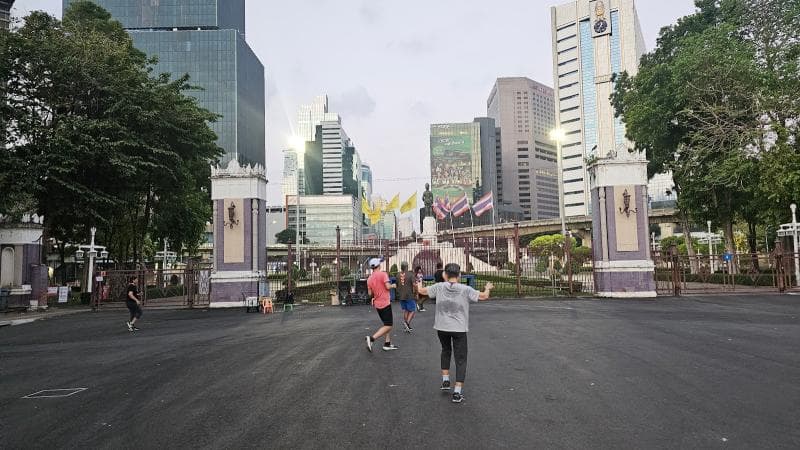
Discover the King Rama VI Statue in Lumphini Park, Bangkok, Thailand. Explore the history, cultural significance, and fascinating facts about this tribute to King Vajiravudh.
Overview
At the western entrance to the expansive Lumphini Park in the bustling heart of Bangkok, Thailand, stands a majestic bronze statue dedicated to King Rama VI, also known as King Vajiravudh. This significant monument serves as a proud tribute to a monarch whose vision profoundly shaped modern Thailand, particularly in urban development and public welfare. Placed strategically to greet visitors, the statue offers a moment of contemplation before one steps into the verdant oasis of Lumphini Park itself. It is not merely a statue but a historical marker, intrinsically linked to the very foundation and identity of Thailand's first public park.
The King Rama VI Statue depicts King Vajiravudh in his regal ceremonial uniform, complete with a sword, standing tall on a high pedestal. Its presence underscores his enduring legacy and his dedication to the Thai people, serving as a focal point for both locals and travelers seeking to understand a pivotal era in the nation's history. The surrounding area at the park's entrance is often a hub of activity, reflecting the vibrant life that King Rama VI envisioned for this public space.
History & Cultural Background
King Vajiravudh, reigning as Rama VI from 1910 until 1925, was a forward-thinking monarch of the Chakri dynasty. He played a crucial role in modernizing Siam, implementing educational reforms and fostering a strong sense of Thai nationalism. His vision extended to urban planning, leading to the creation of Lumphini Park, Thailand's inaugural public park.
The land on which Lumphini Park now flourishes was once King Rama VI's private property, known as Thung Sala Daeng, or 'Sala Daeng Field'. In 1925, the King generously donated this substantial plot to the nation. Initially, it was intended to host a grand national exhibition to showcase Thai products and industrial advancements to the world. However, due to the global impact of World War I and the King's untimely passing, the exhibition plans were not fully realized. Despite this, King Rama VI's unwavering commitment to public good led him to bequeath the land for conversion into a public park. He named it 'Lumphini' after Lumbini, the birthplace of Siddhartha Gautama Buddha in Nepal, a choice reflecting hope for prosperity.
The statue itself, a bronze masterpiece, was sculpted by the renowned Professor Silpa Bhirasri, an Italian artist better known as Corrado Feroci. Completed with the assistance of four Thai artists, it was enshrined on June 7, 1941, and officially inaugurated on March 27, 1942, by His Majesty King Bhumibol Adulyadej.
What Makes It Special
The King Rama VI Statue stands out not just as a sculptural work but as a profound symbol of a monarch's progressive ideals and his lasting gift to his people. Its significance is deeply intertwined with Lumphini Park itself, making it an integral part of the park's history and identity. The statue commemorates King Rama VI's pioneering spirit in urban development, as he transformed a royal estate into Thailand's first public green space.
What truly makes this monument special is its continuous role as a point of connection between the past and the present. It acts as a quiet guardian at the park's entrance, reminding every visitor of the King's vision for a modern Siam that valued public recreation, learning, and shared national identity. The King's depiction in his full ceremonial uniform, sword at his side, embodies his leadership and his commitment to his country.
Stories, Fun Facts & Local Details
King Rama VI, or King Vajiravudh, was a monarch of many talents, notably recognized as a gifted artist who penned several modern novels and short stories. He was also distinguished as the first member of the Thai royal family to receive an extensive education both in Siam and abroad in Britain. His dedication to the younger generation is exemplified by his establishment of the Boy Scouts in Thailand in 1911, a movement that continues to thrive today.
A delightful local detail is the practice among Thai people of leaving offerings at the statue throughout the day, a gesture of reverence and respect for the beloved monarch. These small acts of devotion highlight the statue's deep cultural resonance within the community. While Lumphini Park is now a tranquil urban haven, it holds a lesser-known history: during World War II, it served as a Japanese Army camp, with parts of it even converted into agricultural plots to mitigate wartime food shortages.
The choice of the name 'Lumphini' itself is a fun fact, as it directly references Lumbini in Nepal, the birthplace of Buddha. This naming reflects a desire for peace and prosperity for the park and its visitors, underscoring the spiritual and cultural layers embedded within this seemingly simple public space.
Visitor Perspective
For any traveler exploring Bangkok, a visit to the King Rama VI Statue and Lumphini Park offers a refreshing respite from the city's vibrant energy. The statue is conveniently located at the western gate of Lumphini Park, making it easily accessible for all.
Reaching this historical landmark is straightforward, with excellent public transportation links. Visitors can take the Metro MRT to Si Lom or Lumphini stations, or the BTS Skytrain to Sala Daeng station, all of which are just a short walk from the monument. There is no admission fee to visit either the statue or the park, making it an accessible cultural experience. The statue and park are open daily, typically from early morning until late evening, usually 5:00 AM to 9:00 PM, allowing ample time for exploration and reflection. Whether you're seeking a moment of quiet reflection, a glimpse into Thai history, or simply a starting point for enjoying Lumphini Park's natural beauty, the King Rama VI Statue provides a meaningful and enriching introduction to this iconic Bangkok destination.
Coordinates: 100.54167, 13.73056
View on Google Maps💬 How Travelers Describe This Place
Based on community votes
Interesting
951Beautiful
748Must See
499Photogenic
491Unique
427
Traveler Stories
Discover memorable experiences shared by travelers who have visited this place.
No traveler stories yet.
Be the first traveler to share what made this place memorable.

Tour
By
Spot
Discover amazing places around the world. Your journey starts here.
Explore
© 2026 TourBySpot. All rights reserved.