Jeroan Complex
Bali, Indonesia
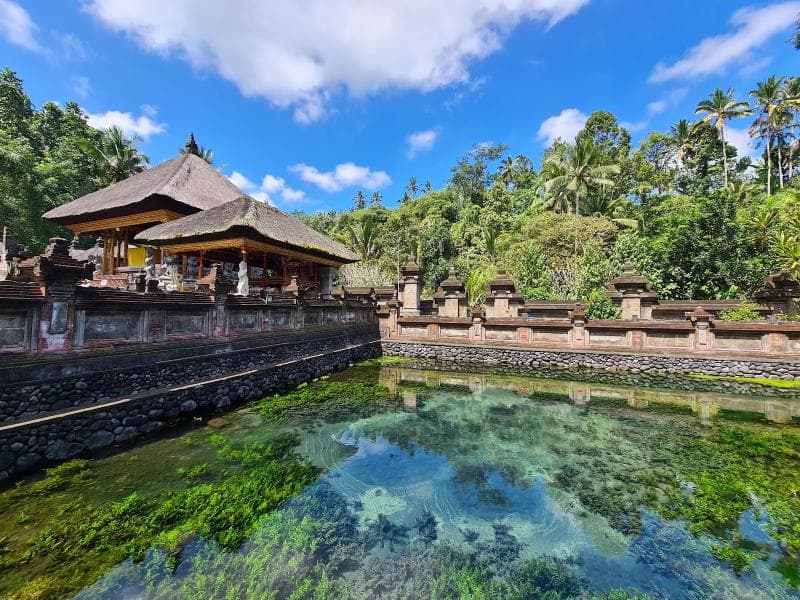
Explore the sacred Jeroan Complex within Tirta Empul Temple in Bali, Indonesia, the spiritual heart where holy springs flow for purification rituals.
Overview
Nestled amidst the lush landscapes of Tampaksiring, Bali, the Tirta Empul Temple stands as a profound testament to Balinese spirituality and architectural heritage. Within this expansive complex lies the Jeroan Complex, the innermost and most sacred section of the temple. Dedicated to Vishnu, the Hindu god of water, Tirta Empul, whose name translates to 'holy water spring', has drawn worshippers and seekers for centuries.
The temple is renowned for its natural spring, which continuously feeds purification pools where devotees partake in the sacred 'Melukat' ritual, a spiritual cleansing.
Traditional Balinese temple architecture, including Tirta Empul, typically divides into three main courtyards: the outer courtyard (Jaba Pura), the middle courtyard (Jaba Tengah), and the inner sanctum (Jeroan). The Jeroan Complex is the holiest of these areas, representing the highest spiritual zone.
History & Cultural Background
The Tirta Empul Temple complex was founded around a large water spring in 962 AD, during the Warmadewa dynasty.
Its origins are deeply intertwined with Balinese mythology, particularly the legend of Lord Indra and the malevolent King Mayadenawa. According to the tale, King Mayadenawa, who possessed magical powers, poisoned the local water sources to harm Lord Indra's troops. In response, Lord Indra struck the earth with his staff, creating a sacred spring that produced life-giving water, thereby neutralizing the poison and reviving his warriors.
This divine act is believed to be the origin of Tirta Empul's holy spring, symbolizing the triumph of good over evil and associating the waters with powerful healing properties and spiritual cleansing.
For Balinese Hindus, Tirta Empul is not merely a temple, but a vital pilgrimage site, embodying a living connection to their spiritual traditions and rich cultural history.
What Makes It Special
The Jeroan Complex distinguishes itself as the innermost and most revered part of the Tirta Empul Temple. While the Jaba Tengah houses the famous purification pools for the Melukat ceremony, the Jeroan is where the very source of this sacred water originates.
It is within this quiet, inner sanctum that the natural spring continuously gushes forth crystal-clear water, believed to be 'amritha' or holy water, feeding all the temple's pools and fountains.
This area often features large Hindu shrines, exquisitely adorned, standing as central points of worship and devotion. The spring itself, sometimes teeming with green algae and small fish, provides a serene visual of life's continuous flow, underscoring the sacredness of water in Balinese Hinduism.
The architecture of the Jeroan reflects the highest spiritual hierarchy within the Balinese 'Tri Mandala' concept, making it the most potent area for prayer and connection with the deities.
Stories, Fun Facts & Local Details
- The Origin Story's Significance: The legend of Lord Indra creating the spring not only explains its existence but also underscores the enduring Balinese belief in divine intervention and the eternal battle between dharma (good) and adharma (evil).
- Meaning of 'Jeroan': The term 'Jeroan' itself translates to 'inside' or 'inner part' in Balinese and Indonesian, perfectly describing its position as the temple's spiritual core.
- Amritha - The Water of Immortality: The spring water from Tirta Empul is considered by Balinese Hindus to be 'amritha', meaning holy or purified water, essential for ritual purification to cleanse souls and avert evil.
- Beyond Public Purification: While many visitors participate in the communal purification in the Jaba Tengah, the Jeroan often remains a more tranquil space, primarily used by local devotees for intense prayer and offerings, highlighting its deeper sacred function.
- Architectural Harmony: The division of the temple into three zones – Jaba Pura, Jaba Tengah, and Jeroan – mirrors the Balinese philosophical concept of 'Tri Loka' (bhur, bwah, swah), representing the earthly, intermediate, and heavenly realms respectively, with the Jeroan symbolizing the most divine.
Visitor Perspective
Visiting the Jeroan Complex offers a unique glimpse into the profound spiritual heart of Tirta Empul Temple. While the bustling Jaba Tengah invites participation in the purification ritual, the Jeroan provides a quieter, more contemplative atmosphere. It is here that one can observe local devotees engaged in sincere prayer and making offerings, connecting directly with the temple's divine source.
As the most sacred section, access to certain parts of the Jeroan is typically reserved for those actively participating in specific religious ceremonies, reinforcing its importance as a living place of worship rather than solely a tourist attraction.
Travelers are encouraged to approach this area with utmost respect, maintaining silence and reverence. Observing the intricately carved shrines and witnessing the serene natural spring that continuously feeds the entire temple complex can be a deeply moving experience, offering a powerful sense of connection to Bali's enduring spiritual essence.
Adherence to temple etiquette, such as wearing a sarong and sash, is essential throughout the entire Tirta Empul complex, including the Jeroan, as a sign of respect for Balinese culture and the sanctity of the site.
Coordinates: 115.31603, -8.41494
View on Google Maps💬 How Travelers Describe This Place
Based on community votes
Photogenic
879Must See
723Unique
482Interesting
396Beautiful
274
Traveler Stories
Discover memorable experiences shared by travelers who have visited this place.
No traveler stories yet.
Be the first traveler to share what made this place memorable.

Tour
By
Spot
Discover amazing places around the world. Your journey starts here.
Explore
© 2026 TourBySpot. All rights reserved.