Jan Hus Monument
Prague, Czech Republic
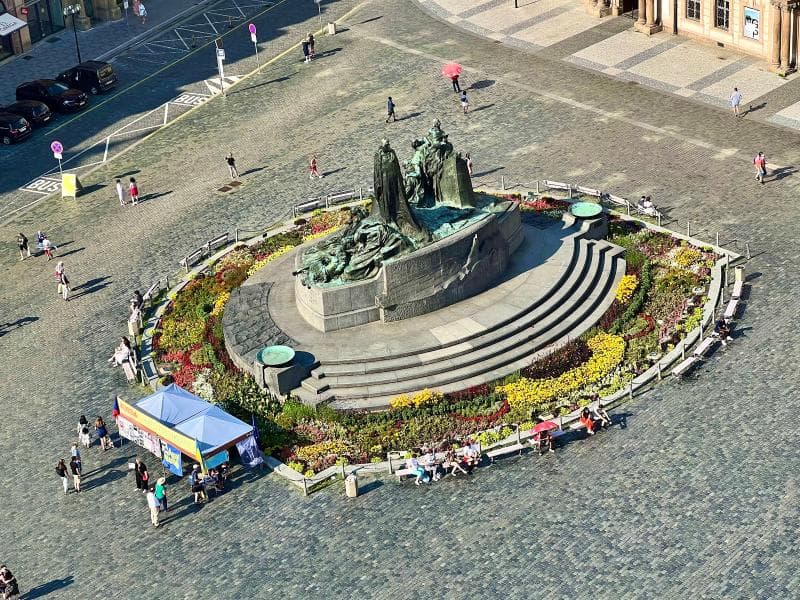
Discover the Jan Hus Monument in Prague's Old Town Square, a powerful symbol of Czech national identity and the legacy of reformer Jan Hus.
Overview
In the vibrant heart of Prague's Old Town Square stands a colossal and deeply symbolic tribute: the Jan Hus Monument. This monumental sculpture, dedicated to the influential Czech religious reformer Master Jan Hus, is more than just a statue; it is a profound emblem of Czech national identity, resilience, and the enduring quest for truth. Visitors to the bustling square cannot miss its imposing presence, drawing attention not only to its artistic merit but also to the powerful history it commemorates. It is a focal point for understanding the Czech spirit, encapsulating centuries of struggle for religious and national self-determination.
The monument was unveiled on July 6, 1915, precisely 500 years after Jan Hus was martyred for his beliefs. Its strategic location in the Old Town Square, a place steeped in Czech history, amplifies its significance, making it a poignant landmark that continues to inspire and educate.
History & Cultural Background
Jan Hus, born in Bohemia around 1369, was a priest, philosopher, and rector at Prague's Charles University. He emerged as a pivotal figure, challenging the corruption within the Catholic Church long before Martin Luther's Reformation. Hus preached passionately in Czech at Bethlehem Chapel, advocating for church reform, emphasizing biblical authority over ecclesiastical tradition, and criticizing practices such as the sale of indulgences. His radical ideas and unwavering commitment to truth quickly gained a large following, but also drew the ire of church authorities.
In 1414, Hus traveled to the Council of Constance to defend his teachings, having been promised safe conduct. However, he was arrested, tried for heresy, and, despite his refusal to recant unless proven wrong by scripture, was condemned. On July 6, 1415, Jan Hus was burned at the stake. His martyrdom sparked outrage across the Czech lands, leading to the Hussite Wars—a series of conflicts that profoundly shaped Czech history and culture. Hus's death transformed him into a national hero, a symbol of resistance against oppression and a beacon for Czech national consciousness.
The idea for a monument to Jan Hus gained momentum during the Czech National Revival, a period from the mid-19th to early 20th century when Czechs sought to assert their distinct cultural and political identity against Austro-Hungarian rule. Designed by sculptor Ladislav Šaloun, the monument was funded entirely by public donations, reflecting widespread national pride and reverence for Hus. Its unveiling in 1915, amidst World War I and still under Habsburg rule, was unofficially celebrated, with citizens covering it in flowers to protest the authorities' refusal to officially inaugurate it. This act further cemented the monument's role as a symbol of defiance and national aspiration.
What Makes It Special
The Jan Hus Monument is a masterpiece of Art Nouveau and Symbolist sculpture, created by Ladislav Šaloun. Its design is rich with layers of meaning, inviting contemplation from every angle. The central figure of Jan Hus stands tall, serene yet defiant, gazing towards the Church of Our Lady before Týn, which was a significant Hussite church during his era. His posture conveys a man who chose truth and conscience over submission.
Surrounding Hus are several allegorical groups that tell a broader story of Czech history and struggle. On one side are the triumphant Hussite warriors, representing the followers who fought for his ideals. On the other side are figures symbolizing Czech Protestants forced into exile after the Battle of White Mountain in 1620, a poignant reminder of centuries of religious persecution. A young mother figure embodies national rebirth, hope, and the continuation of Czech life. Together, these elements weave a narrative that extends beyond Hus himself, connecting his legacy to the ongoing struggles for Czech spiritual independence and national renewal. The monument's material, a combination of stone and bronze, adds to its powerful and enduring presence.
Stories, Fun Facts & Local Details
One of the most striking aspects of the Jan Hus Monument is its enduring message: 'Pravda vítězí' — 'Truth prevails.' This phrase, deeply associated with Hus and inscribed on the monument, later became the motto of Czechoslovakia and continues to be a powerful national maxim. It reflects Hus's belief that truth was worth defending, even at the cost of one's life.
The monument's inauguration in 1915 was deliberately understated by the Austro-Hungarian authorities, who saw Hus as a symbol of rebellion. Yet, the people of Prague transformed it into a spontaneous act of national solidarity by adorning it with flowers, turning a quiet unveiling into a powerful statement of national pride.
The monument's significance continued through different eras. During Communist rule, sitting at the feet of the memorial became a subtle yet potent form of political dissent, a quiet homage to freedom and resistance. Today, July 6th is a national holiday in the Czech Republic, known as Jan Hus Day, commemorating his death and celebrating his profound impact on the nation. This tradition highlights how deeply Hus's legacy is woven into the fabric of modern Czech identity.
Visitor Perspective
When you approach the Jan Hus Monument in Old Town Square, take a moment to walk around it and appreciate its intricate details. It is not designed to be viewed from a single angle; its meaning unfolds as you observe the different sculptural groups and their symbolic representations. Notice the contrasting expressions and poses of the figures, from the resolute Hus to the exiled Protestants and the hopeful mother.
The monument offers a quiet space for reflection amidst the bustling square, a chance to connect with a pivotal moment in European history and the enduring spirit of a nation. It serves as a reminder of the power of conviction and the long struggle for freedom of thought and national self-determination. Standing before it, you can feel the echoes of centuries of history, from religious reform to national revival. It is a powerful experience, encouraging visitors to ponder the values of truth, conscience, and independence that Jan Hus championed and that continue to resonate in the Czech Republic today.
Coordinates: 14.42111, 50.08778
View on Google Maps💬 How Travelers Describe This Place
Based on community votes
Unique
551Beautiful
547Must See
336Interesting
298Photogenic
212
Traveler Stories
Discover memorable experiences shared by travelers who have visited this place.
No traveler stories yet.
Be the first traveler to share what made this place memorable.

Tour
By
Spot
Discover amazing places around the world. Your journey starts here.
Explore
© 2026 TourBySpot. All rights reserved.