Hong Kong Space Museum
Hong Kong, China

Explore the Hong Kong Space Museum, an iconic egg-shaped landmark in Tsim Sha Tsui, Hong Kong, China. Discover interactive exhibits, a state-of-the-art planetarium, and engaging space science displays for all ages.
Overview
The Hong Kong Space Museum, an integral part of the vibrant Tsim Sha Tsui Promenade in Hong Kong, China, stands as a beacon of astronomy and space science. Instantly recognizable by its distinctive egg-shaped dome, this public museum is dedicated to igniting curiosity about the universe. It serves as a gateway for visitors to explore the cosmos, offering a blend of educational and entertaining experiences for all ages.
Strategically positioned at the seaside of Tsim Sha Tsui, the museum is not just an architectural marvel but also a significant educational institution aimed at popularizing scientific knowledge.
History & Cultural Background
The genesis of the Hong Kong Space Museum dates back to 1961 when the Urban Council first proposed the idea of a planetarium. A decade later, in 1971, the Urban Services Department formed a working group to study international planetarium models, laying the groundwork for Hong Kong's own facility.
In 1973, the Hong Kong Government decided on Tsim Sha Tsui as the museum's location and appointed Mr. Joseph Liu Hing-chai, a passionate astronomy enthusiast, as the Planetarium Advisor. Construction commenced in 1977, and the museum officially opened its doors to the public on October 8, 1980. This marked a significant milestone as it introduced the first local planetarium for the popularization of astronomy and space science in Hong Kong. The museum notably housed the world's first computerized planetarium and was the first in the Eastern Hemisphere to boast an OMNIMAX film projector with a fully automatic control system at its Space Theatre.
Managed by the Leisure and Cultural Services Department of the Hong Kong Government, the museum has continuously evolved, incorporating advanced technologies and updating its exhibits to remain relevant and engaging for new generations.
What Makes It Special
The Hong Kong Space Museum's unique egg-shaped dome is its most distinguishing feature, making it a prominent and easily identifiable landmark along the Tsim Sha Tsui waterfront.
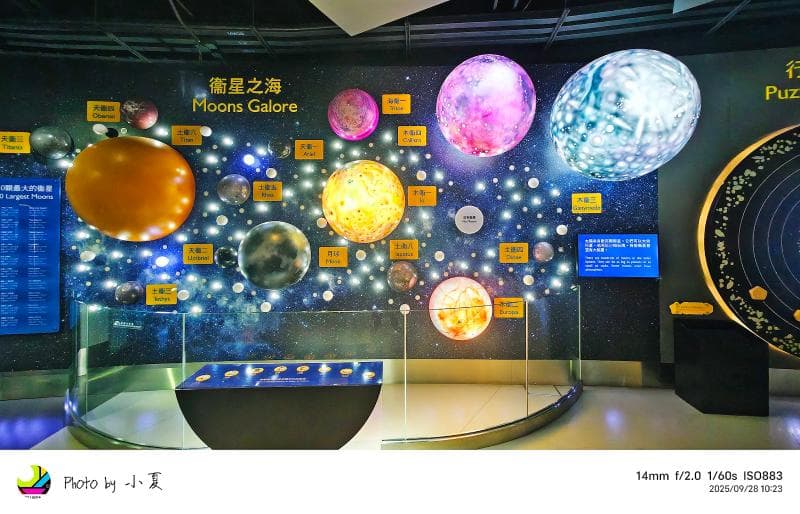
Inside, the museum is divided into two main exhibition halls: the 'Hall of the Cosmos' and the 'Hall of Space Exploration'. Covering a total area of 1,600 square meters, these halls feature around a hundred exhibits, with more than half being interactive. Visitors can engage with hands-on displays that cover topics from the solar system to distant galaxies, exploring the science and evolution of the universe.
A major highlight is the Stanley Ho Space Theatre, located beneath the iconic dome. This theatre features a 23-meter diameter hemispherical projection dome that offers immersive shows, including OMNIMAX films, sky shows, and 3D dome shows. These programs take audiences on captivating journeys through space, offering educational and entertaining experiences that go beyond traditional viewing.
Interactive exhibits further enhance the visitor experience. Examples include 'Gravity Surfing,' where visitors can stand on surfboards to understand how gravity warps space, and 'Fire a Rocket,' which allows for simulating a rocket launch. The 'Moon / Mars VR' exhibit even uses data from the China National Space Administration and The Hong Kong Polytechnic University to create a virtual reality environment for experiencing spacewalks on celestial bodies.
Stories, Fun Facts & Local Details
The museum's iconic egg-shaped dome quickly became a beloved architectural feature of the Tsim Sha Tsui skyline, visible from afar and easily accessible amidst other major attractions.
A testament to its pioneering spirit and the contributions of its early visionaries, asteroid (6743) Liu was named after Mr. Joseph Liu, the first Chief Curator of the Hong Kong Space Museum, in 1998. The museum's initial cost was significant, rising from an estimated HK$6 million in 1973 to HK$60 million by 1980, reflecting the ambition and scale of the project.
Its location on Salisbury Road places it adjacent to other cultural institutions like the Hong Kong Cultural Centre and the Hong Kong Museum of Art, making it part of a vibrant cultural hub on the Tsim Sha Tsui Promenade. The area itself is a major sightseeing hotspot, complete with the Avenue of Stars, the nightly 'A Symphony of Lights' show, and the iconic Star Ferry.
Visitor Perspective
For those planning a visit, the Hong Kong Space Museum is conveniently located at 10 Salisbury Road, Tsim Sha Tsui. It is easily accessible via public transport, with the MTR East Tsim Sha Tsui Station (Exit J) and Tsim Sha Tsui Station (Exit E) just a short walk away. The Star Ferry Terminal is also nearby, offering a scenic approach to the museum.
Visitors typically spend two to three hours exploring the museum's two exhibition halls and attending a show at the Stanley Ho Space Theatre. Many exhibits are interactive and designed to be engaging for children and young adults, making it a popular family-friendly destination. The museum also hosts various extension activities, including stargazing events, astronomy classes, and lectures.
The museum strives for accessibility, offering facilities such as Braille and tactile floor plans, an inquiry counter suitable for wheelchair users, and an induction loop system for the hearing impaired. For the most current information on opening hours, ticket prices, and show schedules, it is advisable to check the official Hong Kong Space Museum website, as details can change.
Coordinates: 114.17187, 22.29422
View on Google Maps💬 How Travelers Describe This Place
Based on community votes
Must See
872Beautiful
684Unique
363Interesting
250Photogenic
88
Traveler Stories
Discover memorable experiences shared by travelers who have visited this place.
No traveler stories yet.
Be the first traveler to share what made this place memorable.

Tour
By
Spot
Discover amazing places around the world. Your journey starts here.
Explore
© 2026 TourBySpot. All rights reserved.