Hoa Phong Tower
Hanoi, Vietnam
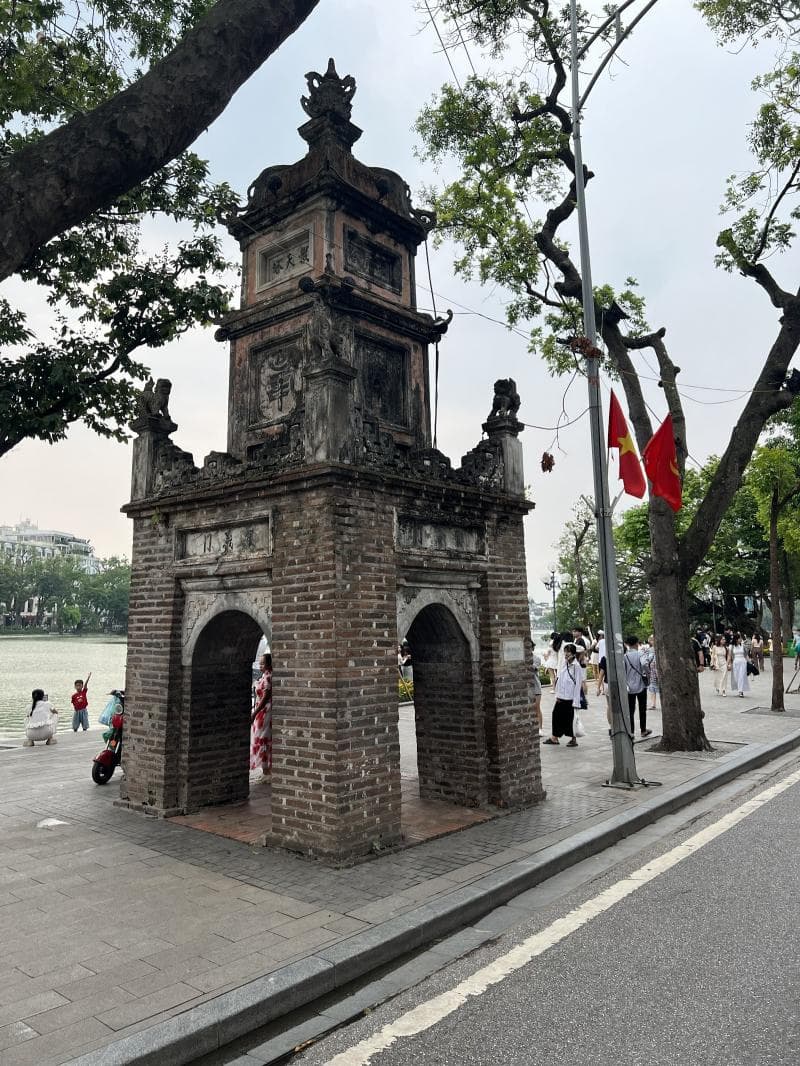
Discover Hoa Phong Tower, a historic brick remnant of Bao An Pagoda on Hoan Kiem Lake in Hanoi, Vietnam. Explore its unique architecture and cultural significance.
Overview
Tucked away on the southeastern shore of Hoan Kiem Lake in Hanoi, Vietnam, stands the Hoa Phong Tower. This ancient, moss-covered brick structure is a silent sentinel, often mistaken for an extension of the more famous Turtle Tower, yet it holds its own distinct and profound historical significance. Hoa Phong Tower is, in fact, the last remaining vestige of the once-grand Bao An Pagoda, a massive religious complex that dominated the area in the 19th century. Its unique architecture and storied past make it a remarkable symbol of Hanoi's enduring cultural heritage, offering a tranquil spot for reflection amidst the city's vibrant energy.
History & Cultural Background
The history of Hoa Phong Tower is deeply intertwined with the rise and fall of a magnificent religious institution. It was originally built as part of the Bao An Pagoda, a significant Buddhist site constructed between 1842 and 1847. The pagoda was established on the former grounds of the Ngu Long Pavilion, dating back to 1740. Commissioned by Hanoi General Nguyen Dang Giai, the Bao An Pagoda was an enormous complex, covering over 100 acres (approximately 360,000 square meters) and comprising 36 large and small buildings with a total of 235 rooms. Its sheer scale made it the most renowned pagoda in Hanoi during the 19th century, featuring an octagonal layout with a moat full of lotuses and numerous stone bridges.
However, the pagoda's grandeur was short-lived. Following Hanoi's fall to the French in 1883, the French army occupied the site, utilizing it as a logistics headquarters. The pagoda fell into disrepair, with Buddha statues and sacred objects lost. From 1882 to 1889, much of Bao An Pagoda was systematically demolished to make way for new administrative buildings, including the Hanoi Post Office and the residence of the Governor of Tonkin. Miraculously, the Hoa Phong Tower, located outside the main pagoda grounds, survived this period of destruction, standing today as the sole physical testament to the once-thriving Bao An Pagoda.
What Makes It Special
Hoa Phong Tower stands out for its distinctive architectural style, which is surprisingly uncommon for traditional Buddhist structures. The tower features a unique square design with three tiers, constructed from exposed brick. The first tier is notably larger and taller than the upper two, featuring arched doors on all four sides, earning it the moniker 'Four-Gate Tower'. These doors bear inscriptions reflecting Confucian values: 'Bao Phuc mon', 'Bao An mon', 'Bao Duc mon', and 'Bao Nghia mon'.
On the second tier, square pillars at each corner once held statues of mythical 'Nghe' creatures, all facing east, the direction of the rising sun. The third tier is inscribed with 'Hoa Phong Thap' on its east-west sides and 'Bao Thien Tower' on its north-south sides. Topping the structure is a stone gourd decoration, a symbolic element that signifies blessings in both Buddhist and Taoist traditions. The bricks used in its construction, particularly for the second layer, are believed to be from the famous Bat Trang ceramic village, adding another layer of cultural authenticity. Its unusual placement in front of the temple gate, rather than within its gardens, further distinguishes it.
Stories, Fun Facts & Local Details
The name 'Hoa Phong' itself carries meaning, translating to 'favorable winds across the four seasons', symbolized by its four entrances facing the cardinal directions. This reflects a deep connection to nature and prosperity in Vietnamese culture. A common misconception among visitors, and even some locals, is that Hoa Phong Tower is part of the architectural complex of Turtle Tower, which also sits within Hoan Kiem Lake. However, as the last remaining fragment of the vast Bao An Pagoda, Hoa Phong Tower has its own independent and poignant story.
Its survival, despite the widespread demolition of the pagoda, speaks volumes about its silent resilience and historical value. Today, it stands as a quiet yet powerful reminder of Hanoi's past, a city that has gracefully evolved while preserving fragments of its ancient soul. The tower embodies an ideology popular during the Nguyen Dynasty, 'Cu Nho Mo Thich', which indicates a blend of Confucian and Buddhist philosophies in its decorative motifs and inscriptions.
Visitor Perspective
For those exploring Hoan Kiem Lake, Hoa Phong Tower offers a momentary pause and a tangible connection to Hanoi's layered history. Situated conveniently on Dinh Tien Hoang Street, opposite the Hanoi Post Office, it is easily accessible and provides a picturesque backdrop for photographs. Many visitors find its timeworn beauty captivating, prompting them to capture its essence.
While not as prominent as other landmarks around the lake, its understated charm and historical depth invite a closer look. Walking around the tower, one can appreciate the intricate brickwork and the subtle architectural details that tell a story of a bygone era. The area around Hoan Kiem Lake, including the tower's vicinity, transforms into a vibrant pedestrian zone on weekends, offering a unique opportunity to experience Hanoi's urban life blending seamlessly with its ancient heritage. It is a place for quiet contemplation, offering a serene escape and a deeper understanding of the city's rich past.
Coordinates: 105.85322, 21.02628
View on Google Maps💬 How Travelers Describe This Place
Based on community votes
Unique
998Photogenic
903Interesting
481Must See
472Beautiful
92
Traveler Stories
Discover memorable experiences shared by travelers who have visited this place.
No traveler stories yet.
Be the first traveler to share what made this place memorable.

Tour
By
Spot
Discover amazing places around the world. Your journey starts here.
Explore
© 2026 TourBySpot. All rights reserved.