Historical Reliefs
Tbilisi, Georgia
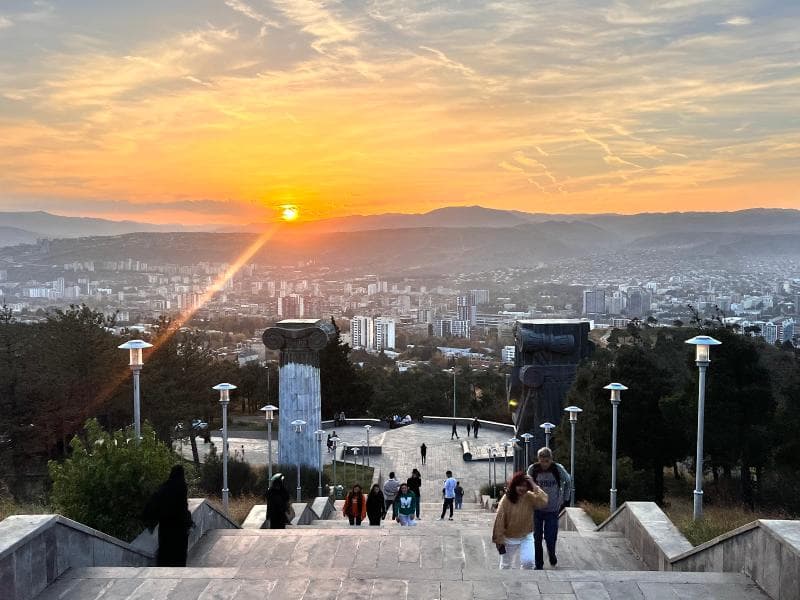
Explore the Historical Reliefs of the Chronicle Of Georgia in Tbilisi, Georgia, a monumental tribute depicting 3000 years of history and faith.
Overview
Perched majestically on Keeni Hill, overlooking the vast expanse of the Tbilisi Sea, the Historical Reliefs within the Chronicle Of Georgia offer a profound journey through the nation's rich past. Often affectionately called the 'Georgian Stonehenge' due to its monumental scale, this impressive open-air structure in Tbilisi is a powerful visual encyclopedia of Georgian history and unwavering Christian faith. Designed by the celebrated Georgian sculptor Zurab Tsereteli, the complex began construction in 1985, though it was never fully completed, lending it an air of ongoing narrative. Comprising 16 massive pillars, each soaring between 30 and 35 meters, these bronzed and stone columns are intricately adorned with high-relief sculptures that chronicle millennia of Georgian statehood and Christianity. Visitors can explore this compelling site freely, immersing themselves in the grandeur of its scale and the depth of its historical storytelling, all while enjoying panoramic views of the surrounding landscape and the capital city.
History & Cultural Background
The Chronicle Of Georgia was conceived as a monumental tribute to commemorate two pivotal anniversaries: 3,000 years of Georgian statehood and 2,000 years of Christianity in the country. Its construction commenced during the final years of the Soviet Union in 1985, a period when national identities within the Soviet framework were undergoing redefinition. The sculptor Zurab Tsereteli intentionally chose this prominent hilltop location in the northern outskirts of Tbilisi, allowing for a grand complex that would have been restricted within the city's historic core. The monument serves as a powerful cultural statement, reclaiming Georgia's medieval monarchs, foundational dynasties, and the central role of Christian Orthodoxy in the nation's formation. After Georgia regained its independence in 1991, the monument gained new significance, transforming into an explicit symbol of national sovereignty and historical continuity, asserted against the backdrop of 20th-century upheavals. It embodies Georgia's resilience and enduring heritage, telling its story through stone and bronze.
What Makes It Special
The true uniqueness of the Historical Reliefs lies in their comprehensive visual narrative of Georgian history and faith, presented on an awe-inspiring scale. Each of the 16 colossal columns is a storytelling masterpiece, divided into distinct sections. The upper portions vividly depict Georgia's pantheon of kings, queens, and national heroes, including revered figures like King David IV, known as David the Builder, and the illustrious Queen Tamar, whose reign marked a golden age for the Georgian kingdom. These figures are sculpted in high relief, showcasing their vestments, crowns, and attributes from different historical eras. The lower sections shift focus to the spiritual bedrock of the nation, illustrating scenes from the life of Christ and crucial episodes related to Georgia's conversion to Christianity, grounding the political narrative in its deep religious identity. Some reliefs also capture traditional Georgian agricultural scenes, celebrating harvests and viticulture. This dual narrative — intertwining secular rule with sacred belief — makes the reliefs an unparalleled testament to a nation's soul. The sheer size, the intricate detail, and the profound historical scope encased in these bronze and stone artworks provide a captivating experience, making it feel less like a static monument and more like a dynamic, unfolding history book.
Stories, Fun Facts & Local Details
One fascinating aspect of the Chronicle Of Georgia is its unfinished nature. While work began in 1985, parts of the complex, including some of the reliefs, remain uncompleted, giving it a 'work in progress' feel, as if Georgia's story is still being written. This adds an extra layer of meaning and intrigue for visitors. The monument's nickname, 'Georgian Stonehenge,' highlights its atmospheric impact rather than architectural similarity, evoking a sense of being dwarfed by something on a grand, more-than-human scale. Beyond the main pillars, the site includes a statue of Saint Nino, the Cappadocian woman credited with bringing Christianity to Georgia, identifiable by her signature grapevine cross. There's also a small, functioning chapel dedicated to the Annunciation, adding a spiritual dimension to the visit. Locals know that the best time to visit for photography is late afternoon or sunset, when the sun casts a warm glow on the weathered bronze and stone reliefs, enhancing their three-dimensionality and creating dramatic shadows. This period also offers breathtaking views over the Tbilisi Sea and the sprawling city, making it a favorite spot for contemplation and capturing memorable moments.
Visitor Perspective
Visiting the Historical Reliefs at the Chronicle Of Georgia offers a powerful and reflective experience. As an open-air, public monument, it is accessible 24 hours a day, year-round, and admission is free. This allows for a flexible visit, though a recommended duration of 1 to 1.5 hours is usually sufficient to explore the site and absorb its grandeur. There are no formal interpretative centers, so a bit of prior research about Georgian history and its key figures can greatly enhance the understanding and appreciation of the detailed carvings. The climb to the monument involves a wide staircase, and while there is little shade, the panoramic vistas from the hilltop are rewarding, especially of the Tbilisi Sea. The sheer scale and intricate artistry of the reliefs compel visitors to pause and reflect on the struggles, triumphs, and enduring faith that have shaped Georgia. It's a place that transcends a mere tourist attraction, offering a profound connection to the heart and soul of the Georgian nation, a quiet testament to a storied past that continues to inspire.
Coordinates: 44.8104195, 41.7706165
View on Google Maps💬 How Travelers Describe This Place
Based on community votes
Photogenic
995Interesting
964Beautiful
926Must See
646Unique
482
Traveler Stories
Discover memorable experiences shared by travelers who have visited this place.
No traveler stories yet.
Be the first traveler to share what made this place memorable.

Tour
By
Spot
Discover amazing places around the world. Your journey starts here.
Explore
© 2026 TourBySpot. All rights reserved.