Historic Buildings
Warsaw, Poland
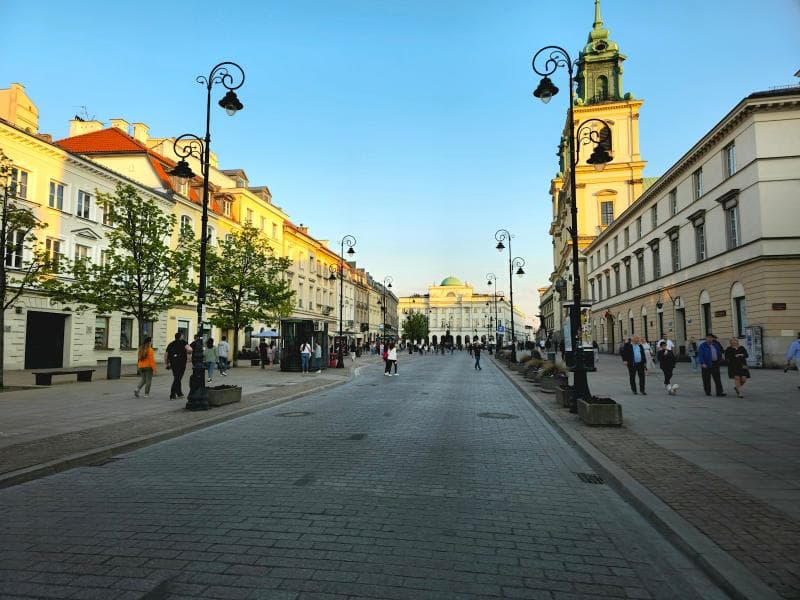
Explore Nowy Świat Street in Warsaw, Poland. Discover historic buildings, neoclassical architecture, and the rich cultural heritage of this vibrant Royal Route thoroughfare.
Overview
Nowy Świat Street, or 'New World Street', stands as a truly iconic and historically significant thoroughfare in Warsaw, Poland. It forms an integral segment of the Royal Route (Trakt Królewski), a majestic path that stretches from the Royal Castle and Old Town southwards to King John III Sobieski's 17th-century royal residence at Wilanów. Today, this bustling street is celebrated for its vibrant atmosphere, lined with elegant shops, inviting cafes, and diverse restaurants, making it a beloved destination for both locals and travelers seeking to immerse themselves in the city's pulse and rich past. It is more than just a street; it's a testament to Warsaw's enduring spirit and its remarkable ability to rebuild and thrive.
History & Cultural Background
The origins of Nowy Świat date back before the 16th century, when it served as a crucial main road connecting Warsaw to the numerous aristocratic palaces and villages located to the south. The street's evocative name, 'Nowy Świat', meaning 'New World', was coined in the 17th century as the city began its substantial expansion beyond its original confines.
Over centuries, the landscape of Nowy Świat transformed dramatically. Initially characterized by open fields and wooden manors, the street gradually became more urbanized. By the 18th century, it was incorporated into Warsaw, and its vicinity saw the development of brick palaces and tenements. The Napoleonic era brought significant architectural changes, with wooden structures giving way to stately, three-storey neoclassical buildings made of stone and brick.
By the late 19th century, Nowy Świat had blossomed into one of Warsaw's principal business and shopping districts, a bustling hub attracting both Varsovians and tourists. However, the street's rich architectural tapestry was almost entirely obliterated during World War II, particularly during the Warsaw Uprising in 1944. Over 90% of its buildings were destroyed, leaving a landscape of devastation.
In a remarkable act of post-war reconstruction, it was decided to rebuild Nowy Świat not in its early 20th-century Art Nouveau style, but to restore its early 19th-century neoclassical appearance. This meticulous reconstruction effort often relied on historical paintings, such as those by Bernardo Bellotto (Canaletto), to faithfully recreate the street's former grandeur.
What Makes It Special
Nowy Świat's uniqueness stems from its extraordinary blend of historical authenticity and contemporary vitality, shaped by a compelling history of destruction and rebirth. As a pivotal part of the Royal Route, it links many of Warsaw's most significant historical sites, offering a continuous narrative of the city's past.
The neoclassical architecture, diligently restored after the immense damage of World War II, presents a harmonious and elegant streetscape. This architectural consistency, a deliberate choice during reconstruction, gives visitors a sense of stepping back into the Warsaw of the early 1800s. The street's transformation into a more pedestrian-friendly zone in 1996 further enhanced its charm, inviting leisurely exploration away from heavy traffic.
It's a living museum, where each building, though often rebuilt, carries the echoes of centuries of history, from aristocratic residences to bustling commercial centers, all while serving as a vibrant social and cultural artery of modern Warsaw.
Stories, Fun Facts & Local Details
The Royal Route Connection: Nowy Świat is a significant stretch of the Royal Route, a ceremonial path that leads visitors past numerous palaces, churches, and monuments. This route was historically used by Polish monarchs.
A Place to Meet: In the 19th century, Nowy Świat was so central to Warsaw's social life that a popular saying emerged: 'If you want to meet your friend, whom you have not seen for years, stroll through Nowy Świat twice, and you'll meet him for sure.' This highlights its former role as the city's salon.
Copernicus and Planets: Near the northern end, where Nowy Świat transitions into Krakowskie Przedmieście, stands the Nicolaus Copernicus Monument in front of the Polish Academy of Science. If you look down at the pavement around the statue, you might find subtle depictions of the planets Copernicus studied, a clever detail that delights curious visitors.
Chopin's Heart: A short walk from Nowy Świat leads to the Holy Cross Church (Bazylika Świętego Krzyża), a magnificent baroque edifice where, famously, Frédéric Chopin's heart is enshrined within one of the pillars.
Pre-War Pharmacy: At Nowy Świat 18, visitors can discover a pharmacy that still contains authentic furniture from the period before World War II, offering a rare glimpse into the street's untouched past.
The Controversial Palm Tree: At Rondo de Gaulle, at the street's southern end, you'll find a striking and somewhat controversial artificial palm tree. Installed in 2002, this 15-meter plastic art installation, 'Greetings from Jerusalem Avenue', was inspired by the artist's visit to Israel and commemorates the Jewish community that once thrived in the area. It has become a modern symbol of Warsaw.
Visitor Perspective
Walking along Nowy Świat offers a truly immersive experience into Warsaw's character. It's a journey through architectural elegance and vibrant city life. As you stroll, take time to appreciate the neoclassical facades, each telling a story of resilience and meticulous reconstruction. The street's pedestrian-friendly nature encourages lingering in charming cafes, browsing unique boutiques, and enjoying the lively street atmosphere.
From the grandeur of its historical buildings to the subtle details that hint at past lives, Nowy Świat engages the senses. It provides a perfect starting point for exploring other major attractions, seamlessly connecting to Krakowskie Przedmieście, the University of Warsaw, the Royal Castle, and the Old Town. Observing the flow of daily life against such a rich historical backdrop offers a unique perspective on how Warsaw beautifully bridges its past and present. It's a place where every corner seems to whisper tales of bygone eras while embracing the energy of the 'new world' it represents.
Coordinates: 21.01178, 52.22977
View on Google Maps💬 How Travelers Describe This Place
Based on community votes
Unique
853Photogenic
639Beautiful
190Interesting
93Must See
32
Traveler Stories
Discover memorable experiences shared by travelers who have visited this place.
No traveler stories yet.
Be the first traveler to share what made this place memorable.

Tour
By
Spot
Discover amazing places around the world. Your journey starts here.
Explore
© 2026 TourBySpot. All rights reserved.