Hilltop Observation Areas
Tbilisi, Georgia
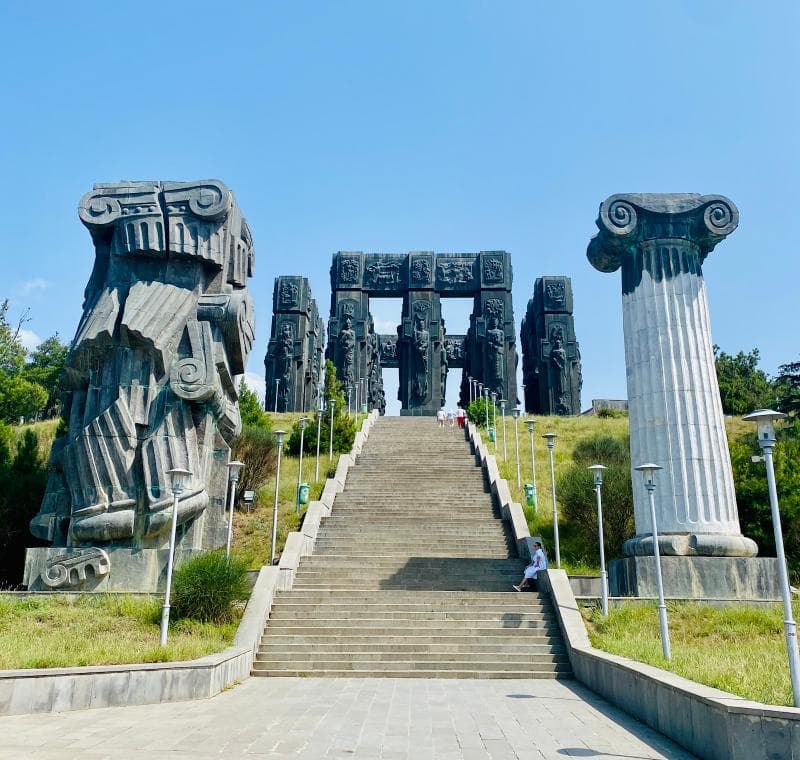
Explore the Hilltop Observation Areas at the Chronicle of Georgia in Tbilisi, Georgia. Discover colossal pillars depicting Georgian history and faith, offering panoramic city views.
Overview
Perched majestically atop Keeni Hill on the northern outskirts of Tbilisi, Georgia, the Hilltop Observation Areas at the Chronicle of Georgia offer a breathtaking panorama and a profound journey through the nation's rich history. This monumental complex, often referred to as the 'Georgian Stonehenge' due to its impressive scale, is an open-air historical tapestry crafted from stone and bronze. Visitors ascend a series of steps to reach the main plateau, where sixteen colossal pillars stand as silent guardians of Georgia's past. From this vantage point, the sprawling city of Tbilisi stretches to the south, while the vast expanse of the Tbilisi Sea, a man-made reservoir, glistens to the east. It is a place designed not just for observation but for reflection, inviting travelers to connect with the very essence of Georgian identity.
The monument serves as a powerful visual narrative, presenting thousands of years of statehood and faith through intricate artistry. Unlike many bustling tourist sites, the Hilltop Observation Areas often provide a tranquil experience, allowing for an unhurried exploration of its detailed carvings and expansive views.
History & Cultural Background
The Chronicle of Georgia, known locally as Sakartvelos Matiane, was conceived by the celebrated Georgian sculptor Zurab Tsereteli. Construction began in 1985 during the final years of the Soviet Union. The ambitious project was initiated to commemorate two pivotal anniversaries: 3,000 years of Georgian statehood and 2,000 years of Christianity in the country. Although work continued for years, the monument was never fully completed, adding a unique layer to its mystique as an ongoing tribute.
Tsereteli intentionally chose Keeni Hill for its commanding presence, allowing for a monumental complex that would be visible from various points and unconstrained by urban limitations. The monument's design reflects a period when Georgian national identity was being re-examined, offering a grand artistic statement that synthesizes the nation's historical journey.
What Makes It Special
What truly sets the Hilltop Observation Areas within the Chronicle of Georgia apart are its sixteen towering pillars, each standing between 30 to 35 meters (approximately 100-115 feet) tall. These immense columns are entirely covered in intricate bas-reliefs, making them monumental storybooks. The lower sections of the pillars are dedicated to scenes from the New Testament, depicting significant moments in the life of Jesus Christ such as the Last Supper, Palm Sunday, and the Annunciation.
In stark contrast, the upper sections narrate the epic history of Georgia. Here, one can find depictions of revered Georgian kings, queens, and national heroes, alongside iconic figures from literature like the poet Shota Rustaveli. The seamless blend of profound religious narratives with vivid historical chronicles creates a powerful duality, offering a comprehensive visual representation of the foundations of Georgian culture and faith. The sheer scale and detail of these sculptures, combined with the expansive views from its elevated position, make it an extraordinary cultural landmark.
Stories, Fun Facts & Local Details
Locals and visitors alike sometimes refer to the Chronicle of Georgia as 'Tbilisi's Stonehenge,' a testament to its imposing circular arrangement of colossal stones. Beyond the main pillars, the complex also includes a small Georgian Orthodox church dedicated to Saint Nino, the woman credited with bringing Christianity to Georgia in the 4th century. Her symbol, the grapevine cross, is also present within the monument.
Interesting details abound, from engravings of Georgian monarchs on the ground to depictions of ancient myths, such as the Argonauts and the Golden Fleece, connecting Georgia to classical antiquity. The monument's location atop Keeni Hill provides a unique perspective not just on historical events, but also on the city's geographical expanse, offering a view of both Soviet-era architecture in the northern suburbs and the natural beauty of the Tbilisi Sea. Its relatively off-the-beaten-path location means it often feels less crowded, allowing for a more personal and reflective experience.
Visitor Perspective
Reaching the Hilltop Observation Areas involves a walk up a significant staircase, which adds to the sense of arrival and anticipation. Once at the summit, visitors are met with invigorating breezes, especially coming from the Tbilisi Sea, making it advisable to bring a light jacket even on warmer days. The site is open 24 hours a day, seven days a week, and there is no entrance fee, providing complete flexibility for exploration.
For photographers and those seeking the most dramatic visual experience, visiting in the late afternoon or during sunset is highly recommended. The setting sun casts a golden glow upon the bronze reliefs, enhancing their intricate details and creating a truly awe-inspiring atmosphere. The panoramic vistas include the vast, blue expanse of the Tbilisi Sea, often dotted with distant boats, and the sprawling urban landscape of Tbilisi. Comfortable walking shoes are a must for navigating the steps and exploring the expansive grounds of this majestic historical site.
Coordinates: 44.810438, 41.770503
View on Google Maps💬 How Travelers Describe This Place
Based on community votes
Photogenic
964Unique
926Beautiful
646Interesting
482Must See
380
Traveler Stories
Discover memorable experiences shared by travelers who have visited this place.
No traveler stories yet.
Be the first traveler to share what made this place memorable.

Tour
By
Spot
Discover amazing places around the world. Your journey starts here.
Explore
© 2026 TourBySpot. All rights reserved.