Grand Théâtre
Lyon, France
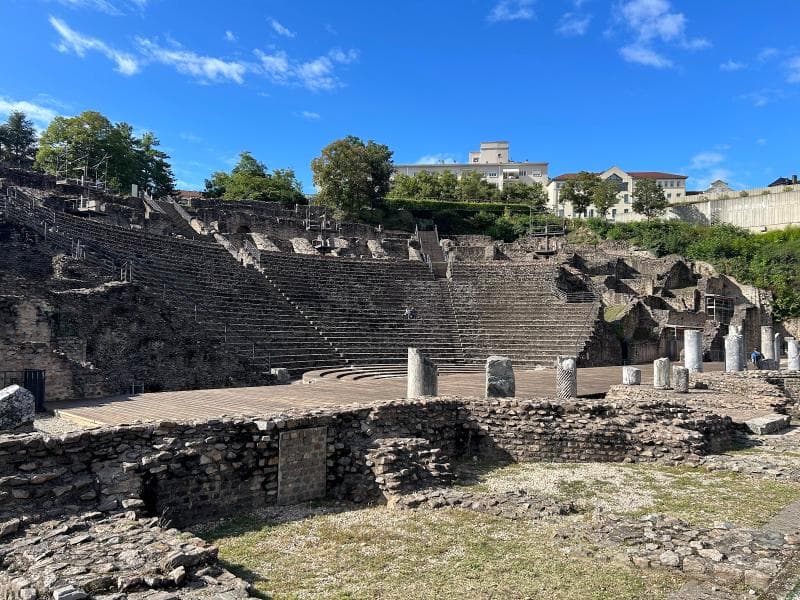
Explore Lyon's Grand Théâtre, part of Théâtres Romains De Fourvière. Discover this ancient Roman theatre in France, a UNESCO site with rich history.
Overview
Nestled on the historic Fourvière Hill in Lyon, France, the Grand Théâtre, often referred to as the Ancient Theatre of Fourvière, stands as a remarkable testament to the grandeur of Roman civilization. This impressive archaeological site is part of the larger Théâtres Romains De Fourvière complex, which also includes a smaller Odeon. Recognized as a UNESCO World Heritage Site, the Grand Théâtre offers a captivating journey back to the city's ancient origins as Lugdunum, the capital of Roman Gaul. Today, this exquisitely preserved structure continues its legacy as a vibrant cultural venue, hosting the renowned 'Nuits de Fourvière' festival and providing visitors with a tangible connection to over two millennia of history and performance.
Standing atop the hill, the theatre not only presents an immersive historical experience but also boasts panoramic views of modern-day Lyon, making it a popular spot for both history enthusiasts and curious travelers. Its enduring presence underscores Lyon's long-standing role as a cultural and historical crossroads in Europe.
History & Cultural Background
The Grand Théâtre's story began around 15 BCE, when it was first commissioned under the reign of Emperor Augustus, making it the oldest Roman theatre in France. Initially, this monumental structure had a diameter of approximately 90 meters and could accommodate an audience of about 4,700 to 5,000 spectators. Its primary purpose was to stage tragedies and comedies, serving as a central hub for entertainment and public gatherings in the flourishing Roman city of Lugdunum.
A significant expansion occurred in the early 2nd century CE, likely under Emperor Hadrian, which enlarged the theatre to its current impressive diameter of 108 meters and boosted its seating capacity to between 10,000 and 10,700 people. This expansion solidified its status as one of the largest Roman theatres in Gaul. The theatre's design incorporated classic Roman architectural elements, including the 'cavea' (the tiered seating area with 25 stands), 'vomitorias' (the access passages for spectators), and the 'balteus' (a dividing wall separating social classes). A 'velum', or large awning, could even be stretched across the cavea to protect the audience from the elements. The semi-circular orchestra pit, measuring 27 meters in diameter, was the stage for choirs, dancers, and actors. By the 3rd century CE, with the decline of the Roman Empire, the theatre was abandoned and gradually fell into ruin, serving as a quarry for building materials before being rediscovered and extensively restored in the 20th century.
What Makes It Special
What truly sets the Grand Théâtre apart is its extraordinary blend of ancient heritage and modern vitality. As the oldest Roman theatre in France and one of the largest, it offers a direct window into the architectural prowess and cultural life of ancient Rome. The ingenuity of its Roman builders is evident in its construction, which masterfully utilized the natural slope of Fourvière Hill, ensuring remarkable acoustics even without modern amplification.
Its unique pairing with the adjacent Odeon, a smaller theatre primarily for music and poetry, forms a rare archaeological ensemble within the Roman world, showcasing the diverse entertainment options available to Lugdunum's citizens. More than just a relic, the Grand Théâtre is a living monument. Each summer, it transforms into the dramatic backdrop for the 'Nuits de Fourvière' festival, where contemporary music, dance, and theatrical performances breathe new life into its ancient stones, fulfilling its original purpose as a center for public spectacle.
Stories, Fun Facts & Local Details
Imagine the vibrant scenes that unfolded within these walls: the roar of the crowd, the dramatic recitations of actors, and the rhythmic movements of dancers. The theatre's original stage, known as the 'pulpitum', was supported by a wall and featured elaborate decorations, including columns that once commemorated Roman emperors, with their ashes sometimes stored at the base. The orchestra floor itself was a work of art, often adorned with intricate geometric patterns using multi-colored marbles imported from distant lands, a testament to the wealth and artistic sensibilities of the era. Archaeologists have even uncovered details about the sophisticated mechanism used to operate the stage curtain, a feature that can be seen in models at the nearby Lugdunum Museum.
For centuries, this grand structure lay buried and forgotten, its stones reclaimed by nature or repurposed for new constructions in the burgeoning city below. Its rediscovery in the early 20th century and subsequent restoration efforts were a monumental undertaking, piecing together fragments of history to reveal the magnificent theatre we see today. The site was classified as a 'Historical Monument' in 1905, ensuring its protection and preservation for future generations.
Visitor Perspective
Visiting the Grand Théâtre is an effortlessly rewarding experience. Entry to the site is free of charge, allowing everyone to explore its ancient tiers and imagine its past splendor. You can easily spend 30 to 60 minutes wandering through the ruins, though a more comprehensive visit including the adjacent Lugdunum Museum (which does have an entry fee) is highly recommended to gain deeper historical context. To reach this historical gem, simply take the Funicular F1 to the Minimes – Théâtres Romains station from the Vieux Lyon metro station, a pleasant journey up Fourvière Hill. When visiting during warmer months, arriving in the morning is advisable to avoid the heat that can accumulate on the stone seating. It's also wise to wear shoes with good grip, as the ancient surfaces can be slippery, especially after rain. From the upper seating rows, you'll not only find quieter spots but also enjoy some of the most breathtaking panoramic views over Lyon.
Coordinates: 4.81972, 45.75972
View on Google Maps💬 How Travelers Describe This Place
Based on community votes
Photogenic
1.0kUnique
869Must See
416Interesting
309Beautiful
33
Traveler Stories
Discover memorable experiences shared by travelers who have visited this place.
No traveler stories yet.
Be the first traveler to share what made this place memorable.

Tour
By
Spot
Discover amazing places around the world. Your journey starts here.
Explore
© 2026 TourBySpot. All rights reserved.