Government Quarter
Astana, Kazakhstan
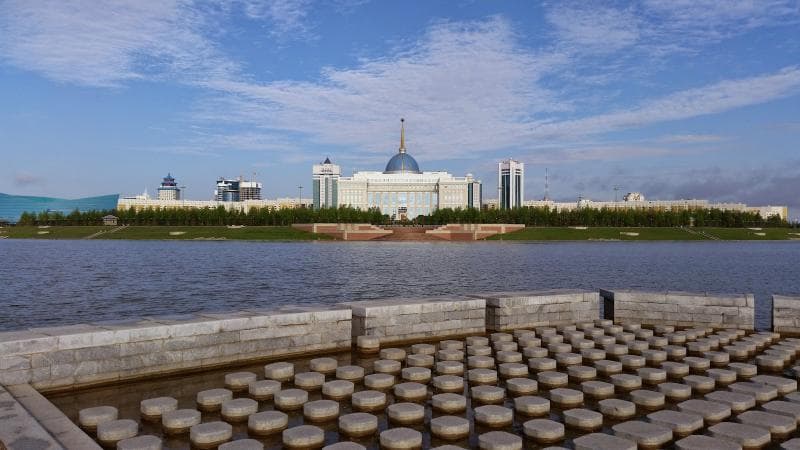
Explore the Government Quarter in Astana, Kazakhstan, home to the Ak Orda Presidential Palace, a symbol of national pride and modern architecture.
Overview
In the heart of Astana, Kazakhstan's dynamic capital, lies the prestigious Government Quarter, an architectural ensemble centered around the magnificent Ak Orda Presidential Palace. This sub-spot, often referred to as the administrative or presidential district, serves as the official workplace of the President of Kazakhstan and the core of the nation's political life. Situated on the left bank of the Ishim River, the Ak Orda is a gleaming symbol of the country's independence and forward-looking vision. Its striking design, a harmonious blend of classical European architecture and sophisticated Eastern motifs, immediately captures the eye. The palace, with its pristine white marble facade and an iconic blue and gold dome, stands as a focal point within a meticulously planned urban landscape, reflecting Kazakhstan's ambition and cultural identity.
History & Cultural Background
The Ak Orda Presidential Palace, inaugurated in 2004, is a relatively recent, yet profoundly significant, landmark in Kazakhstan's history. Its construction followed the decision in 1997 to relocate the capital from Almaty to Astana, then known as Akmola. This move was a bold statement of national sovereignty and a strategic step towards developing a modern, internationally recognized capital city. The name 'Ak Orda' itself carries deep cultural weight, translating as 'White Headquarters' or 'White Residence'. This nomenclature not only describes the dominant color of its snow-white marble facades but also alludes to the historical 'White Horde', a significant state formation in ancient Kazakhstan, thereby symbolizing the continuity of generations and the enduring sovereignty of the modern state. The architectural synthesis seen in the palace, combining European monumentality with traditional Kazakh and Oriental ornamental decor, was a deliberate choice to express the preservation of steppe traditions while promoting Eurasian culture and aspiring to global civilization standards.
What Makes It Special
The Ak Orda Presidential Palace is a masterpiece of modern architecture and symbolic design. Standing at an impressive 80 meters (or 86 meters including the spire), the seven-story structure features a distinctive blue and gold dome, crowned with a golden statue of a sun with 32 rays and a steppe eagle flying beneath it. These elements mirror the national flag of Kazakhstan, embodying freedom, power, and a bright future. The interior is equally grand, featuring luxurious furnishings and an opulent use of materials, including 21 types of marble and generous amounts of gold. Each of the palace's numerous halls serves a specific state function, from the Grand Central Hall on the ground floor to the Marble Hall for signing international agreements, the Oval Hall for summit talks, and the Golden Hall for private meetings. One particularly unique feature is the Oriental Hall, designed in the traditional yurt form, paying homage to Kazakhstan's nomadic heritage. The building is not merely a functional government office but a profound architectural statement, meticulously planned as the compositional and conceptual center of Astana's urban axis, connecting other key landmarks like Khan Shatyr and Baiterek Tower.
Stories, Fun Facts & Local Details
Beyond its official functions, the Ak Orda Presidential Palace holds intriguing details that add to its allure. For instance, the palace's location was carefully chosen to incorporate principles of Feng Shui. The Ishim River, which gently curves around the palace, is seen as forming a 'Jade Belt', an auspicious formation believed to bring wealth and prosperity. The seven levels of the building are also imbued with symbolic meaning, referencing the 'seven heavens' found in religious cosmology, transforming the structure into a celestial abode. The interior is adorned with a rich collection of Kazakh fine art, representing a humorous synthesis of Western and Eastern cultures and reflecting the steppe civilization in a contemporary light. While the palace itself is a restricted facility, the surrounding Presidential Park and Nurzhol Boulevard offer a splendid experience. Visitors can enjoy the beautifully landscaped alleys, impressive fountains, and floral displays, all while capturing stunning photographs of the palace's exterior.
Visitor Perspective
Although the interior of the Ak Orda Presidential Palace is generally not accessible for casual public tours, its external grandeur and surrounding district offer a compelling experience for any traveler to Astana. The palace forms the majestic backdrop to Nurzhol Boulevard, a vibrant pedestrian artery lined with sculptures and green spaces, leading to other significant city attractions like the Baiterek Tower and the Palace of Peace and Reconciliation. Walking through the Government Quarter allows visitors to grasp the scale and ambition of Astana's urban planning, witnessing firsthand the city's modern architecture and its symbolic landmarks. The area is perfect for a leisurely stroll, offering numerous vantage points for photography, especially as the sun sets and the palace lights up. It's a chance to feel the pulse of Kazakhstan's governance and appreciate the nation's vision for the future, all within a visually stunning environment.
Coordinates: 71.44639, 51.12583
View on Google Maps💬 How Travelers Describe This Place
Based on community votes
Photogenic
989Must See
791Interesting
613Beautiful
514Unique
207
Traveler Stories
Discover memorable experiences shared by travelers who have visited this place.
No traveler stories yet.
Be the first traveler to share what made this place memorable.

Tour
By
Spot
Discover amazing places around the world. Your journey starts here.
Explore
© 2026 TourBySpot. All rights reserved.