Government Buildings
Tashkent, Uzbekistan
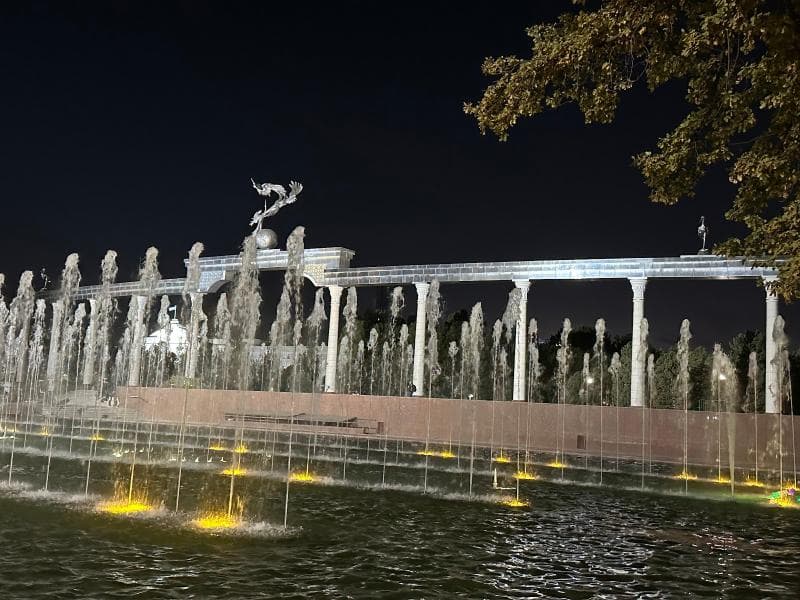
Explore the government buildings within Independence Square, Tashkent, Uzbekistan, including the Senate and Cabinet of Ministers, symbolizing national sovereignty and history.
Overview
Independence Square, or Mustaqillik Maydoni, in Tashkent, Uzbekistan, serves not only as a vibrant public space but also as the distinguished home to several crucial government buildings. These administrative structures are primarily situated on the western side of the expansive square, establishing it as the political and ceremonial heart of the nation. Among the prominent edifices found here are the Cabinet of Ministers, the Senate of Uzbekistan, and the Ministry of Finance. Their presence underscores the square's profound significance as a symbol of the country's sovereignty and governance, embodying the aspirations of modern, independent Uzbekistan.
While the square itself is often likened to a large park due to its lush green zones, fountains, and monuments, these government buildings contribute a sense of grandeur and historical continuity. They represent the executive and legislative branches of Uzbekistan's government, making Independence Square a focal point for national celebrations and official state events.
History & Cultural Background
The land occupied by Independence Square has a long-standing history as a center of power in Tashkent, dating back over a century. Before the Russian conquest in 1865, the area near the current square housed the palace of the Kokand Khan. Following Russian administration, it became the site of the Turkestan Governor-General's residence, known as the 'White House,' and later, the headquarters of the Council of People's Commissars of the Uzbek SSR during the Soviet era.
After Uzbekistan declared its independence in September 1991, the square underwent a transformative renaming from 'Lenin Square' to 'Mustaqillik Maydoni' in 1992, signifying the nation's newfound freedom. This pivotal moment initiated a comprehensive reconstruction that reimagined the area to reflect Uzbek national identity. The iconic Monument of Independence and Humanism, featuring a globe with the outline of Uzbekistan, replaced a former Lenin monument.
The construction and renovation of the government buildings within the square were integral to this post-independence vision. For instance, the Senate building, which houses the upper chamber of the Oliy Majlis (Parliament of Uzbekistan), was erected to the south of the Independence Monument, replacing the Alisher Navoi Library in 2003. This historical evolution from colonial administrative hub to Soviet-era political center, and ultimately to the seat of an independent nation's government, imbues these buildings with deep cultural and historical layers.
What Makes It Special
The collection of government buildings within Independence Square is special because it physically manifests the administrative core of a sovereign nation, nestled within a space designed to celebrate that very independence. Their classical architectural styles, such as the Senate building's prominent columns and porticoes, convey a sense of gravitas and stability. Unlike many administrative complexes that stand in isolation, these buildings are seamlessly integrated into a grand civic space that blends monuments, green areas, and fountains, creating a unique synthesis of governance and public life.
The strategic placement of these institutions within Mustaqillik Maydoni means that they are not just functional offices but also symbols visible to all who visit the square. They stand as a testament to Uzbekistan's journey from its complex past to its current status as a self-determined state, actively participating in the global community. The contrast between their solemn administrative function and the square's festive atmosphere during national holidays offers a compelling dimension to the visitor experience.
Stories, Fun Facts & Local Details
The government buildings of Independence Square are intrinsically linked to the broader narrative of Uzbekistan's independence. While specific anecdotal stories about the buildings themselves might be less publicized, their existence within the square tells a powerful story. The decision to establish the Cabinet of Ministers, the Senate, and the Ministry of Finance here solidified Independence Square's role as the nerve center of the new republic.
A fascinating detail lies in the continuous function of this site as a center of governance across different historical epochs. From the Governor-General's residence to the Council of People's Commissars and now the Parliament and Cabinet, the land has consistently served as the locus of state authority. This continuity, despite radical political changes, speaks to the inherent strategic importance of the location. Additionally, the architectural transformations of these buildings, from Soviet-era designs to more modern and classical styles, reflect the evolving aesthetic and political aspirations of the nation over time.
Visitor Perspective
For a curious traveler, observing the government buildings at Independence Square offers a tangible connection to Uzbekistan's national identity and political landscape. While the interiors are typically not accessible to the public, their imposing exteriors and classical designs provide a backdrop to the square's many other attractions. Standing before the Senate building or the Cabinet of Ministers, one can appreciate the scale of governance that takes place within these walls.
The buildings are best viewed as part of the wider experience of Independence Square, where moments of solemn reflection (at the Monument of Independence or the Alley of Memory) converge with the everyday life of Tashkent residents. Walking along the tree-lined avenues and admiring the architectural details provides a sense of the country's national pride and its commitment to its independent future. It's an opportunity to witness the physical embodiment of a nation's aspirations within a space that is both historically charged and beautifully maintained.
Coordinates: 69.278333, 41.313889
View on Google Maps💬 How Travelers Describe This Place
Based on community votes
Must See
931Interesting
670Unique
655Beautiful
266Photogenic
166
Traveler Stories
Discover memorable experiences shared by travelers who have visited this place.
No traveler stories yet.
Be the first traveler to share what made this place memorable.

Tour
By
Spot
Discover amazing places around the world. Your journey starts here.
Explore
© 2026 TourBySpot. All rights reserved.