Government Building
Zagreb, Croatia
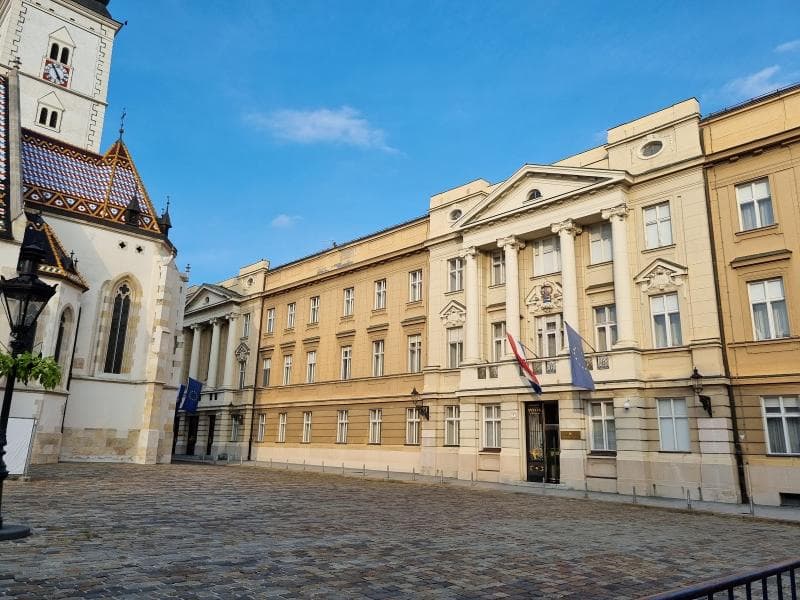
Explore Banski dvori, the historic seat of the Croatian Government in Zagreb, Croatia. Discover its rich political history on St. Mark's Square.
Overview
Situated proudly on the western side of Zagreb's historic St. Mark's Square, Banski dvori stands as a monumental symbol of Croatian governance and history. While St. Mark's Church, with its distinctive tiled roof, dominates the square's center, Banski dvori is the actual 'Government Building' that forms an integral part of this politically significant locale. It currently serves as the official seat of the Government of Croatia and the office of the Prime Minister. This two-story Baroque Classicism building has witnessed centuries of Croatian political evolution, from the residence of powerful bans (viceroys) to the heart of modern-day state administration. Its location on St. Mark's Square, alongside the Croatian Parliament and the Constitutional Court, underscores the square's enduring role as Zagreb's political and historical core, even though the square itself has seen restrictions on public access in recent years.
History & Cultural Background
The story of Banski dvori, meaning 'Ban's Court,' is deeply intertwined with Croatia's national narrative. Its origins trace back to the early 19th century when it was constructed and expanded, incorporating earlier buildings, to become the residence of the Croatian bans. From 1809 to 1918, it served as the official home for these viceroys, who governed on behalf of the Hungarian king, solidifying its importance in the region's administration. Notably, Ban Josip Jelačić, a significant figure in Croatian history, resided and died within its walls.
Throughout the 20th century, Banski dvori adapted to the tumultuous political landscape. It housed the Government of the State of Slovenes, Croats, and Serbs after the dissolution of Austria-Hungary in 1918, and later the presidency of the Socialist Republic of Croatia during the Yugoslav period. In May 1990, it was designated the official residence for both the President and the Government of Croatia. A pivotal moment in its history occurred on October 7, 1991, during the Croatian War of Independence, when the building was targeted by an airstrike from the Yugoslav People's Army, aiming to assassinate President Franjo Tuđman, Stipe Mesić, and Ante Marković. Miraculously, all survived, and the very next day, the Croatian Parliament declared independence from Yugoslavia. This event cemented Banski dvori's place in Croatia's struggle for sovereignty.
What Makes It Special
What truly sets Banski dvori apart is its profound symbolic weight. It is not just an administrative building; it is a tangible connection to Croatia's statehood and its journey through various historical epochs. The Baroque Classicism architectural style of its two-story facade gives it a dignified presence on St. Mark's Square. Its continuous function as a seat of power, despite changes in rulers and political systems, speaks volumes about its enduring significance. The building's survival through conflicts, particularly the 1991 bombing, has turned it into a symbol of national resilience.
Moreover, its location on St. Mark's Square places it at the nexus of legislative, executive, and judicial power in Croatia, with the Parliament (Sabor Palace) and Constitutional Court also framing the square. This concentration of governmental authority around the historic St. Mark's Church creates a unique urban ensemble that reflects centuries of political and religious life in Zagreb's Upper Town.
Stories, Fun Facts & Local Details
One of the most striking stories associated with Banski dvori is the aforementioned 1991 airstrike. The fact that the targeted leaders survived, and that Croatian independence was declared the very next day, adds a dramatic layer to the building's narrative, marking it as a site of national courage and determination. The building's name, 'Ban's Court,' directly references the Croatian bans who once lived there, a title carrying centuries of historical legacy.
St. Mark's Square itself has long been a stage for significant civic events. Until 2020, it was a traditional site for presidential inaugurations, and historically, it hosted royal ceremonies and state declarations. However, following a shooting incident in October 2020, the square has been subject to increased security measures, and access has been restricted to visitors, tourists, and even residents of nearby buildings, a change that reflects the ongoing importance of the government institutions surrounding it. This shift means that the bustling public square it once was is now a more guarded symbol of state power.
The Croatian Parliament, whose building also faces St. Mark's Square, has convened at this location since 1737. Decisions of immense historical import, such as secession from Austria-Hungary in 1918 and from Yugoslavia in 1991, were made within its walls, further cementing the square's role in the birth and rebirth of the Croatian state.
Visitor Perspective
For the curious traveler, visiting Banski dvori is primarily an external experience. The building's facade, with its elegant Baroque Classicism, offers a glimpse into Croatia's rich architectural heritage. While direct access to the interior is typically restricted due to its function as a government building, its presence on St. Mark's Square provides a powerful visual context for understanding Croatian politics and history. The iconic St. Mark's Church, with its colorful tiled roof, serves as a striking backdrop, making the entire square a photographer's delight.
Despite the current security restrictions on the square itself, the panoramic view from the surrounding Upper Town still allows for an appreciation of this historic precinct. Travelers can admire Banski dvori alongside the Parliament and the Constitutional Court, reflecting on their collective historical weight. The atmosphere, even with restrictions, conveys a sense of solemn importance and national identity. Understanding its past as the seat of viceroys and its present as the heart of the Croatian government enriches any visit to this central part of Zagreb's Upper Town, offering a deep dive into the nation's civic and cultural heart.
Coordinates: 15.97306, 45.81639
View on Google Maps💬 How Travelers Describe This Place
Based on community votes
Unique
944Interesting
638Beautiful
396Photogenic
363Must See
340
Traveler Stories
Discover memorable experiences shared by travelers who have visited this place.
No traveler stories yet.
Be the first traveler to share what made this place memorable.

Tour
By
Spot
Discover amazing places around the world. Your journey starts here.
Explore
© 2026 TourBySpot. All rights reserved.