Giant’s Hall
Innsbruck, Austria
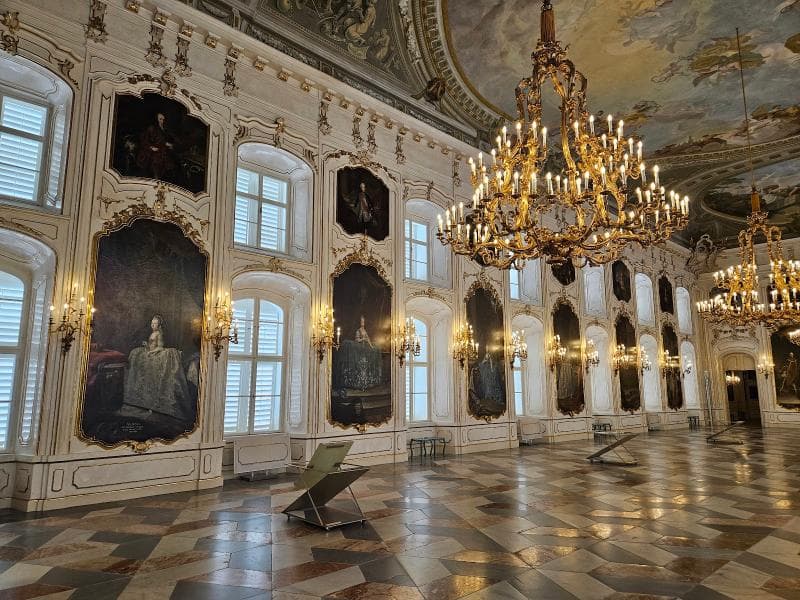
Discover the opulent Giant's Hall in Hofburg Innsbruck, Austria, a magnificent Rococo ballroom with deep Habsburg history and stunning frescoes.
Overview
Stepping into the Giant's Hall, or 'Riesensaal', within the historic Hofburg Innsbruck is like journeying back to the grandeur of the Habsburg Empire. This magnificent space is celebrated as the largest and most visually stunning area of the Imperial Palace, epitomizing the opulence of the Austrian monarchy. Adorned with breathtaking frescoes, shimmering chandeliers, and intricate Rococo embellishments, the hall serves as a testament to centuries of imperial power and artistic flair. Today, it remains Innsbruck's most dignified festive and ceremonial hall, frequently hosting elegant receptions, gala dinners, and concerts, echoing its original purpose as a venue for lavish imperial banquets.
The Giant's Hall is an integral part of the Imperial Apartments within Hofburg Innsbruck, which itself is recognized as one of Austria's three most significant cultural buildings, alongside the Hofburg Palace and Schönbrunn Palace in Vienna. Its commanding presence and rich history make it a cornerstone of any visit to the imperial complex in the heart of Tyrol.
History & Cultural Background
The Hofburg Innsbruck's story traces back to the 14th century, initially built as a medieval castle by the Counts of Görz-Tyrol. Over generations, it evolved significantly. Emperor Maximilian I, in the late 15th century, expanded the palace in the late Gothic style, moving the imperial apartments and banquet hall to what is now the second floor – the very location of the Giant's Hall.
However, the hall's current splendor is largely attributed to Empress Maria Theresa, who orchestrated an extensive Baroque renovation of the Hofburg between 1754 and 1776. A pivotal moment occurred in 1765 during the wedding celebrations of her son, Leopold II, to Maria Luisa of Spain, when her beloved husband, Emperor Francis I, suddenly passed away in the palace. Deeply affected, Maria Theresa transformed the Hofburg into a memorial, commissioning the master of Austrian Rococo, Franz Anton Maulbertsch, to create the spectacular ceiling fresco in the Giant's Hall between 1775 and 1776. This artistic endeavor replaced earlier frescoes depicting Hercules, which originally lent the hall its name.
What Makes It Special
What truly sets the Giant's Hall apart is its deeply personal and symbolic transformation under Maria Theresa. The hall's original name stemmed from Hercules frescoes, but Maria Theresa redefined its iconography. She chose to adorn the vast ceiling with a grand fresco by Maulbertsch and the walls with oversized portraits of herself, her husband, and their numerous children and grandchildren. This display wasn't merely decorative; it was a powerful statement, a 'dynasty billboard' proclaiming the enduring strength and future of the Habsburg-Lorraine line.
A poignant detail among these family portraits is the depiction of children who had passed away in infancy, subtly placed in the clouds. This sensitive inclusion transforms the celebratory space into a commemorative one, adding layers of emotional depth. The hall's Rococo style, characterized by its elegant white and gold palette, further accentuates its magnificent scale, which could accommodate over 170 guests during imperial banquets. For today's visitors, a thoughtful touch includes strategically placed mirrors, allowing for comfortable viewing of the breathtaking ceiling artwork without straining one's neck.
Stories, Fun Facts & Local Details
The Giant's Hall holds more than just beauty; it's steeped in compelling narratives. The very impetus for its Rococo transformation was a personal tragedy for Maria Theresa. The sudden death of her husband, Emperor Francis I, during their son's wedding festivities in Innsbruck cemented the Hofburg's role as a memorial site for the Empress. This personal grief dramatically shaped the palace's subsequent artistic direction, including the themes within the Giant's Hall.
It's interesting to note that the name 'Giant's Hall' predates its current décor. It refers not to its impressive size, but to the earlier frescoes of Hercules that once adorned its walls, a testament to the layers of history within these imperial spaces. Maria Theresa, a monarch known for her shrewdness, leveraged the hall as a powerful propaganda tool. By prominently displaying her prolific family, she showcased the stability and continuity of the Habsburg-Lorraine dynasty at a time when its future had once seemed uncertain.
Visitor Perspective
For those eager to experience the grandeur of the Giant's Hall, it forms a highlight of the Imperial Apartments tour within Hofburg Innsbruck. As you wander through this historic space, you'll feel the echoes of imperial banquets and significant historical events that unfolded here. The palace is generally open daily from 9:00 AM to 5:00 PM, with the last admission at 4:30 PM, allowing ample time to explore. While photography inside the Hofburg's imperial rooms is typically not permitted, the visual splendor of the Giant's Hall is designed to leave a lasting impression.
Admission to the Imperial Apartments, including the Giant's Hall, usually requires a ticket, though many visitors opt for the Innsbruck Card, which often grants free entry to the Hofburg and other city attractions. The palace is conveniently located at Rennweg 1, making it easily accessible in the heart of Innsbruck, close to other famous landmarks like the Golden Roof and the Hofkirche.
Coordinates: 11.3949, 47.26886
View on Google Maps💬 How Travelers Describe This Place
Based on community votes
Beautiful
476Unique
465Interesting
276Must See
128Photogenic
126
Traveler Stories
Discover memorable experiences shared by travelers who have visited this place.
No traveler stories yet.
Be the first traveler to share what made this place memorable.

Tour
By
Spot
Discover amazing places around the world. Your journey starts here.
Explore
© 2026 TourBySpot. All rights reserved.