Giacometti Windows
Zurich, Switzerland
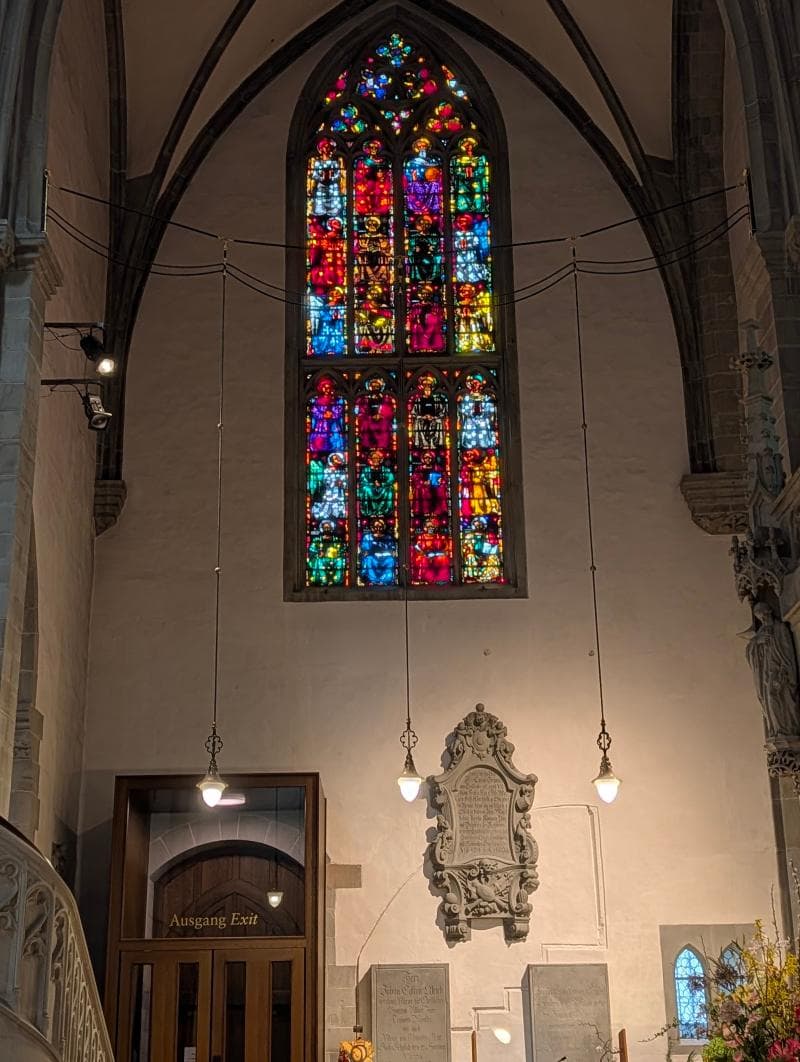
Discover the vibrant Giacometti Windows by Augusto Giacometti inside Fraumünster Church in Zurich, Switzerland. Explore its unique artistry and history.
Overview
Nestled within the historic Fraumünster Church in Zurich, Switzerland, the Giacometti Windows offer a profound artistic and spiritual experience. While many visitors are drawn to the renowned Marc Chagall windows, it is the magnificent stained-glass creation by Augusto Giacometti in the church's north transept that commands attention for its vibrant colors and unique style. This single, large, nine-meter-tall window, often referred to as 'Heavenly Paradise' and dating from 1945, presents a striking contrast and complement to the other masterpieces within this ancient abbey.
The Fraumünster Church itself stands as a landmark on the Limmat River, its elegant green spire a familiar sight in Zurich's skyline. As a former Benedictine convent with a rich past, the church serves not only as a place of worship but also as a significant cultural treasury, blending centuries of history with remarkable modern art. The Giacometti Window is an integral part of this blend, offering a moment of quiet contemplation and visual splendor to any curious traveler.
History & Cultural Background
The Fraumünster's story began in 853 AD when King Louis the German founded a Benedictine convent for aristocratic women, including his daughter Hildegard, establishing its crucial role in Zurich's early political and religious life. For centuries, the abbesses held considerable power, even having the right to mint coins and collect tolls, making them effective rulers of the city. This powerful institution shaped Zurich's medieval development until the Reformation in the 16th century brought an end to the convent's religious function.
Centuries later, in the mid-20th century, the church embarked on an artistic revitalization. While Marc Chagall's celebrated five-part window cycle in the choir was installed between 1970 and 1978, Augusto Giacometti's monumental window actually predates them. Augusto Giacometti, the uncle of the more widely known sculptor Alberto Giacometti, created his 'Heavenly Paradise' window in the north transept in 1945. This addition marked a significant moment in the church's continuous artistic evolution, bridging its ancient spiritual heritage with a bold, modern artistic expression.
What Makes It Special
Augusto Giacometti's 'Heavenly Paradise' window is distinguished by its radiant use of color and abstract yet evocative forms. Standing at nine meters tall, it depicts a celestial vision with a distinct palette of deep blues, greens, and vibrant reds, differing notably from Chagall's narrative biblical scenes. Instead of telling a linear story, Giacometti's work is a symphony of light and color, creating an immersive, almost otherworldly atmosphere within the church.
Unlike his nephew Alberto, known for his elongated, gaunt sculptures, Augusto Giacometti was a pioneer of abstract painting and a master of color. His stained-glass work in Fraumünster showcases his unique artistic fingerprint, a departure from traditional figurative religious art. This window is not merely a decorative element; it is an experience, transforming sunlight into a cascade of brilliant hues that wash over the ancient stone, inviting viewers into a meditative state. Its placement in the north transept allows it to catch the afternoon light, offering a different visual experience compared to the Chagall windows.
Stories, Fun Facts & Local Details
A common point of confusion for visitors is distinguishing between Augusto Giacometti, the artist behind this window, and his more famous nephew, Alberto Giacometti. While both are celebrated Swiss artists, it was Augusto who left his luminous mark on the Fraumünster. This family connection adds a fascinating layer to the church's artistic legacy, highlighting a different facet of the esteemed Giacometti artistic lineage.
Another intriguing detail is how the light interacts with the window throughout the day. While Chagall's windows are often best appreciated in morning light, Augusto Giacometti's window in the north transept truly comes alive in the afternoon, when the sun's rays stream through, intensifying its colors and patterns. This dynamic interplay of light and art means that each visit can offer a subtly different visual spectacle. The sheer scale of the window, reaching nine meters high, also means that one must step back to fully appreciate its grandeur and the intricate flow of its design.
Visitor Perspective
Visiting the Giacometti Window in Fraumünster Church is an unmissable part of exploring Zurich's cultural heart. Upon entering, travelers are encouraged to allow ample time to absorb the beauty and historical significance of this sacred space. The church maintains a respectful atmosphere, and while photography without flash is generally permitted, quiet contemplation is encouraged.
An audio guide, often included with admission, provides invaluable insights into the history of the church and the artistry of its stained-glass windows, including Giacometti's. To truly witness the full splendor of the Giacometti Window, consider visiting in the afternoon when the light conditions are ideal for illuminating its vibrant colors. Observing how the light transforms the interior space offers a deeply moving and aesthetically rich experience, connecting visitors with centuries of history and enduring artistic brilliance.
Coordinates: 8.543690883324498, 47.37344809558439
View on Google Maps💬 How Travelers Describe This Place
Based on community votes
Interesting
443Must See
414Unique
310Beautiful
277Photogenic
233
Traveler Stories
Discover memorable experiences shared by travelers who have visited this place.
No traveler stories yet.
Be the first traveler to share what made this place memorable.

Tour
By
Spot
Discover amazing places around the world. Your journey starts here.
Explore
© 2026 TourBySpot. All rights reserved.