German Church
Stockholm, Sweden
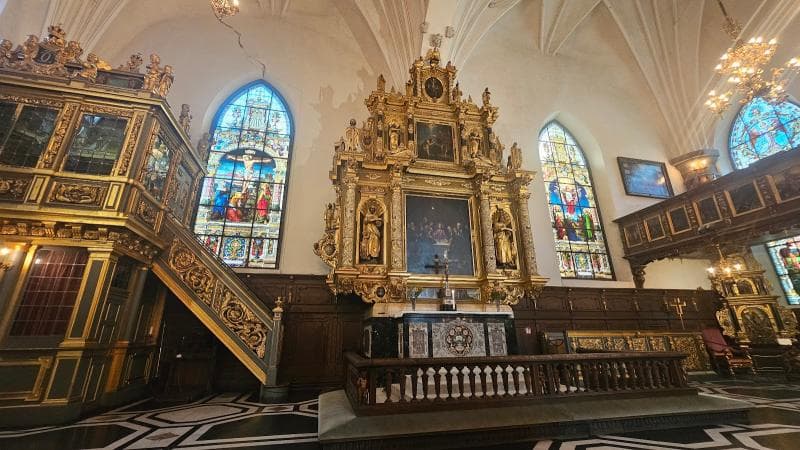
Explore the historic German Church (Tyska kyrkan) in Gamla Stan, Stockholm, Sweden. Discover its Baroque interior, 96-meter spire, and rich merchant history.
Overview
Nestled amidst the charming cobblestone alleys of Gamla Stan, Stockholm's Old Town, stands the magnificent German Church, officially known as St. Gertrude's Church (Sankta Gertruds kyrka or Tyska kyrkan). This prominent landmark, with its soaring spire, serves as a testament to Stockholm's rich multicultural history and the significant influence of its German merchant community. It is not merely a historical building but an active Lutheran parish that continues to serve Stockholm's German-speaking congregation. The church's architecture beautifully blends Baroque interiors with a striking Neo-Gothic spire, creating a distinctive silhouette against the city's skyline.
History & Cultural Background
The origins of the German Church trace back to the 14th century, rooted in the St. Gertrude's Guild, an association formed by the thriving German merchant community in Stockholm. These merchants played a crucial role in Baltic trade and had a profound impact on the city's development. It was in 1571 that King John III granted German expatriates the privilege to form their own separate parish, marking a significant moment for the community. Initially, the church building itself evolved from the guild's headquarters, with construction phases beginning in the 1580s. The present structure largely took shape between 1638 and 1642 under the guidance of Hans Jacob Kristler, an architect from Strasbourg. The German Church quickly became a vital center for religious life and cultural exchange, reflecting the strong Hanseatic heritage that shaped much of medieval Stockholm.
What Makes It Special
The German Church is a masterpiece of architectural fusion and elaborate craftsmanship. Its most striking feature is its impressive 96-meter (315 ft) tall spire, which is the tallest point in Gamla Stan and a recognizable landmark across the city. The current Neo-Gothic spire was completed in 1878 after a devastating fire destroyed the earlier one, and it was designed by Berlin architect Julius Carl Raschdorff. The exterior also features unique Neo-Gothic gargoyles, an unusual sight in Swedish architecture. Inside, visitors are greeted by a richly decorated Baroque interior, featuring elaborate woodcarvings, vibrant stained-glass windows, and a beautifully crafted organ. A prominent ten-meter Baroque altar and an impressive pulpit made of alabaster and ebony from 1660 are central to the sanctuary. Another highlight is the 'King's Gallery' (Kungaläktaren), designed by the renowned architect Nicodemus Tessin the Elder for Queen Hedvig Eleonora, adorned with opulent Renaissance and Baroque details.
Stories, Fun Facts & Local Details
The German Church is steeped in fascinating stories and unique details. Perched atop its towering spire is a copper rooster weather vane. Remarkably, this original brass rooster survived the destructive fire of 1878 that engulfed the church's first tower. Against all odds, it was later restored and now stands inside the church entrance, symbolizing resilience and enduring faith. Look closely at the southern portal, and you'll find sandstone statues of Jesus and Moses, flanked by figures representing Love, Hope, and Faith, meticulously crafted in the 1640s. Beneath the marble floor of the church, remnants of the original 14th-century guild building's wine cellars are still preserved, a tangible link to its merchant past. St. Gertrude, the church's namesake, is traditionally known as the patron saint of travelers, fitting for a church founded by a community of merchants. For centuries, the church's carillon has filled the air of the Old Town with daily psalms, a tradition that continues to this day.
Visitor Perspective
The German Church welcomes curious travelers and those seeking a moment of reflection. Entry to the main church is generally free, though voluntary donations are encouraged to support its upkeep. It is typically open daily during the summer months with slightly reduced hours in winter, and it's always advisable to check the current opening times before planning your visit. For a small fee, visitors can climb the tower, which offers unparalleled panoramic views over the terracotta rooftops of Gamla Stan and beyond. As an active parish, German-language services are held every Sunday at 11 am. The church also frequently hosts classical concerts and cultural events, making it a vibrant hub within Stockholm's historic heart.
Coordinates: 18.071667, 59.324167
View on Google Maps💬 How Travelers Describe This Place
Based on community votes
Unique
921Photogenic
831Must See
357Interesting
232Beautiful
147
Traveler Stories
Discover memorable experiences shared by travelers who have visited this place.
No traveler stories yet.
Be the first traveler to share what made this place memorable.

Tour
By
Spot
Discover amazing places around the world. Your journey starts here.
Explore
© 2026 TourBySpot. All rights reserved.