Galileo’s Tomb
Florence, Italy
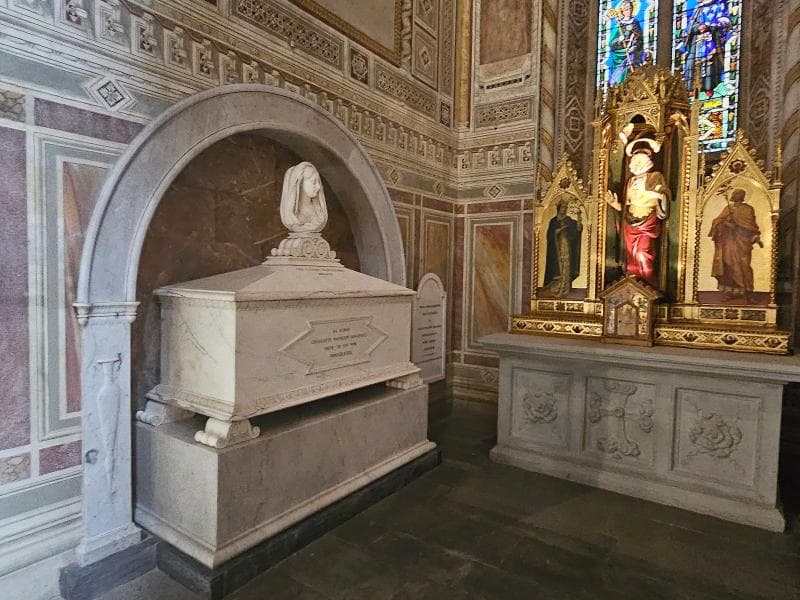
Explore Galileo's Tomb in Florence, Italy, located within the Basilica of Santa Croce. Discover his history, remarkable monument, and fascinating stories.
Overview
Deep within the revered Basilica of Santa Croce in Florence, Italy, often celebrated as the 'Temple of Italian Glories,' lies the monumental tomb of Galileo Galilei, one of history's most influential scientists. This grand marble memorial pays tribute to the father of modern science, whose revolutionary astronomical observations fundamentally reshaped our understanding of the cosmos. It stands as a powerful symbol of human intellect and perseverance, drawing visitors to contemplate the enduring legacy of a man who dared to challenge the prevailing wisdom of his time.
The tomb itself is a masterpiece of Baroque funerary art, rich with symbolism reflecting Galileo's groundbreaking discoveries. It is a focal point within the basilica, offering a poignant narrative of scientific advancement, religious conflict, and eventual recognition that unfolded over centuries. For those exploring Florence, a visit to Galileo's Tomb provides a unique opportunity to connect with a pivotal moment in intellectual history, surrounded by the artistic and historical splendor of Santa Croce.
History & Cultural Background
Galileo Galilei died in 1642, famously under house arrest after being condemned by the Church for his staunch support of the heliocentric model of the universe, which placed the Sun, not the Earth, at the center of the solar system. This controversial stance led to accusations of heresy, and consequently, he was initially denied burial in consecrated ground within the Basilica of Santa Croce, despite his family owning a burial vault there.
Following his death, Galileo was initially interred in a small, inconspicuous room near the Novitiate Chapel within the basilica, a testament to the Church's opposition to his ideas. It was almost a century later, in 1737, that circumstances finally allowed for a proper tribute. Galileo's devoted pupil, Vincenzo Viviani, passionately advocated for a suitable monument and even allocated funds in his will for its creation.
The political climate shifted under Grand Duke Gian Gastone de' Medici, who pursued policies aimed at modernizing the state and curbing the Church's power. His intervention paved the way for the construction of the elaborate monumental tomb, designed by Giovanni Battista Foggini. Galileo's remains were then ceremoniously moved to their current prominent location in the north aisle of Santa Croce, directly opposite the tomb of another Florentine giant, Michelangelo, marking a significant re-evaluation of his historical importance.
What Makes It Special
Galileo's Tomb is an exceptional piece of Baroque design, completed in 1737 by Giovanni Battista Foggini. The monument features a central bust of Galileo, sculpted by Foggini, depicting him looking towards the heavens, telescope in hand – a poignant symbol of his astronomical observations.
Flanking the sarcophagus are two allegorical statues that celebrate his intellectual contributions. To the left stands Astronomy, carved by Vincenzo Foggini, holding a parchment that illustrates the sunspots Galileo discovered. On the right, Geometry, by Girolamo Ticciati, displays a plank demonstrating the principles of falling bodies, a key area of Galileo's physics research.
Above the bust, a crest subtly incorporates an image of Jupiter and its moons, known as the 'Medici planets,' a direct nod to one of Galileo's most significant discoveries and his patrons. Below, a Latin inscription, composed by Simone di Bindo Peruzzi, declares 'Tanto Nomini Nullum Par Elogium' – meaning 'no praise is sufficient for such a great name,' encapsulating the profound respect and admiration that eventually came to define his legacy. The tomb's prominent position, directly across from Michelangelo's, signifies Galileo's elevated status among Florence's most treasured sons.
Stories, Fun Facts & Local Details
The journey of Galileo's remains to their final resting place is steeped in fascinating details. When his body was finally exhumed in 1737 for reburial in the grand new monument, workers made a curious discovery. Alongside Galileo's remains, another body was found, believed by many to be that of his beloved daughter, Suor Maria Celeste, who had passed away earlier. His loyal student, Vincenzo Viviani, is also interred within the tomb, fulfilling his wish to be buried near his master.
During this exhumation, some of Galileo's devoted admirers took extraordinary 'keepsakes' – specifically, three fingers, a tooth, and a vertebra. These relics are now preserved and displayed at the Museo Galileo in Florence and the University of Padua, offering a tangible, if unusual, connection to the great scientist.
Another captivating local belief, often shared by guides, suggests that the placement of Galileo's tomb directly opposite Michelangelo's is not merely coincidental. According to this charming lore, it was believed that Michelangelo's spirit 'leapt' into Galileo's body, given that Galileo was born shortly after Michelangelo's death, symbolically passing the torch of Florentine genius. It wasn't until 1992 that the Catholic Church officially acknowledged the errors made in Galileo's condemnation, marking a modern reconciliation with his scientific truths.
Visitor Perspective
Visiting Galileo's Tomb within the Basilica of Santa Croce is a profound experience for any traveler interested in history, science, or art. As you step into this magnificent Franciscan church, you are immediately enveloped by centuries of Italian heritage. Santa Croce is famously the burial place of many other eminent Italians, including Michelangelo, Machiavelli, and Rossini, earning its moniker as the 'Pantheon of Florence' or 'Temple of Italian Glories.'
Galileo's monumental tomb is situated prominently in the north aisle, making it relatively easy to locate. Standing before it, one can't help but reflect on the powerful narrative it embodies: the struggle between scientific discovery and dogmatic belief, and the eventual triumph of intellectual freedom. The intricate details of the monument, from the allegorical statues to the celestial motifs, invite contemplation on Galileo's immense contributions to human knowledge and the courage it took to pursue truth in the face of adversity.
To deepen your understanding, consider visiting the nearby Museo Galileo, which houses many of his original instruments and offers further insights into his revolutionary work. Sometimes, a ticket to Santa Croce may even offer a discount for entry to the museum. This combined experience provides a comprehensive journey through the life and legacy of one of history's most pivotal figures, making for a truly enriching visit to Florence.
Coordinates: 11.262085, 43.768514
View on Google Maps💬 How Travelers Describe This Place
Based on community votes
Beautiful
951Unique
491Must See
427Interesting
414Photogenic
277
Traveler Stories
Discover memorable experiences shared by travelers who have visited this place.
No traveler stories yet.
Be the first traveler to share what made this place memorable.

Tour
By
Spot
Discover amazing places around the world. Your journey starts here.
Explore
© 2026 TourBySpot. All rights reserved.