Dominican Monastery
Dubrovnik, Croatia
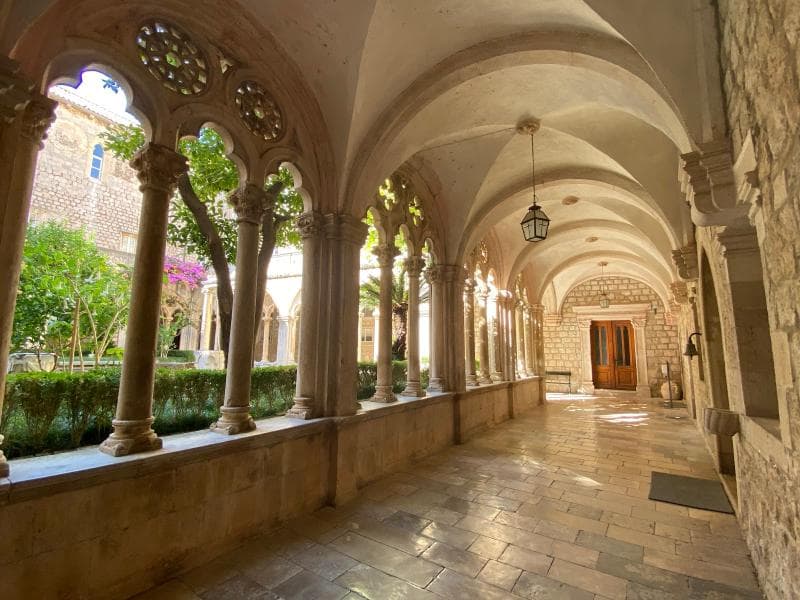
Explore Dubrovnik's Dominican Monastery, a 14th-century architectural gem and art treasury within the Old Town walls. Discover Gothic cloisters, priceless art, and compelling history in Croatia.
Overview
The Dominican Monastery, nestled within the historic embrace of Dubrovnik Old Town, stands as a testament to centuries of spiritual devotion, architectural evolution, and strategic importance. Situated near the Ploče Gate, where it seamlessly integrates with the city's formidable walls, this venerable complex is not merely a religious site but a significant architectural and cultural landmark. Its construction, initiated as early as 1225 with major building phases continuing into the 14th century, saw it grow into a harmonious blend of predominantly Gothic and early Renaissance styles, subtly accented by Romanesque and Baroque influences. Visitors approach this impressive structure via a grand stone stairway, setting the stage for the rich history and artistry held within its robust walls.
History & Cultural Background
The journey of the Dominican Monastery began with the establishment of the Dominican order in Dubrovnik around 1225, culminating in the formal founding of the friary in 1315. Its development was a collaborative effort, supported by both local government and skilled craftsmen from various regions. Critically, the monastery's location was chosen for its strategic military value. Unlike the Franciscan monastery, the Dominican complex was ingeniously integrated into Dubrovnik's defensive system, bolstering the vulnerable northeastern section of the city walls. This defensive posture reflected the Republic of Ragusa's astute concerns over political instability and the perpetual need for protection, particularly against its powerful trading rival, Venice.
Over the centuries, the monastery proved resilient, largely surviving the devastating 1667 earthquake, though it subsequently underwent extensive renovations to restore its grandeur. Beyond its defensive and religious functions, the monastery played a pivotal role in the cultural and intellectual life of Dubrovnik, serving as an important center for philosophy and theology from the late 14th century. A curious chapter in its long history saw the monastery repurposed as stables during Napoleon's occupation in 1806, a temporary disruption before it reclaimed its sacred and scholarly identity.
What Makes It Special
What truly sets the Dominican Monastery apart is its magnificent architectural synthesis and its invaluable artistic treasures. It proudly ranks among the largest Gothic buildings along the eastern Adriatic coast, yet its diverse elements—from Romanesque portals to Renaissance additions—converge into a singularly harmonious unit. The church itself, designed in a simple yet commanding Gothic style, features a distinctive pentagonal apse. The southern portal, initially bearing Romanesque characteristics, was enhanced in 1419 by Bonino of Milan with a striking pointed Gothic arch. Inside, the church's elaborately decorated interior houses a grand pulpit and numerous gravestones of notable Dubrovnik families.
However, the heart of the complex's appeal lies in its late-Gothic cloister, built between 1456 and 1483. Designed by the Florentine architect Maso di Bartolomeo, its graceful triple arches enclose a tranquil Mediterranean garden, offering a serene escape. In the center of this verdant courtyard stands an ornate 14th-century stone well, which continues to provide water. The monastery also boasts a remarkable museum, a true treasury of cultural heritage. Here, visitors can admire a rich collection of paintings from the celebrated Dubrovnik painting school, featuring masters like Nikola Božidarević, Lovro Dobričević, and Mihajlo Hamzić. The museum's collection extends to precious artifacts, exquisite jewelry, and an extraordinary library housing over 220 incunabulas and numerous illuminated manuscripts. A highlight is the immense 14th-century golden Gothic crucifix by Paolo Veneziano, towering at five meters and considered one of the largest in Europe. Another significant artwork is a restored painting of Saint Blaise, Mary Magdalene, and the angel Rafael, attributed to Titian's circle.
Stories, Fun Facts & Local Details
The Dominican Monastery holds several captivating stories and unique details that bring its history to life. One such tale involves the impressive stone stairway leading to the monastery's entrance. Legend has it that the monks deliberately designed the balustrade with unevenly mortared columns to deter men who would loiter, hoping to catch a glimpse of women's ankles as they ascended the steps. This small, human detail offers a glimpse into the social mores and playful ingenuity of the past.
During the harrowing Siege of Dubrovnik in 1991, the ancient well in the cloister courtyard became an unexpected beacon of survival, providing essential fresh water for an estimated fifty percent of the besieged city's population. This highlights the monastery's enduring utility and its deep connection to the daily lives of Dubrovnik's residents, far beyond its spiritual role. Another fascinating aspect is the subtle artistry of the cloister's capitals, which, upon closer inspection, reveal intricate variations of leaves, masks, and other carved details, preventing a sense of strict uniformity and adding a touch of personalized craftsmanship. The monastery's seemingly stern exterior, designed to blend with the city's formidable defenses, belies the peaceful, sun-drenched sanctuary within its walls.
Visitor Perspective
For the curious traveler, the Dominican Monastery offers a deeply enriching experience, providing a welcome respite from the bustling streets of Dubrovnik Old Town. Stepping through its Gothic doorway, one is immediately enveloped in an atmosphere of tranquility and historical depth. The monastery serves as a peaceful haven, allowing visitors to wander through the serene Gothic cloister, admire the meticulously preserved architecture, and explore the extensive museum collection at their own pace. It is an ideal destination for those seeking a quiet moment of contemplation or a deeper understanding of Dubrovnik's spiritual, artistic, and historical legacy. Located conveniently behind Sponza Palace and easily accessible on foot, the monastery invites visitors to uncover its secrets, making it a must-see for anyone wishing to connect with the authentic soul of this remarkable city. While there is an admission fee, the journey through its hallowed halls and sunlit courtyard offers an invaluable glimpse into a bygone era.
Coordinates: 18.111147, 42.641735
View on Google Maps💬 How Travelers Describe This Place
Based on community votes
Photogenic
981Interesting
795Unique
753Beautiful
172Must See
79
Traveler Stories
Discover memorable experiences shared by travelers who have visited this place.
No traveler stories yet.
Be the first traveler to share what made this place memorable.

Tour
By
Spot
Discover amazing places around the world. Your journey starts here.
Explore
© 2026 TourBySpot. All rights reserved.