Defensive Walls
Split, Croatia
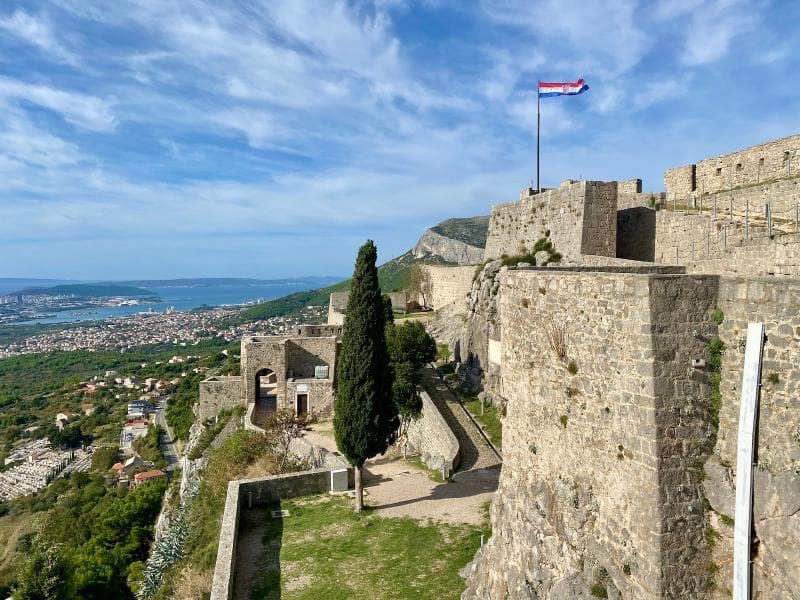
Explore the formidable Defensive Walls of Klis Fortress in Split, Croatia, a historic stronghold with over 2000 years of layered history and stunning views.
Overview
Perched dramatically on a formidable limestone ridge between the Kozjak and Mosor mountains, the Defensive Walls of Klis Fortress stand as a powerful testament to over two millennia of history in Split, Croatia. This strategic stronghold, often referred to as 'the key to Dalmatia', has continuously guarded the crucial mountain pass connecting the Adriatic coast with the inland highlands. The walls themselves are not a single structure but a complex, layered system, reflecting the myriad cultures and empires that have shaped its formidable defenses, from ancient Illyrians to medieval Croatian kings, Ottomans, Venetians, and Austrians.
Visitors to Klis Fortress today are immediately struck by its commanding position and the intricate network of defensive walls that blend almost seamlessly with the natural rock formations. This architectural marvel, inaccessible on three sides due to sheer cliffs, embodies a rich history of military engineering and strategic brilliance.
History & Cultural Background
The origins of the defensive walls at Klis trace back to the 2nd century BC, when the ancient Illyrian Dalmatae tribe first fortified this commanding site. The Romans later recognized its strategic value, establishing a fort known as 'Clausura', which evolved into the modern name 'Klis'.
During the 9th to 11th centuries, Klis rose to prominence as a royal castle and the seat of many Croatian dukes and kings, including Duke Mislav and Duke Trpimir I, who expanded its fortifications. The fortress became a symbol of Croatian statehood, with important historical documents, like the Trpimir Charter of 852, issued from its walls.
Its most legendary period, however, unfolded during the 16th century when it served as a critical frontier defense against the encroaching Ottoman Empire. For over two decades, Captain Petar Kružić and his Uskoks, a group of Christian guerrilla fighters, valiantly defended Klis against numerous Ottoman sieges, earning a legendary status throughout Christian Europe. The fortress eventually fell in 1537 after Kružić's death, remaining under Ottoman rule for over a century before being recaptured by the Venetian Republic in 1648. Subsequent Venetian and Austrian rulers continued to adapt and enhance the defensive structures, resulting in the multi-layered appearance we see today.
What Makes It Special
What truly sets the Defensive Walls of Klis Fortress apart is their sophisticated, layered design, which evolved over centuries to counter changing siege tactics. The fortress is essentially composed of three main defensive sections, each enclosed by walls and accessible through separate entrances, all integrated into the natural topography of the ridge.
The first defensive line, located on the far west, features the main entrance, an impressive semi-circular gateway built by the Austrians in the early 19th century. Near this, the 'Position Avanzato', first mentioned in 1648, was a crucial outwork designed to protect the initial gates against artillery.
Moving eastward, the second defensive line encompasses the central part of the fortress, characterized by ramparts and bastions. The final and most elevated third defensive line crowns the eastern part of the cliff, built upon the foundations of earlier Illyrian and Roman fortifications. This area, with its commanding views, served as the ultimate stronghold. Important bastions like Bembo and Malipiero, particularly the latter's pentagonal shape with wide cannon openings, highlight the adaptation to gunpowder warfare. The ingenious incorporation of seven rainwater cisterns within the walls demonstrates self-sufficiency during prolonged sieges.
Stories, Fun Facts & Local Details
The story of Petar Kružić and the Uskoks is deeply ingrained in Croatian folklore, a tale of extraordinary bravery against overwhelming odds. Their twenty-five-year defense of Klis transformed the fortress into a symbol of resistance and heroism.
An interesting cultural detail is the building within the third defensive ring that served as a mosque during the Ottoman occupation. After the Venetians regained control, it was converted into a Catholic church dedicated to Saint Vitus, symbolizing the region's shifting religious and political landscape.
In more recent times, Klis Fortress has gained international recognition as a filming location for the popular television series 'Game of Thrones', where it depicted the city of Meereen. This exposure has brought new waves of visitors eager to see the real-life setting of a fictional world.
Visitor Perspective
Exploring the Defensive Walls of Klis Fortress offers a truly immersive historical experience. As you ascend through the various defensive layers, the panoramic views become increasingly breathtaking, encompassing the city of Split, the ancient Roman ruins of Salona, and the scattered islands of the Adriatic Sea.
The pathways, though restored, retain their ancient character with uneven stone surfaces and steps, requiring comfortable footwear. Visitors can spend between 1.5 to 2 hours wandering through the gates, towers, and bastions, envisioning the countless struggles and triumphs these walls have witnessed. The sheer scale and strategic positioning of the walls provide a profound sense of the fortress's historical importance and the ingenuity of its builders.
Coordinates: 16.523, 43.5605
View on Google Maps💬 How Travelers Describe This Place
Based on community votes
Interesting
948Photogenic
913Beautiful
595Must See
358Unique
196
Traveler Stories
Discover memorable experiences shared by travelers who have visited this place.
No traveler stories yet.
Be the first traveler to share what made this place memorable.

Tour
By
Spot
Discover amazing places around the world. Your journey starts here.
Explore
© 2026 TourBySpot. All rights reserved.