Deesis Mosaic
Istanbul, Turkey
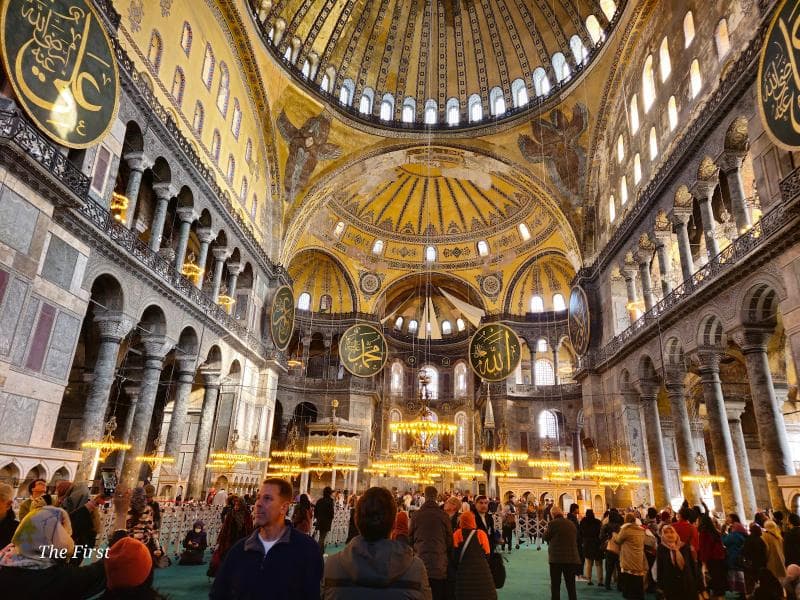
Discover the Deesis Mosaic, a 13th-century Byzantine masterpiece in Hagia Sophia, Istanbul, Turkey. Experience its stunning naturalism and spiritual depth.
Overview
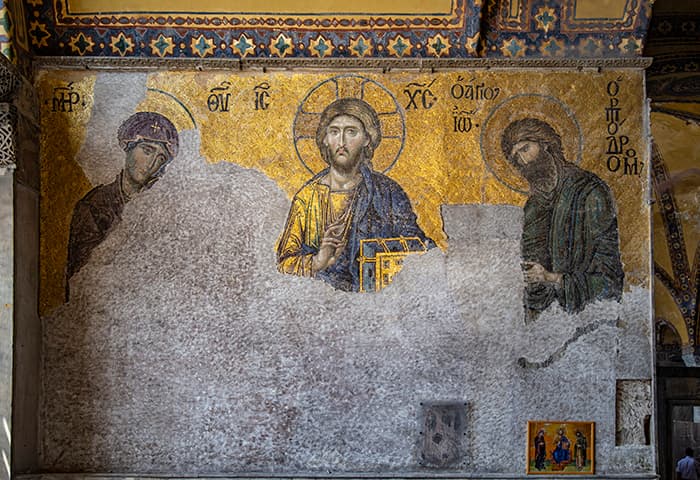
Nestled within the grandeur of the Hagia Sophia in Istanbul, Turkey, the Deesis Mosaic stands as a profound testament to Byzantine artistry and spiritual depth. Located in the upper south gallery of this historic edifice, it is widely considered one of the finest examples of late Byzantine mosaic work. The mosaic powerfully depicts Jesus Christ Pantocrator, or 'Ruler of All', at its center. He is flanked by the Virgin Mary on his right and John the Baptist on his left, both shown in attitudes of deep supplication. The name 'Deesis' itself comes from the Greek word for 'entreaty' or 'supplication', perfectly capturing the scene's emotional essence. Created in the 13th century, around 1261, this mosaic is celebrated for its striking naturalism and emotional intensity, marking a significant evolution in Byzantine art.
History & Cultural Background
The creation of the Deesis Mosaic is steeped in a pivotal moment of Byzantine history. It was crafted around 1261, a period immediately following the Byzantine Empire's recapture of Constantinople from the Latin Crusaders, who had occupied the city from 1204 to 1261. This artistic masterpiece thus symbolized more than just religious devotion; it represented a powerful declaration of the empire's rebirth and the restoration of Orthodox identity after decades of Latin rule. The mosaic's thematic core revolves around the concept of intercession, a deeply held belief in Orthodox Christianity. The Virgin Mary, as the Mother of God, and John the Baptist, as the Forerunner, are portrayed appealing to Christ on behalf of humanity, imploring his mercy at the time of judgment. This profound theological message would have resonated deeply with a people recovering from foreign occupation, seeking divine solace and hope for the future. The mosaic's very existence within Hagia Sophia, a building that has transitioned from a cathedral to a mosque, then a museum, and back to a mosque, underscores its enduring historical and cultural significance.
What Makes It Special
What truly sets the Deesis Mosaic apart is its groundbreaking artistic style. It represents a significant departure from the more rigid and symbolic forms of earlier Byzantine art, showcasing an unprecedented level of naturalism and emotional depth. The faces of Christ, Mary, and John the Baptist are rendered with remarkable realism, featuring subtle shading and complex expressions that convey profound human emotion, such as the Virgin's sorrowful gaze or Christ's compassionate authority. This artistic advancement is often associated with the Palaeologan Renaissance, a period of cultural revival in the late Byzantine Empire, with the Deesis Mosaic frequently cited as its pinnacle. The technical mastery involved is equally impressive; Byzantine mosaicists used exceptionally small tesserae, some as tiny as 1-2 mm, particularly for the delicate features of faces and hands. These minute pieces of colored glass and stone were meticulously angled to catch and reflect the natural light from nearby windows, creating a shimmering, three-dimensional effect that imbued the figures with a sense of life and movement. The monumental scale of the figures, approximately two and a half times larger than life, further amplifies its powerful visual impact.
Stories, Fun Facts & Local Details
The Deesis Mosaic holds several intriguing details that enhance its allure. Unfortunately, the lower half of this magnificent mosaic has been lost to time and past damages, likely due to water or deterioration over centuries. However, the surviving upper portions, especially the exquisitely detailed faces, remain incredibly impactful. The deliberate angling of the tesserae by the Byzantine artists was not merely for aesthetic appeal; it was a sophisticated technique designed to manipulate light, creating a dynamic visual experience that changes with the viewer's position and the time of day. In the mosaic, the Virgin Mary is traditionally placed on Christ's right, signifying her esteemed position as the Theotokos, or Mother of God. John the Baptist, known as 'the Forerunner' (Prodromos) in Orthodox tradition, completes this powerful triad. Scholars often interpret the scene as a representation of the 'heavenly court', where Mary and John act as celestial courtiers, pleading with the divine judge on behalf of all humanity. Furthermore, the mosaic's preservation for centuries under layers of plaster, applied when Hagia Sophia functioned as a mosque, is often considered a fortunate accident of history, shielding it from destruction and decay.
Visitor Perspective
For those visiting Hagia Sophia, finding the Deesis Mosaic is a rewarding experience. It is situated in the upper south gallery, meaning visitors will need to ascend to the second level of the building. Upon reaching the gallery, it is advisable to actively seek out this masterpiece, as its location in a side corridor or chamber means some visitors might inadvertently walk past it. Despite the partial loss of its lower section, the sheer beauty, emotional depth, and artistic skill evident in the surviving upper part, particularly the faces, are profoundly moving. Many describe viewing it as an awe-inspiring moment, a direct connection to the spiritual and artistic zenith of the Byzantine Empire. Fortunately, access to the mosaics in the upper gallery, including the Deesis, has generally remained open to tourists, offering an unobstructed view of this historical and artistic treasure.
Coordinates: 28.9799, 41.0085
View on Google Maps💬 How Travelers Describe This Place
Based on community votes
Must See
934Interesting
326Beautiful
279Unique
276Photogenic
270
Traveler Stories
Discover memorable experiences shared by travelers who have visited this place.
No traveler stories yet.
Be the first traveler to share what made this place memorable.

Tour
By
Spot
Discover amazing places around the world. Your journey starts here.
Explore
© 2026 TourBySpot. All rights reserved.