Croatian Parliament Exterior
Zagreb, Croatia
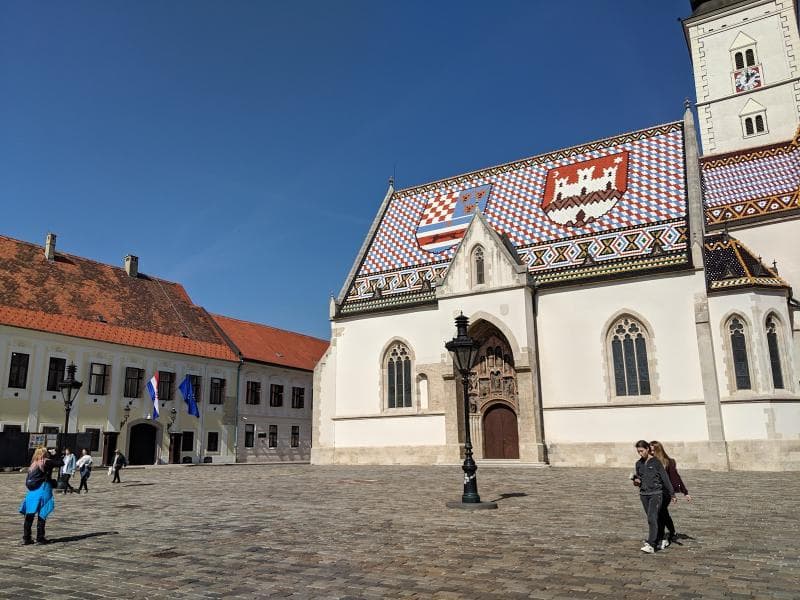
Explore the exterior of the Croatian Parliament building (Sabor Palace) in Zagreb, Croatia, a historic landmark on St. Mark's Square.
Overview
Nestled in the historic Upper Town (Gornji Grad) of Zagreb, Croatia, on the picturesque St. Mark's Square, stands the Croatian Parliament building, known locally as the Sabor Palace. While many visitors are drawn to the iconic St. Mark's Church with its vibrant tiled roof, the Parliament building's exterior offers a profound glimpse into Croatia's rich political heritage. It's important to note that the Parliament building is a distinct structure, located alongside, rather than inside, St. Mark's Church, both being central features of the historic square. This imposing edifice serves as the legislative heart of the Republic of Croatia, where decisions shaping the nation's destiny have been made for centuries. Its facade, a blend of architectural styles, tells a silent story of evolving governance and national identity.
History & Cultural Background
The history of the Croatian Parliament building is deeply interwoven with the narrative of Croatian statehood. Though parliamentary sessions in Zagreb can be traced back to the 13th century, a dedicated building for the assembly was not established until 1731, when a house was acquired on St. Mark's Square. This marked a pivotal moment, providing a steady venue for legislative work that had previously been conducted in various noble residences or royal courts. The first recorded session in a dedicated building on this site took place on May 6, 1737.
Over the subsequent 150 years, the building underwent numerous renovations and expansions, reflecting the changing needs and political landscape of the time. What began as a single property gradually incorporated surrounding city palaces through complex construction interventions, eventually uniting them into the single, grand palace we see today. The final significant expansion and overhaul, completed in 1911, gave the building its present-day appearance. This site has borne witness to epoch-making decisions, including the votes to sever political ties from the Austro-Hungarian Empire in 1918 and, more recently, from Yugoslavia in 1991, cementing its place as a symbol of Croatian independence and democratic will.
What Makes It Special
The exterior of the Croatian Parliament building is special not only for its historical significance but also for its architectural character. It showcases a fascinating blend of Classicism, Neo-Renaissance, and Art Nouveau (Secession) styles, a testament to its long construction and adaptation process. This architectural amalgamation creates a distinctive landmark that stands proudly on St. Mark's Square, complementing the surrounding historic buildings, including the iconic St. Mark's Church and the Government Palace. The facade, with its baroque and decorative elements, catches the eye, inviting contemplation of the power and history it represents.
Currently, the building is undergoing extensive renovation due to damage sustained in the March 2020 earthquake. This comprehensive project aims to reinforce its structure, adapt it to modern safety requirements, and restore its representative historic interiors and facade, including all decorative elements. While the renovation means the Parliament is temporarily relocated, the ongoing work highlights the commitment to preserving this crucial piece of Croatian heritage for future generations.
Stories, Fun Facts & Local Details
St. Mark's Square, where the Parliament building is located, has always been the vibrant heart of Zagreb's Upper Town, serving as a market square and later a political and cultural hub. Imagine the countless historical figures who have walked these cobblestones, from medieval dignitaries to modern-day politicians, all contributing to Croatia's rich tapestry.
A notable aspect of the Parliament's history is that prior to having a permanent home, parliamentary documents were stored in Zagreb's Cathedral. In 1764, these documents, along with the 'Chest of Privileges' – a special chest commissioned in 1643 to hold royal privileges – were transferred to the newly established Parliament House on St. Mark's Square. This detail underscores the deep respect for legal and historical continuity that characterizes Croatian governance.
Another interesting fact is that Ivan Kukuljević Sakcinski, a parliamentary deputy, was the first to use the Croatian language in formal parliamentary deliberations in 1847, calling for its replacement of the then-official Latin language. This was a significant step in asserting Croatian national identity.
Visitor Perspective
Although the Croatian Parliament building is currently closed for internal visits due to extensive renovations expected to conclude around mid-2028, its exterior remains a must-see for any curious traveler to Zagreb. The surrounding St. Mark's Square itself is a primary attraction, offering a captivating blend of history, culture, and stunning architecture. Standing in the square, you can admire the Parliament's impressive facade alongside the colorful roof of St. Mark's Church and the nearby Government building, immersing yourself in the political and cultural essence of the city.
The Upper Town, with its narrow streets, museums, and scenic viewpoints, provides a perfect backdrop for exploration. Even with the ongoing restoration, the visible efforts to preserve and renew this historic landmark speak volumes about its enduring importance. A stroll around the exterior offers a profound sense of connection to Croatia's past and present, making it an invaluable stop for understanding the nation's journey. Keep an eye on official tourism or Parliament websites for updates on when the building may reopen for public tours in the future.
Coordinates: 15.97417, 45.81611
View on Google Maps💬 How Travelers Describe This Place
Based on community votes
Unique
980Must See
963Interesting
389Photogenic
340Beautiful
201
Traveler Stories
Discover memorable experiences shared by travelers who have visited this place.
No traveler stories yet.
Be the first traveler to share what made this place memorable.

Tour
By
Spot
Discover amazing places around the world. Your journey starts here.
Explore
© 2026 TourBySpot. All rights reserved.