Corinthian Columns
Antalya, Turkey
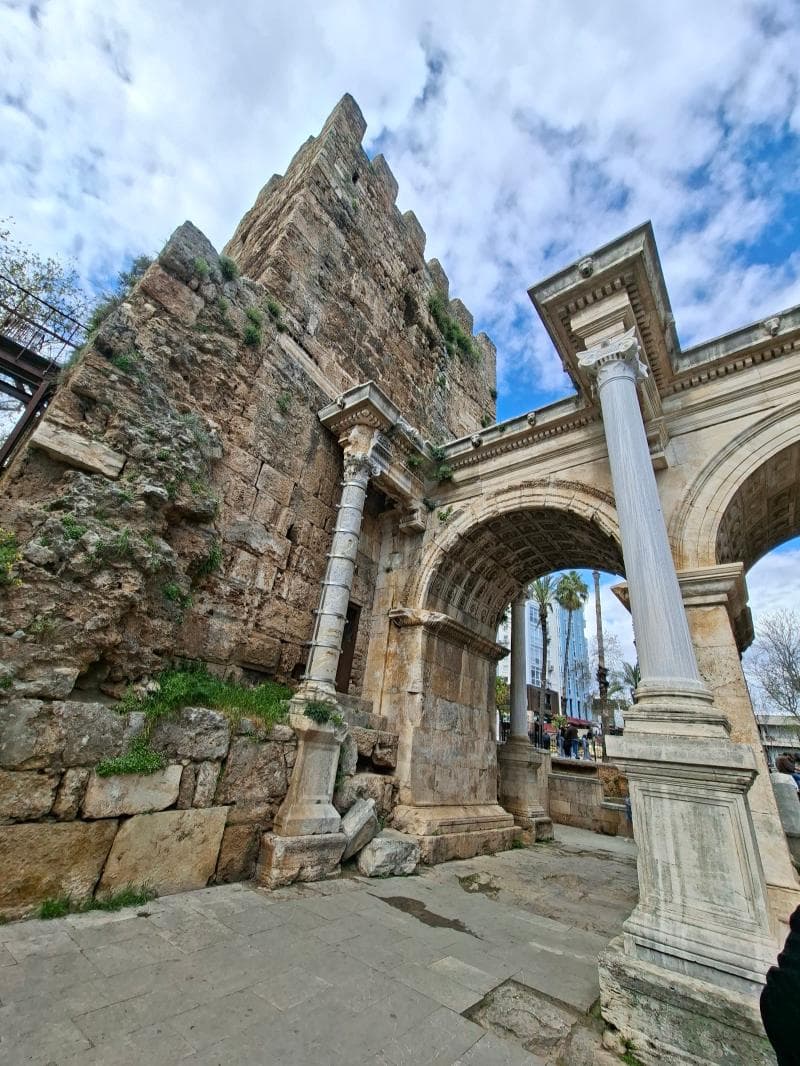

Discover the exquisite Corinthian Columns of Hadrian's Gate in Antalya, Turkey. Explore this ancient Roman triumphal arch and its rich history.
Overview
As you step into the vibrant heart of Antalya, Turkey, a majestic Roman triumphal arch stands proudly, serving as a captivating gateway to the city's historic old town, Kaleiçi. This is Hadrian's Gate, locally known as Üçkapılar, or 'The Three Gates'. Built predominantly of gleaming white marble with granite column shafts, this architectural marvel is a testament to ancient Roman craftsmanship. Its most striking features are the elegant Corinthian-style columns that flank its three identical archways, drawing the eye upwards to their intricately carved capitals and the detailed entablature above. The gate measures over eight meters in height from the ancient pavement to the top of its entablature, offering a grand sense of scale.
Passing through Hadrian's Gate is more than just walking from one side to another; it is an immersive journey from the bustling modern city into the serene, cobblestone streets of Antalya's past. The gate's remarkable preservation allows visitors to appreciate the delicate artistry of its floral motifs and rosettes that adorn the barrel vaults of its arches. It stands as a unique blend of historical significance and enduring beauty, inviting every curious traveler to pause and absorb its centuries-old story.
History & Cultural Background
Hadrian's Gate was erected in 130 CE to commemorate the visit of the Roman Emperor Hadrian to Attaleia, the ancient name for Antalya. This period marked a time of significant peace, known as the Pax Romana, and the gate was conceived more as a ceremonial monument than a defensive structure.
Its survival through millennia is largely attributed to its strategic incorporation into the city walls that surrounded Antalya for many centuries. This enclosure protected the gate, leaving it largely hidden from view until the city walls eventually collapsed or were removed. It was formally documented for the Western world by the Irish hydrographer Francis Beaufort in 1817, and underwent extensive restoration in the 1950s and 1960s, revealing its full splendor to modern eyes.
Flanking the central structure are two towers, each with its own distinct history. The southern tower, known as the Tower of Julia Sancta, dates back to the Roman era, possibly built independently but around the same time as the gate itself. The northern tower, however, tells a different story; while its lower sections are Roman, its upper part was rebuilt much later, in the early 13th century, under the Seljuk Sultan Alaeddin Keykubat I. This unique combination of architectural styles across the towers reflects the layered history of Antalya, showcasing the various civilizations that have left their mark on this significant site.
What Makes It Special
The Corinthian columns of Hadrian's Gate are central to its aesthetic and historical allure. These columns are not purely Corinthian but are described as having 'composite order capitals', which means they beautifully blend the graceful volutes (scrolls) of the Ionic order with the ornate acanthus leaves characteristic of the Corinthian order. This fusion showcases the sophisticated architectural preferences of the Roman Empire, a stylistic choice that adds to the gate's grandeur and elegance.
The white marble, used extensively throughout the gate, with the exception of the granite column shafts, glows under the Mediterranean sun, highlighting the detailed carvings. Above the columns, an entablature featuring a frieze with rich floral motifs and a cornice adorned with lion heads speaks volumes about the Roman attention to decorative detail. Looking up at the barrel vaults, visitors can marvel at the caissons, each uniquely decorated with floral patterns and rosettes, reflecting the prosperity and artistic prowess of Attaleia during Hadrian's time.
Beyond its striking visual appeal, what makes Hadrian's Gate truly special is its function as a tangible link between distinct eras. It is not merely a ruin but a living monument that you can walk through, much like people have done for almost two millennia. Its well-preserved state allows for an intimate encounter with Roman history, a rare privilege in a constantly evolving urban landscape.
Stories, Fun Facts & Local Details
One of the most captivating stories associated with Hadrian's Gate, though largely mythological and anachronistic, involves the legendary Queen of Sheba. Folk tales suggest that she passed through these very arches and rested in Aspendos on her way to meet King Solomon. While charming, this narrative predates the gate's construction by roughly a millennium, illustrating how history and legend can intertwine in local lore.
A more verifiable and equally fascinating detail lies underfoot: the deep, perpendicular ruts visible in the original Roman pavement beneath the arches. These grooves were carved by centuries of cart and chariot wheels, a silent testament to the constant flow of commerce and life that passed through this important gateway. These marks are a poignant reminder of the countless journeys taken and stories unfolding on this very spot.
Historically, the gate is believed to have once supported a second story and perhaps even a statue of Emperor Hadrian himself, further enhancing its monumental presence. Its unique preservation, thanks to being walled up for centuries, meant it was essentially 'rediscovered' and brought back into the city's consciousness in the modern era, adding an element of historical intrigue to its narrative.
Visitor Perspective
Visiting Hadrian's Gate today offers a profound connection to the past while remaining deeply integrated into Antalya's present. It's easily accessible, located centrally on Atatürk Boulevard, and serves as the primary entrance to Kaleiçi. The gate is open to visitors at all hours and is free to enter, allowing for spontaneous exploration.
Many suggest that the best times to visit are during the early morning or late afternoon. The soft, angled sunlight at these times beautifully illuminates the intricate carvings on the Corinthian-style columns and the marble facade, making for stunning photographs and a more immersive experience. The relative quiet of these hours also allows for a more contemplative appreciation of the gate's historical weight.
Passing through the arches leads directly into the charming labyrinth of Kaleiçi, with its narrow streets, historic houses, and array of shops and cafes. It's an ideal starting point for a leisurely stroll through the old town, bridging the gap between ancient Roman grandeur and the vibrant Turkish culture of today. The experience offers a unique perspective on how civilizations have built upon, preserved, and cherished their heritage.
Coordinates: 30.70797, 36.88598
View on Google Maps💬 How Travelers Describe This Place
Based on community votes
Unique
886Interesting
564Must See
443Beautiful
233Photogenic
201
Traveler Stories
Discover memorable experiences shared by travelers who have visited this place.
No traveler stories yet.
Be the first traveler to share what made this place memorable.

Tour
By
Spot
Discover amazing places around the world. Your journey starts here.
Explore
© 2026 TourBySpot. All rights reserved.