Cloisters
Florence, Italy
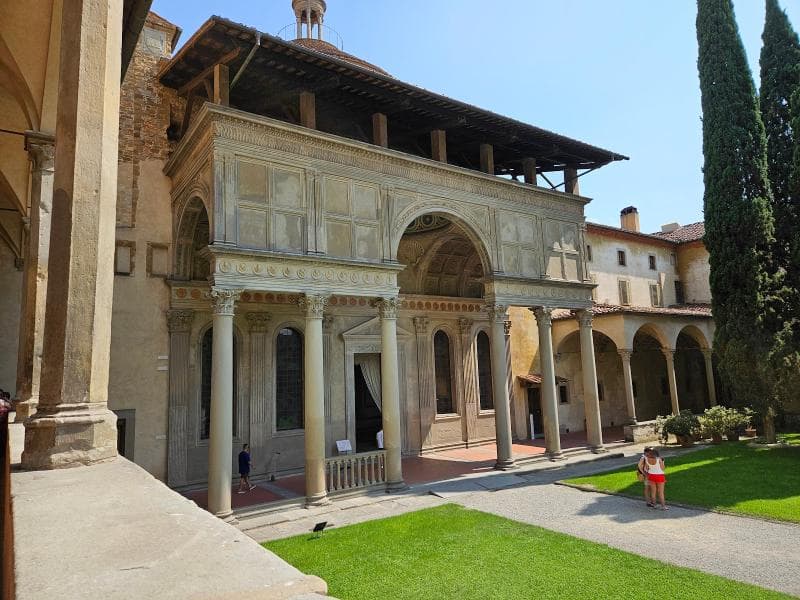
Discover the tranquil Cloisters of the Basilica of Santa Croce in Florence, Italy. Explore Renaissance harmony, the Pazzi Chapel, and ancient history.
Overview
The Basilica of Santa Croce in Florence, Italy, renowned as a Pantheon of Italian glories, conceals within its monumental complex a series of tranquil and historically significant spaces known as its Cloisters. Far more than mere passageways, these cloisters offer a contemplative journey through centuries of Florentine art, faith, and intellect, providing a serene counterpoint to the grandeur of the main basilica. The complex hosts two principal cloisters: the ancient First Cloister, often referred to as the 'Chiostro dei Morti' or 'cloister of the dead', and the elegant Second Cloister, also known as the 'Brunelleschi cloister'. These architectural gems serve as quiet retreats, connecting various parts of the Franciscan monastic community and preserving a profound sense of peace amidst the bustling city. Visitors exploring these arcaded courtyards step into a timeless realm where the whispers of history resonate through harmonious Renaissance architecture.
History & Cultural Background
The history of the Cloisters is deeply intertwined with the Basilica of Santa Croce, which began construction around 1294 for the Franciscan order. The First Cloister, the oldest of these spaces, was initially designed alongside the refectory and served as a burial ground, earning its poignant moniker, 'Chiostro dei Morti'. This cloister underwent several transformations, including the removal of a central building in the late 19th century.
The most celebrated feature is the Pazzi Chapel, nestled within the First Cloister. This architectural marvel was commissioned by the wealthy Florentine banker Andrea de' Pazzi around 1429, intended as both a family chapel and a chapter house for the friars. Often credited to Filippo Brunelleschi, the genius behind Florence's Duomo dome, scholars suggest he provided the initial designs, with others contributing to its construction, which began around 1442-1443 and continued after his death in 1446. Completed around 1478, the Pazzi Chapel stands as one of the earliest and most representative examples of Early Renaissance architecture, embodying its ideals of proportion and harmony.
The Second Cloister, though known as the 'Brunelleschi cloister', was likely designed by Bernardo Rossellino for the affluent patron Tommaso Spinelli. This cloister, with its elegant pietra serena columns, further exemplifies the Renaissance aesthetic.
What Makes It Special
What truly sets the Cloisters of Santa Croce apart is their profound embodiment of Early Renaissance ideals, particularly through the Pazzi Chapel. This chapel is a masterpiece of rational order and geometric precision, where every element contributes to a sense of balanced harmony. Brunelleschi's design introduced a modular system where proportional relationships define the space, creating an experience of serene beauty. The interplay of the grey pietra serena stone, highlighting structural elements against the white plaster walls, is a signature of this Renaissance style.
Beyond the Pazzi Chapel, the cloisters offer a unique blend of architectural tranquility and historical narrative. They were functional spaces linking monastic buildings, but also became repositories of memory and art. The quiet arcades, with their repeating semi-circular arches and columns, evoke a sense of 'inner peace and gentleness,' reflecting Renaissance values of order and noble striving. They provide an intimate setting to appreciate early Florentine artistry and the contemplative spirit of monastic life that shaped so much of the city's cultural heritage.
Stories, Fun Facts & Local Details
The Pazzi Chapel’s history is rich with the drama of Florentine power struggles. Commissioned by the Pazzi family, whose wealth rivaled the Medici, the chapel was a testament to their desire for lasting influence. However, the family's fortunes reversed dramatically in 1478 with the infamous Pazzi Conspiracy, an unsuccessful plot to overthrow the Medici. This political upheaval led to the family's banishment from Florence and the halting of further work on their grand chapel.
A fascinating detail within the Pazzi Chapel's portico is the small dome adorned with glazed terracotta rosettes by Luca della Robbia, featuring the Pazzi crest. These colorful artistic flourishes stand out against the grey stone. The cloisters have also hosted various monumental tombs over time. Interestingly, a monument to Florence Nightingale, born in Florence and named after the city, stands in the cloister, connecting this sacred Florentine space to a figure of global significance. The Cloisters are also notable for housing the 'first Last Supper painted in the history of art' by Taddeo Gaddi, a pupil of Giotto, located in the refectory accessible via the cloisters.
Visitor Perspective
Stepping into the Cloisters of Santa Croce offers a moment of profound calm and reflection, a welcome respite from the often-crowded splendor of the main basilica. The transition from the grand nave to the peaceful courtyards is like entering a different era, where the strict geometry and understated elegance of Renaissance architecture invite introspection. Walking beneath the rhythmic arches of the First Cloister, one can almost sense the footsteps of Franciscan friars who once sought solace and study here. The quiet atmosphere provides an ideal opportunity to appreciate the delicate details of the Pazzi Chapel's design without distraction, allowing its proportional beauty to truly sink in. The contrast between the grey pietra serena and the white plaster creates a striking visual harmony, a hallmark of Brunelleschi's influence.
For a curious traveler, the cloisters are not just architectural spaces but living pages of history, offering insights into monastic life, powerful Florentine families, and the birth of the Renaissance. The subtle play of light and shadow, the hushed echoes, and the sheer antiquity of the surroundings create an emotional connection to Florence's rich past. It's a place to slow down, to observe, and to absorb the spiritual and artistic legacy of a city that profoundly shaped Western culture. The cloisters provide a unique perspective on Santa Croce's monumental complex, revealing its layers of use, adaptation, and enduring beauty.
Coordinates: 11.154388, 43.768417
View on Google Maps💬 How Travelers Describe This Place
Based on community votes
Photogenic
826Unique
800Must See
589Interesting
387Beautiful
90
Traveler Stories
Discover memorable experiences shared by travelers who have visited this place.
No traveler stories yet.
Be the first traveler to share what made this place memorable.

Tour
By
Spot
Discover amazing places around the world. Your journey starts here.
Explore
© 2026 TourBySpot. All rights reserved.