City Hall Exterior
Lyon, France
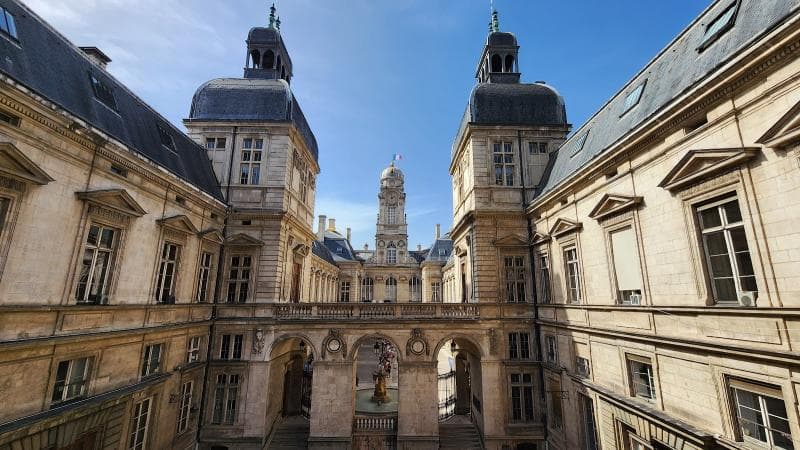
Explore the stunning exterior of Lyon's City Hall, a 17th-century architectural masterpiece in Place des Terreaux, France.
Overview
Standing proudly in the heart of Lyon, France, the exterior of the City Hall (Hôtel de Ville de Lyon) is an architectural marvel that anchors the historic Place des Terreaux. This grand edifice, recognized as one of the city's largest and most significant historical buildings, captivates visitors with its stunning presence. It is nestled elegantly between the bustling Place des Terreaux and the Place de la Comédie, directly facing the Opéra Nouvel. Designated a monument historique by the French government in 1886, the City Hall's facade is a masterpiece of 17th-century design, serving as a powerful symbol of Lyon's rich history and enduring civic pride.
History & Cultural Background
The story of Lyon's City Hall began in the mid-17th century, a period marked by significant urban redevelopment in Lyon, with the Presqu'île emerging as the city's vibrant center. Construction commenced on September 5, 1646, notably coinciding with the birthday of King Louis XIV, and was largely completed by 1672. The original design, attributed to the city architect Simon Maupin, aimed to reflect Lyon's growing wealth and influence. However, shortly after its initial completion, tragedy struck. A devastating fire in 1674 severely damaged the building, necessitating extensive restoration. This crucial task was entrusted to Jules Hardouin-Mansart, the renowned court architect to Louis XIV, celebrated for his work on the Palace of Versailles. The building faced further adversity, including damage during the French Revolution in 1792, when it briefly served as a revolutionary tribunal, and another fire in 1803. Throughout the centuries, it has witnessed countless historical events, maintaining its status as the administrative heart of the city and a testament to Lyon's resilience.
What Makes It Special
The exterior of Lyon's City Hall is a prime example of classical French architecture, blending Renaissance Revival and Baroque styles with lavish symmetry and intricate detailing. Its monumental facade is adorned with ornate sculptures, elegant Corinthian columns, and decorative reliefs that depict allegorical figures and scenes from Lyon's storied past. A striking feature is the equestrian statue of King Henry IV, flanked by graceful female figures symbolizing the region's two major rivers, the Saône and the Rhône. Visitors will also notice medallions depicting the Bourbon dynasty above the ground floor windows and the symbolic Lyon lion carved above window pediments. The central clock tower, topped with a distinctive dome and finely carved sculptures at roof level, adds to its grandeur. This architectural splendor, combined with its central location, makes the City Hall an integral part of Lyon's historic center, which is recognized as a UNESCO World Heritage Site.
Stories, Fun Facts & Local Details
Beyond its imposing appearance, the City Hall exterior holds intriguing stories and details. High above, within its central tower, lies one of Europe's largest carillons, boasting 65 bells whose melodies periodically enrich the atmosphere of Place des Terreaux. A curious local detail that might catch a discerning eye is an angel-shaped door knocker on one of its entrances. The very ground upon which this magnificent structure stands, Place des Terreaux, has a history equally rich and dramatic. It was once a swampy pit known as 'Terralia Nova' and, in a darker chapter, served as a site for public executions, including those by guillotine during the French Revolution. During the Commune de Lyon in 1870, the Republic was famously proclaimed from the City Hall's balcony, a moment that led anarchist Mikhail Bakunin to consider Lyon the 'capital of socialism'. Each December, the City Hall's facade becomes a breathtaking canvas during the Festival of Lights (Fête des Lumières), when it is beautifully illuminated, transforming the square into a magical spectacle.
Visitor Perspective
The exterior of the City Hall is a magnificent sight that can be admired by any traveler to Lyon, completely free of charge and at any time of day. Allocating about 30 to 40 minutes provides ample time to appreciate its intricate facade and capture memorable photographs. Its prime location in Place des Terreaux makes it an ideal starting point for exploring the surrounding attractions, including the famous Bartholdi Fountain and the Museum of Fine Arts, both just steps away. While interior access is typically restricted due to its active administrative function, special occasions like European Heritage Days often provide rare opportunities for guided tours to glimpse its opulent interiors. The vibrant area surrounding the City Hall also offers numerous cafes, restaurants, and shops, allowing visitors to soak in the lively Lyonnaise atmosphere while marveling at this enduring symbol of the city's grandeur.
Coordinates: 4.835, 45.7676
View on Google Maps💬 How Travelers Describe This Place
Based on community votes
Photogenic
982Beautiful
903Must See
481Unique
458Interesting
197
Traveler Stories
Discover memorable experiences shared by travelers who have visited this place.
No traveler stories yet.
Be the first traveler to share what made this place memorable.

Tour
By
Spot
Discover amazing places around the world. Your journey starts here.
Explore
© 2026 TourBySpot. All rights reserved.