Choir
Zurich, Switzerland
Discover the Fraumünster Church Choir in Zurich, Switzerland, renowned for Marc Chagall's stunning stained-glass windows and rich history.
Overview
Nestled within the historic Fraumünster Church in Zurich, Switzerland, the Choir is a sacred space that transcends its architectural origins, captivating visitors with a profound blend of history and breathtaking artistry. More than just an architectural element, the Choir is the spiritual heart of the church and home to some of its most luminous treasures. It is primarily renowned for the unparalleled beauty of its stained-glass windows, which bathe the ancient stones in a kaleidoscope of color and light.
While the larger Fraumünster Church stands majestically on the Limmat River, its slender green spire a distinctive part of Zurich's skyline, it is within the Romanesque Choir that one encounters a truly transformative experience. This area invites quiet contemplation and offers a direct connection to centuries of faith, art, and the rich narrative of Zurich itself.
History & Cultural Background
The history of the Fraumünster Church, and by extension its Choir, stretches back over a thousand years. It was originally founded in 853 CE by King Louis the German, a grandson of Charlemagne, as a Benedictine convent for aristocratic women. His daughter, Hildegard, became its first abbess.
For centuries, the Fraumünster convent wielded immense political and economic power within Zurich. The abbesses held significant privileges, including the right to mint coins, collect tolls, and oversee markets, effectively making them rulers of the city well into the 13th century. This powerful institution gradually saw its influence wane in the 14th century, culminating in its dissolution in 1524 during the Swiss Reformation led by Huldrych Zwingli. The last abbess, Katharina von Zimmern, famously transferred the convent's rights and assets to the city.
The Choir itself is one of the oldest parts of the church, built in the Romanesque style. Its foundations date back to the 9th century. Although the church underwent various architectural changes, incorporating Gothic elements over time, the Romanesque character of the Choir remains an important feature, having been remodeled in stages during the 13th century.
What Makes It Special
What truly elevates the Choir of Fraumünster Church to a world-renowned status are the five magnificent stained-glass windows created by the Russian-French artist Marc Chagall. Installed in 1970, when Chagall was in his eighties, these towering windows transform the space into a vibrant canvas of color and light. Each window, dominated by a specific hue, tells a profound biblical story, drawing visitors into a meditative and visually stunning narrative.
The themes depicted include the Prophets (with Elijah's ascent), Jacob (showing his combat and dreams of heaven), Christ (illustrating various scenes from Christ's life), Zion (an angel trumpeting the end of the world), and Law (Moses looking down upon his suffering people). These windows are widely regarded as among Chagall's finest works in glass, their intense blues, reds, greens, and yellows contrasting powerfully with the otherwise austere interior of the Reformed church.
While Chagall's work defines the Choir, the church also features another significant stained-glass masterpiece: Augusto Giacometti's large rose window in the north transept. Installed in 1945, this window, titled 'Heavenly Paradise', offers a striking contrast with its subtle and harmonious colors, creating a serene effect.
Stories, Fun Facts & Local Details
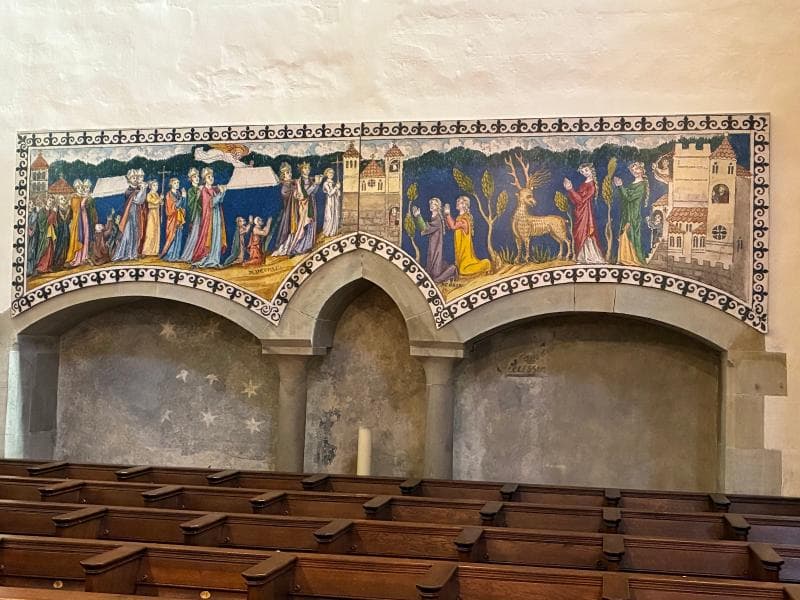
The Fraumünster's founding is intertwined with charming legends. One popular tale recounts how King Louis the German's pious daughters, Hildegard and Bertha, were guided to the site by a radiant stag with glowing antlers, signaling where God intended their convent to be built. This story, though not historical proof, became an integral part of the church's memory and is depicted in the cloister's 20th-century frescoes by Paul Bodmer.
The Fraumünster's rich history extends beyond its stained glass and founding legends. Below the Choir lies a crypt, the oldest part of the church, with foundations dating back to the 9th century. Sealed in 1900, it was reopened to the public in 2016 and now houses an exhibition detailing the history of the Reformation in Zurich and the church's architectural evolution.
Another impressive feature of the Fraumünster, though not located strictly within the Choir, is its grand organ. With 5,793 pipes, it is the largest in the Canton of Zurich, filling the church with magnificent sound during services and concerts, which are regularly held here.
Visitor Perspective
Visiting the Choir at Fraumünster Church is an immersive experience. The best time to appreciate Chagall's windows is often in the morning or midday when the sun illuminates the east-facing glass, making their colors particularly vivid. However, many find that overcast days also enhance the windows' ethereal beauty.
While private photography is generally allowed without flash or tripod, visitors are encouraged to be respectful of this sacred space and maintain a quiet demeanor, as it is a working church where services and events take precedence over tourism. Guided tours are available, often using a 'whisper mode' to preserve the tranquility.
Admission typically costs around 5 CHF for adults, with free entry for children under 16, students with ID, or those entering for prayer. An audio guide is usually included, offering deeper insights into the art and history. Most visitors find that 30 to 60 minutes are sufficient to explore the Choir and the church's other notable features, allowing ample time for reflection on its profound artistic and historical significance in the heart of Zurich.
Coordinates: 8.5413, 47.3696
View on Google Maps💬 How Travelers Describe This Place
Based on community votes
Unique
836Interesting
797Photogenic
286Beautiful
255Must See
86
Traveler Stories
Discover memorable experiences shared by travelers who have visited this place.
No traveler stories yet.
Be the first traveler to share what made this place memorable.

Tour
By
Spot
Discover amazing places around the world. Your journey starts here.
Explore
© 2026 TourBySpot. All rights reserved.