Central Avenue
Minsk, Belarus
Explore Victory Square in Minsk, Belarus, a powerful memorial on Central Avenue (Independence Avenue) honoring WWII heroes with a majestic obelisk and eternal flame.
Overview
Victory Square, known locally as Ploshcha Peramohi, stands as a profound and central landmark in Minsk, Belarus. Situated along Independence Avenue, often considered the city's central thoroughfare, this iconic square is a testament to resilience and remembrance. It serves as a pivotal point where the vibrant urban life of Minsk converges with solemn historical significance. The square's focal point is the majestic Victory Monument, a towering obelisk dedicated to the heroes of the Great Patriotic War. More than just a monument, Victory Square is an entire architectural ensemble, reflecting the post-war reconstruction of Minsk and embodying the spirit of its people.
History & Cultural Background
Before its current designation, the area was known as Round Square until 1958. Its transformation into Victory Square commenced after World War II, a period when Minsk, having suffered immense devastation, underwent significant rebuilding. The decision to establish a memorial square here was part of a larger plan to honor the Soviet Army soldiers and Belarusian partisans who sacrificed their lives during the Great Patriotic War. The central element, the Victory Monument, a 38-meter (or 40-meter, depending on source) granite obelisk, was erected in 1954.
On July 3, 1961, an eternal flame was lit at the monument's base, symbolizing undying memory and gratitude. This date marked the 17th anniversary of Minsk's liberation. Later, in the 1980s, capsules containing soil from the Soviet Union's Hero Cities were placed around the obelisk, further solidifying its national importance. Beneath the square, a Memorial Hall was opened in 1985, accessible via an underground passage, providing a dedicated space for reflection and honor.
What Makes It Special
Victory Square is distinct for its harmonious blend of monumental architecture and poignant symbolism. The 38-meter obelisk, crowned with a replica of the Order of Victory, stands as a powerful visual tribute. Its base features four bronze bas-reliefs, each depicting crucial aspects of the war: 'May 9, 1945,' 'The Soviet Army during the Great Patriotic War,' 'Belarusian Partisans,' and 'Honour to Heroes who gave their lives.' These intricate sculptures tell a compelling story of struggle and triumph.
The square is framed by curved neoclassical buildings constructed in the 1940s and 1950s, examples of the Stalinist Empire style, which contribute to its grand and unified appearance. The inscription 'Подвиг народа бессьмертен' ('The feat of the people is immortal') adorns the buildings at the northern end, reinforcing the square's commemorative purpose. The eternal flame, continuously burning, adds a layer of solemnity, drawing visitors and locals alike to pause and remember.
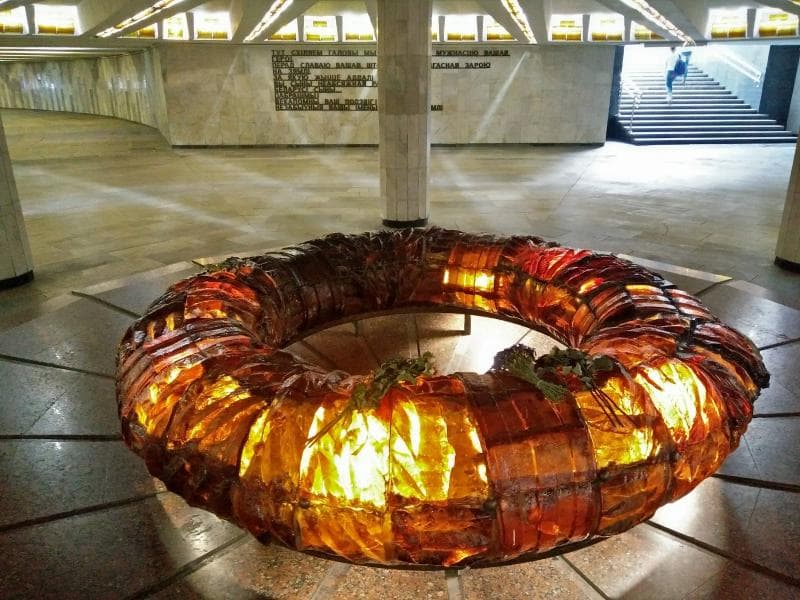
A unique feature lies beneath the square: the Memorial Hall. This underground circular chamber houses a glass wreath in its center and bronze plates on its walls inscribed with the names of 566 Belarusian Heroes of the Soviet Union. This offers a deeply moving and immersive experience, allowing visitors to connect directly with the individual stories of heroism.
Stories, Fun Facts & Local Details
Victory Square is not only a historical site but also a living part of Minsk's cultural fabric. It's a traditional stop for newlyweds, who often visit to lay flowers at the eternal flame and take photographs, integrating personal celebrations with national memory. Public events, celebrations, and national parades, particularly on Victory Day (May 9th), frequently take place here, making it a social hub and a focal point for national pride.
The square's architecture, including the grand Stalinist Empire style buildings along Independence Avenue, forms a significant part of Minsk's post-war identity. These structures, particularly the segment from Independence Square to Victory Square, are recognized for their historical and cultural value, even being considered for UNESCO World Heritage status.
Interestingly, one of the residential buildings surrounding Victory Square was reportedly home to Lee Harvey Oswald during his time in Minsk in the early 1960s, adding a curious footnote to the square's history.
Visitor Perspective
Visiting Victory Square offers a powerful and reflective experience. It's easily accessible via public transportation, with the 'Ploshcha Peramohi' metro station located directly beneath the square, making it convenient for travelers to reach. The regular changing of the guard ceremony at the eternal flame, performed by cadets of the Military Academy of Belarus, is a display of precision and respect that many visitors find impressive.
Beyond the monument, the square is surrounded by green spaces, including the entrance to Gorky Park, offering a pleasant area for strolling and relaxation. Nearby, the Belarusian Great Patriotic War Museum provides extensive insights into the country's wartime experiences, complementing the memorial aspect of the square. For those seeking local cuisine, various dining options are available within walking distance, offering a taste of traditional Belarusian dishes. The blend of solemn remembrance, grand architecture, and vibrant city life makes Victory Square a truly memorable destination in Minsk.
Coordinates: 27.5701, 53.9085
View on Google Maps💬 How Travelers Describe This Place
Based on community votes
Must See
767Photogenic
594Beautiful
516Interesting
301Unique
82
Traveler Stories
Discover memorable experiences shared by travelers who have visited this place.
No traveler stories yet.
Be the first traveler to share what made this place memorable.

Tour
By
Spot
Discover amazing places around the world. Your journey starts here.
Explore
© 2026 TourBySpot. All rights reserved.