Cathedral Entrance
Split, Croatia
Explore the historic Cathedral Entrance within Peristyle Square in Split, Croatia. Discover its Roman origins and rich Christian heritage.
Overview
The Cathedral Entrance in Split, Croatia, leads to the magnificent Cathedral of Saint Domnius, an iconic landmark deeply rooted within the ancient walls of Diocletian's Palace. Facing the historic Peristyle Square, this entrance serves as a gateway to centuries of history, where Roman antiquity seamlessly blends with early Christian heritage. It is not merely a point of entry but a symbolic threshold, inviting visitors to explore a structure that uniquely began its life as the mausoleum of a Roman emperor before its transformative conversion into a sacred Christian space. The Cathedral, known locally as Sveti Duje, stands as a testament to Split's enduring past, recognized as one of the oldest Catholic cathedrals in the world that continues to be used in its original form. Its imposing bell tower, visible from much of the old town, marks its prominent position within the city's vibrant historical core, making it an unmissable destination for anyone exploring Split.
History & Cultural Background
The story of the Cathedral Entrance begins with Emperor Diocletian, who, ironically, was a fierce persecutor of Christians. The central part of the Cathedral of Saint Domnius was originally built in 305 AD as his grand mausoleum, where he was interred in 311 AD. Centuries later, in the 7th century, a remarkable transformation occurred. The mausoleum, a symbol of pagan imperial power, was converted into a Christian cathedral. This conversion was a profound act, re-dedicating the structure to the Virgin Mary, with its bell tower later dedicated to Saint Domnius, the patron saint of Split. Saint Domnius, a bishop of Salona, was martyred during Diocletian's persecutions, creating an astonishing historical irony where the tomb of a persecutor became the resting place of his victims' venerated relics. The Peristyle Square itself, leading to this entrance, was the monumental central courtyard of Diocletian's Palace, established in the 3rd century AD, serving as a formal access point to the emperor's private apartments.
What Makes It Special
What truly sets the Cathedral Entrance and the Cathedral of Saint Domnius apart is its unparalleled historical continuity and architectural fusion. It is a rare example of a building that has served continuously for over 1700 years, adapting from a pagan imperial tomb to a vibrant Christian cathedral. The structure's octagonal shape, inherited from its mausoleum origins, is encircled by an original colonnade of 24 columns, while its interior features Corinthian columns and a frieze that still bears images of Emperor Diocletian and his wife, offering a tangible link to its Roman past. The entrance itself is adorned with magnificent 13th-century carved wooden doors, a masterpiece by master Andrija Buvina. These doors depict 28 intricate panels illustrating scenes from the life of Jesus Christ, making them a significant work of art in Dalmatia. Furthermore, the opportunity to climb the Romanesque bell tower, constructed between the 13th and 16th centuries, provides breathtaking panoramic views of Split's red-tiled rooftops, the Adriatic Sea, and the surrounding islands, an experience that truly connects visitors to the city's unique vantage point.
Stories, Fun Facts & Local Details
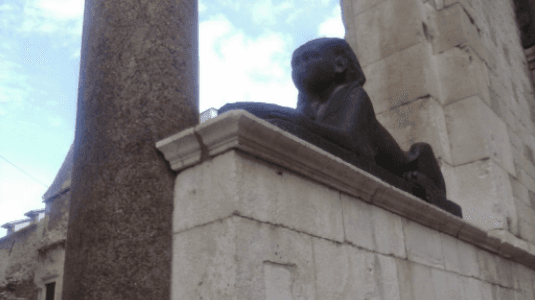
The history of the Cathedral Entrance is rich with fascinating narratives. One of the most striking is the poetic justice embodied by its very existence: the mausoleum of Emperor Diocletian, a man who sought to eradicate Christianity, was ultimately transformed into a cathedral honoring Christian martyrs, including Saint Domnius himself. Imagine the visual splendor of Andrija Buvina's 13th-century wooden doors, which were originally not only intricately carved but also colored and gold-plated, shining brightly as worshippers entered the sacred space. Peristyle Square, just outside the entrance, holds its own intriguing details. It was here that Emperor Diocletian would make grand appearances before his subjects, and today, you can still find an ancient 3500-year-old Egyptian sphinx guarding the square, brought to Split by Diocletian himself. Visitors embarking on the climb up the Cathedral's bell tower should be prepared for an adventure; the steep stone steps eventually give way to more modern, somewhat flimsy metal ones suspended over the internal void, requiring a 'head for heights' but rewarding the brave with unparalleled vistas.
Visitor Perspective
Visiting the Cathedral Entrance is an immersive journey into Split's layered past. As part of the pedestrianized Diocletian's Palace, the best way to approach it is on foot, allowing you to absorb the atmosphere of the ancient stone streets. Allow approximately one to two hours to fully explore the Cathedral's interior, appreciate its historical significance, and perhaps climb the bell tower for its famous panoramic views. Keep in mind that access to the various parts of the complex—the main cathedral, bell tower, crypt, treasury, and baptistery—requires tickets, which can often be purchased as combined passes. During peak summer months, entry to the Cathedral might be through the sacristy, an annex around the right-hand side, while in the low season, the main front door is typically used. For a more serene experience and to truly appreciate the intricate details of the Peristyle and the Cathedral's facade, consider an early morning visit before the square fills with the day's crowds.
Coordinates: 16.44, 43.50833
View on Google Maps💬 How Travelers Describe This Place
Based on community votes
Beautiful
517Unique
422Interesting
394Photogenic
269Must See
251
Traveler Stories
Discover memorable experiences shared by travelers who have visited this place.
No traveler stories yet.
Be the first traveler to share what made this place memorable.

Tour
By
Spot
Discover amazing places around the world. Your journey starts here.
Explore
© 2026 TourBySpot. All rights reserved.