Castle Ruins
Lviv, Ukraine
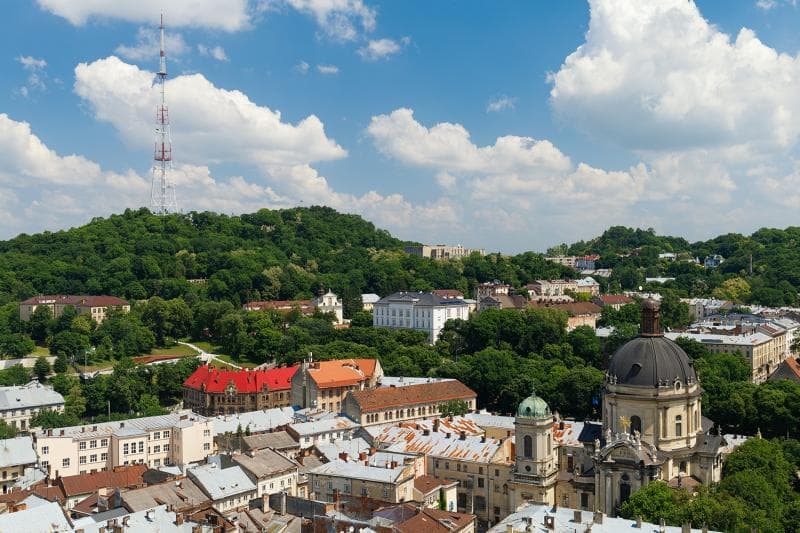
Explore the historic Castle Ruins of Lviv High Castle in Lviv, Ukraine. Discover ancient history, stunning panoramic views, and the Union of Lublin Mound.
Overview
Perched atop Castle Hill, the Castle Ruins within Lviv High Castle in Lviv, Ukraine, mark the highest point of the city, offering visitors unparalleled panoramic views. Standing at 413 meters (1,355 ft) above sea level, this historic site, locally known as Vysoky Zamok, is a blend of ancient history and natural beauty. While only fragments of the original fortress remain, the area has been transformed into a beloved park, serving as both a historical landmark and a tranquil green space. Visitors come to explore its paths, reflect on Lviv's rich past, and enjoy breathtaking vistas that stretch across the city's historic center and beyond.
History & Cultural Background
The story of Lviv High Castle begins in the 13th century with the construction of a wooden fortification by Prince Leo I of Halych, or King Daniel of Galicia, to protect the emerging settlement below. This initial stronghold was often subject to destruction and rebuilding, a testament to the turbulent times it witnessed. In 1340, after Lviv was captured by Casimir III of Poland, the wooden structure was burned, and a new, more robust stone and brick castle began to rise around 1362 under his reign. For centuries, the High Castle served as Lviv's primary defensive fort, a garrison, and even a treasury, safeguarding royal treasures, including golden crowns.
The fortress endured numerous sieges, famously falling to Cossack forces led by Colonel Maksym Kryvonis in 1648 during the Khmelnytsky Uprising. Its strategic importance began to wane after it was heavily damaged and ultimately destroyed by Swedish troops in 1704. By the 19th century, the castle had largely fallen into disrepair, and Austrian authorities initiated its dismantling, with many of its stones repurposed for new city constructions. In place of the formidable castle, a park was established in 1835, and between 1869 and 1900, the artificial Union of Lublin Mound was constructed on the upper terrace, commemorating the 300th anniversary of the Polish-Lithuanian union.
What Makes It Special
The Castle Ruins, though minimal, are profoundly special because they represent the very genesis of Lviv, standing as a silent witness to its foundation and subsequent evolution. The site's primary draw today is the magnificent 360-degree panorama it offers. From the observation platform atop the Union of Lublin Mound, visitors can gaze upon the city's green-domed churches, intricate architecture, and the sprawling urban landscape, nestled amidst rolling hills. This viewpoint truly allows one to appreciate Lviv's layout and its historical relationship with the surrounding terrain. It's a place where the past literally meets the present, with the city's highest point still dominating the skyline, now as a symbol of resilience and beauty rather than defense.
Stories, Fun Facts & Local Details
Legend has it that King Danylo of Galicia, after building the first wooden castle, found living on the exposed hilltop too inconvenient due to harsh winter winds, leading him to build a 'Low Castle' for residence, while the High Castle remained a strategic outpost and treasury. The castle's grim dungeons also once held prisoners, including captured Teutonic knights. A curious detail found on the lower terrace is an artificial grotto, guarded by stone lions that were originally moved from the old Lviv Town Hall, adding a touch of whimsy to the historical landscape. While the castle itself almost entirely disappeared, talks in 2004-2005 of reconstructing a stone castle on the hill ultimately proved unrealistic, preserving its current form as a park dedicated to reflection and scenic beauty. The hill is also famously home to a 141-meter (463-foot) tall television tower, constructed in 1957, which has become a recognizable feature of the Lviv skyline.
Visitor Perspective
Visiting the Castle Ruins of Lviv High Castle is a quintessential Lviv experience, highly recommended for any curious traveler. The journey to the summit involves a walk up winding paths through a beautifully landscaped park. While the ascent can be steep, it is generally walkable from Lviv's city center, taking about 25 minutes from Rynok Square. Wearing sturdy shoes is advisable, especially depending on the season. The reward for the climb is the breathtaking panoramic view from the observation deck, making the effort entirely worthwhile. Visitors consistently praise the stunning scenery and historical ambiance. For the best experience, choose a clear day to ensure optimal visibility and appreciate the vibrant colors of the city and nature. The park offers numerous paths for leisurely strolls and photography, inviting visitors to connect with Lviv's layered past and enjoy its serene environment.
Coordinates: 24.03889, 49.84833
View on Google Maps💬 How Travelers Describe This Place
Based on community votes
Photogenic
963Interesting
663Beautiful
653Must See
566Unique
503
Traveler Stories
Discover memorable experiences shared by travelers who have visited this place.
No traveler stories yet.
Be the first traveler to share what made this place memorable.

Tour
By
Spot
Discover amazing places around the world. Your journey starts here.
Explore
© 2026 TourBySpot. All rights reserved.