Castle Building
Podgorica, Montenegro
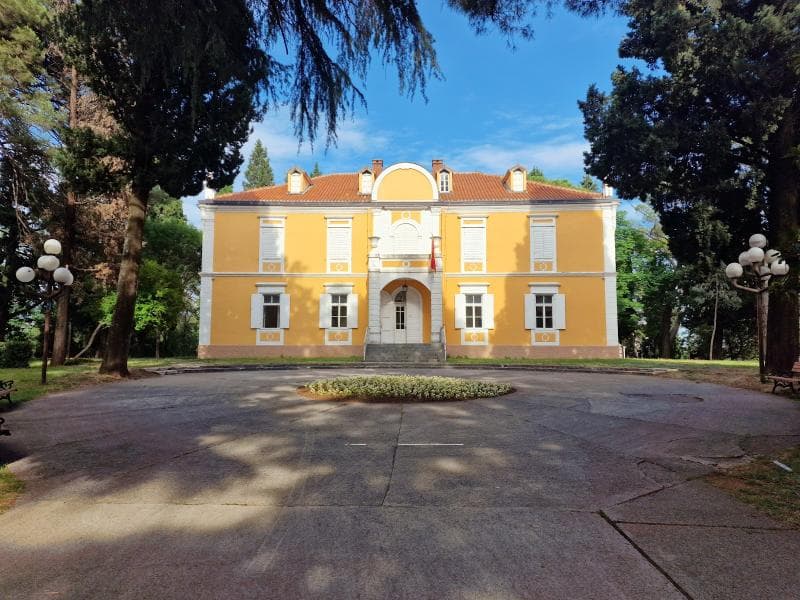
Explore the historic Petrović Castle in Podgorica, Montenegro, King Nikola's former winter residence now home to contemporary art. Discover royal history & culture.
Overview
Nestled within the lush Petrović Park in Podgorica, Montenegro, stands the majestic Petrović Castle, often referred to as King Nikola's Winter Palace. This historically significant 'castle building' is not merely an architectural marvel but a vibrant cultural hub, currently housing the Museum of Contemporary Art of Montenegro. Its stately presence on the right bank of the Morača River offers visitors a unique blend of royal heritage and modern artistic expression, making it a pivotal landmark in the capital city.
The complex, known locally as Kruševac, encompasses several structures including the main palace, the House of the King's Guard, and the charming Church of St. Demetrius, all set within an expansive, serene park-forest. It serves as a testament to Montenegro's rich past and its evolving cultural landscape.
History & Cultural Background
The history of the Petrović Castle building dates back to the late 19th century. Commissioned by King Nikola I Petrović-Njegoš, the last monarch of Montenegro, it was constructed as a winter residence for the royal family. The foundation stone for this two-story neoclassical palace was laid on April 20, 1891, and the grand edifice was completed in 1894. Initially, King Nikola intended it as a representative residence for his son, Prince Mirko Petrović-Njegoš.
The palace's strategic location in Kruševac, an area purchased by Prince Nikola in 1886, marked a period of significant development for Podgorica following its liberation. Over its lifetime, the castle building has witnessed various transformations. During the tumultuous Balkan Wars, it briefly served as a hospital, a testament to its adaptability and the era's needs. In 1983, it was adapted to house the Gallery of Art of Non-Aligned Countries 'Josip Broz Tito,' laying the groundwork for its future as a prominent art institution. Today, it proudly stands as a cultural monument, embodying a key epoch in Montenegrin history.
What Makes It Special
What truly sets the Petrović Castle building apart is its remarkable evolution from a royal residence to a leading center for contemporary art. This elegant 19th-century villa, with its modest yet distinguished facade and wide staircase, provides a striking backdrop for modern artistic expression. The building's original design, a blend of traditional European styles with a residential feel, now seamlessly hosts a diverse collection of art, creating a compelling dialogue between past and present.
Beyond its architectural beauty, the castle complex is distinguished by its extensive park. This tranquil green space features an outdoor sculpture park, where intriguing artworks are harmoniously integrated with the natural surroundings. The combination of historical architecture, a significant art collection, and a beautifully landscaped environment makes the Petrović Castle a multifaceted attraction, offering both aesthetic pleasure and intellectual stimulation.
Stories, Fun Facts & Local Details
King Nikola I, who commissioned the castle, was known as 'Europe's father-in-law' due to his many daughters marrying into various European royal houses. This nickname highlights the diplomatic significance of the Montenegrin royal family during his reign. The castle itself was a symbol of Montenegro's growing stature.
Interestingly, the complex was at the forefront of technological advancements for its time. Shortly after its completion, one of the auxiliary buildings hosted Podgorica's first telegraph station, and by 1895, the main castle building was equipped with the city's first telephones. This blend of royal grandeur and early modern technology offers a glimpse into the forward-thinking spirit of King Nikola's era.
The surrounding Petrović Park is not just any green space; it's home to the oldest cedar forest in Podgorica, interwoven with alpine and coastal pines and acacias. In more recent times, a monument to Jelena Savojska, King Nikola's daughter who became the Queen of Italy, was erected in the castle park in 2021, further enriching the historical narrative of the grounds.
Visitor Perspective
For the curious traveler, visiting the Petrović Castle building offers a journey through time and culture. The main palace, the heart of the complex, houses a permanent gallery exhibition of the Museum of Contemporary Art of Montenegro, showcasing approximately 1000 to 1500 art objects from across Europe, Asia, Africa, and Latin America, alongside significant Montenegrin and Yugoslav art. While entry to the beautiful park and grounds is typically free, providing a peaceful escape for leisurely strolls and appreciating outdoor sculptures, the museum itself usually has a small entrance fee.
Exploring the castle allows for an intimate encounter with Montenegro's royal past and its dynamic contemporary art scene. The first floor of the palace also serves as offices for the Petrović Njegoš Foundation, reflecting its continued connection to the royal lineage. It's advisable to check current exhibition details beforehand, as the temporary displays can be quite abstract. However, an open mind will surely lead to a rewarding experience within this charming 19th-century villa, making it a must-visit for anyone seeking a deeper understanding of Podgorica's rich heritage and artistic pulse.
Coordinates: 19.25028, 42.43778
View on Google Maps💬 How Travelers Describe This Place
Based on community votes
Beautiful
915Interesting
873Photogenic
422Must See
123Unique
53
Traveler Stories
Discover memorable experiences shared by travelers who have visited this place.
No traveler stories yet.
Be the first traveler to share what made this place memorable.

Tour
By
Spot
Discover amazing places around the world. Your journey starts here.
Explore
© 2026 TourBySpot. All rights reserved.