Cannon Positions
Split, Croatia
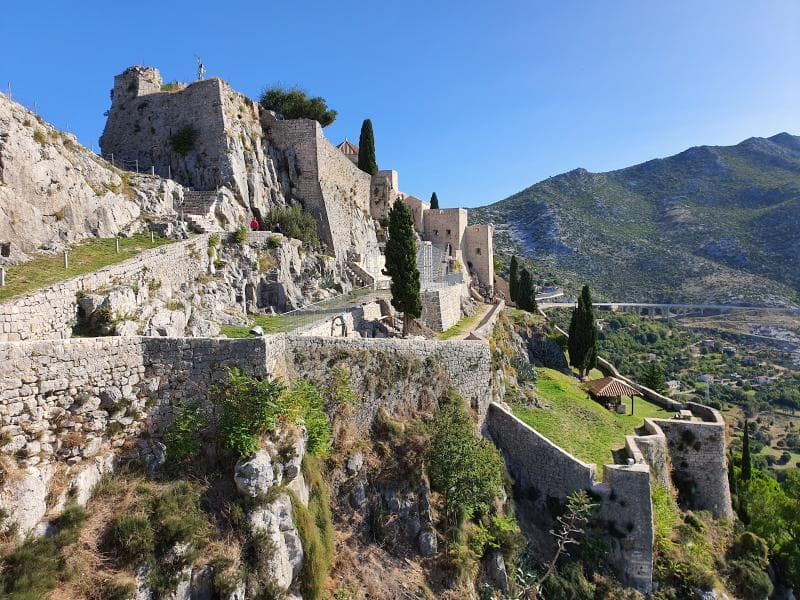
Explore the historic Cannon Positions at Klis Fortress in Split, Croatia. Discover centuries of military evolution and strategic defense.
Overview
Perched majestically atop a rocky bluff between the Mosor and Kozjak mountains, Klis Fortress stands as a silent sentinel overseeing Split and the Adriatic Sea. While the entire fortress is a testament to centuries of strategic defense, the 'Cannon Positions' within its formidable walls are particularly striking. These elevated platforms and fortified bastions tell a compelling story of military evolution, where the introduction of gunpowder weaponry reshaped ancient strongholds into resilient artillery strongpoints. Visitors exploring Klis Fortress encounter these positions, offering not only breathtaking panoramic views but also a tangible connection to the intense historical struggles for control of this pivotal pass in Dalmatia.
History & Cultural Background
The history of Klis Fortress stretches back over two millennia, with its origins tracing to an Illyrian stronghold, later expanded by the Romans. Its strategic significance as the 'Key to Dalmatia,' controlling the vital mountain pass between the coast and the inland, made it a coveted prize for various empires. For centuries, it served as a royal castle and a seat for many Croatian rulers, including Duke Mislav and the Trpimirović dynasty. However, it was during the tumultuous Ottoman wars, particularly the 16th and 17th centuries, that the fortress underwent significant transformations to incorporate advanced artillery. The legendary defense led by Croatian captain Petar Kružić and his Uskok fighters against the Ottomans highlighted the fortress's enduring importance, even before large-scale cannon deployment. Later, under Venetian and Austrian rule, the fortress was extensively modernized, with the addition of numerous artillery positions designed to withstand and deliver devastating cannon fire, adapting the ancient site to new military technologies and defensive needs.
What Makes It Special
The Cannon Positions at Klis Fortress are special because they represent a crucial period in military history when defensive architecture had to adapt to the destructive power of cannons. Among these, the Bembo Bastion stands out as the largest artillery position within the fortress, situated in the third defensive ring. Constructed by the Venetians in the mid-17th century, it was strategically built upon the remnants of the earlier Kružić tower, showcasing the continuous layering of defensive structures over time. Another significant point is Position Maggiore, the second-largest artillery area, characterized by its high walls and distinctive funnel-shaped openings engineered for cannons. This area also housed a substantial gunpowder storage facility built by the Austrians in the 1820s, underscoring its pivotal role in sustaining long sieges. Other notable areas include Position Avanzato, designed to protect the fortress's main entrances from siege artillery, and Position Scala, identified as a gun-platform. These sites offer a unique glimpse into the engineering prowess and tactical thinking of past eras, demonstrating how the fortress evolved to counter and utilize advanced weaponry.
Stories, Fun Facts & Local Details
Imagine the thunderous roar of cannons echoing through the mountain pass, a sound that would have been commonplace during Klis's intense sieges. The placement of each cannon was a carefully calculated decision, leveraging the fortress's natural elevation and the rugged terrain to maximize defensive advantage. For instance, the high ground of Greben, to the north of the fortress, was identified as a key position for cannon attacks, providing an advantageous firing angle over approaching forces. The need for robust artillery support also led to practical innovations, such as the construction of artillery barracks by the Austrians in the early 19th century near the second entrance, to house the military personnel operating these formidable weapons. While the early Uskoks were known for their guerrilla tactics, the later Venetian and Austrian periods transformed Klis into a formidable artillery stronghold, a testament to the changing face of warfare. These positions were not merely static platforms; they were integral to the fortress's living, breathing defense system, requiring constant vigilance, maintenance, and the brave souls who operated them. Walking through these areas, one can almost hear the commands given, the grinding of cannon wheels, and the desperate struggle for survival and dominance that defined Klis for centuries.
Visitor Perspective
Today, as you traverse the narrow paths and climb the ancient staircases of Klis Fortress, reaching the Cannon Positions is a journey back in time. The raw, imposing stone walls, scarred by centuries of conflict, lead you to these crucial vantage points. Standing on the Bembo Bastion or surveying the landscape from Position Maggiore, you gain an unparalleled perspective not only of the strategic genius behind their placement but also of the sheer physical scale of the battles fought here. The views are expansive, stretching across the red-tiled roofs of Klis village, the sprawling city of Split, and the glittering expanse of the Adriatic Sea dotted with islands. It's a powerful experience, allowing a curious traveler to contemplate the fortress's resilience and the lives of those who defended it. The wind whipping through the openings where cannons once stood serves as a natural reminder of the exposed, yet dominant, position these formidable weapons held. It is a place where history feels alive, inviting reflection on the past and appreciation for the strategic importance of this remarkable Croatian landmark.
Coordinates: 16.52415, 43.56004
View on Google Maps💬 How Travelers Describe This Place
Based on community votes
Beautiful
639Unique
569Photogenic
476Interesting
128Must See
93
Traveler Stories
Discover memorable experiences shared by travelers who have visited this place.
No traveler stories yet.
Be the first traveler to share what made this place memorable.

Tour
By
Spot
Discover amazing places around the world. Your journey starts here.
Explore
© 2026 TourBySpot. All rights reserved.