Buddha Feet Engravings
Yangon, Myanmar
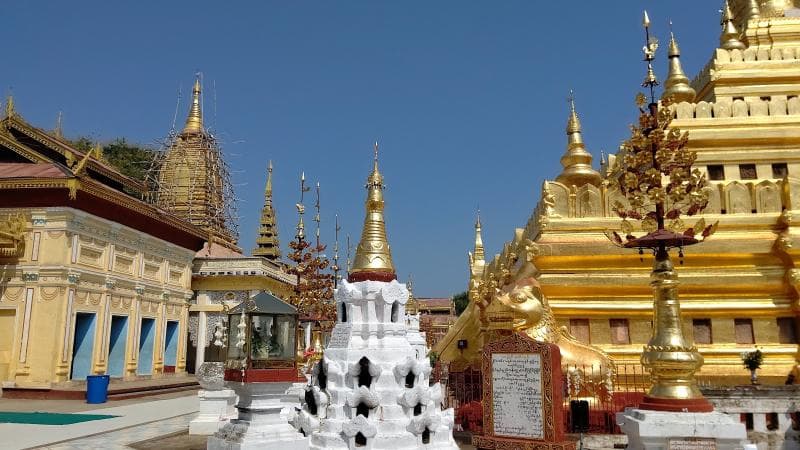
Explore the profound Buddha Feet Engravings at Chaukhtatgyi Buddha Temple in Yangon, Myanmar, featuring 108 auspicious symbols of enlightenment.
Overview
Deep within the Chaukhtatgyi Buddha Temple in Yangon, Myanmar, lies a captivating detail often missed by those who only gaze upon the colossal reclining Buddha: the intricate Buddha Feet Engravings. These unique carvings, found on the soles of the Buddha's feet, are not merely decorative but serve as a profound visual narrative of Buddhist cosmology and the enlightened path. They invite a closer look, revealing a universe of symbolism that is both ancient and deeply spiritual, offering visitors a quiet moment of reflection amidst the grandeur of the temple.
History & Cultural Background
The Chaukhtatgyi Buddha Temple, a significant Buddhist site in Yangon, is most famous for its enormous reclining Buddha image, which stretches 66 meters (217 feet) in length, making it one of Myanmar's largest. The original Buddha image was initially constructed in 1907. However, due to proportional issues and an 'aggressive expression' on its face, it was later demolished in the 1950s. A new, more serene image was then crafted under the supervision of master craftsman U Thaung, and consecrated in 1973. This modern rendition of the Reclining Buddha, adorned with distinctive facial features, vibrant detailing, and custom-made glass eyes, reflects mid-20th-century craftsmanship while preserving traditional symbolism. The temple itself dates back to 1899, funded by Sir Po Tha, a wealthy Burmese Buddhist.
Culturally, the Chaukhtatgyi Buddha is a revered symbol of Theravada Buddhism, which is widely practiced in Myanmar. The reclining posture itself represents the Buddha's parinirvana, his passing into final nirvana, a state of ultimate enlightenment and liberation from the cycle of rebirth. The temple complex serves not only as a tourist attraction but also as an important pilgrimage site, where locals and monks regularly engage in prayers and offerings.
What Makes It Special
The true marvel for many lies not just in the Buddha's immense size, but in the detailed engravings on the soles of its feet. These feet display 108 auspicious characteristics, known as lakshanas, intricately carved and gilded in red and gold. Each of these 108 symbols holds deep meaning in Buddhist philosophy, representing the Buddha's virtues, his past lives, and the path to enlightenment.
The number 108 itself is profoundly sacred across various Eastern spiritual traditions, including Buddhism. It is often associated with spiritual completeness, with explanations ranging from the 108 stages a soul goes through on its journey, to the 108 books in Buddhist teachings (Kanjur), or the 108 steps found in many Buddhist temples. In the context of the Buddha's feet, these symbols illustrate the cycle of Samsara across the Three Realms: the inanimate world, the animate world, and the heavenly realm. This detailed map on the Buddha's soles symbolically signifies his transcendence from the cycle of birth and death, achieving ultimate enlightenment.
Stories, Fun Facts & Local Details
The engravings are typically arranged in a grid, with a prominent chakra (wheel) design at the center, surrounded by the 108 symbols, each contained within its own box. Visitors can examine each symbol, often with accompanying English descriptions, explaining the cosmological meaning. Among the 108 symbols, 59 are said to represent the human world, 21 the animal world, and 28 the world of gods, collectively illustrating the Buddha's lofty achievement of transcending these realms and avoiding reincarnation.
An interesting aspect of the main statue is its vivid color palette, often referred to as the 'Sweet-Eyed Buddha.' The Buddha's face is white, with striking red lips and blue eyeshadow, complemented by a golden robe and red fingernails. The immense glass eyes, measuring about 1.77 by 0.58 meters (5 ft 10 in by 1 ft 11 in), were custom-made by the Naga Glass Factory, adding to its distinct appearance. Renovations in the 1960s and 70s were often funded by donations from Buddhists and foreign tourists, with contributors' names sometimes carved into the structure.
Visitor Perspective
Visiting the Buddha Feet Engravings offers a unique opportunity to connect with Myanmar's deep spiritual traditions. Approaching the colossal reclining Buddha, visitors are drawn to its serene expression and then down to the feet, where the intricate artistry unfolds. The atmosphere within the temple is one of profound tranquility and reverence, ideal for quiet contemplation. While observing the engravings, one can witness monks and devotees performing their daily rituals, offering flowers and burning incense, which provides a genuine glimpse into the living religious culture of Myanmar. The site feels accessible and peaceful, encouraging a reflective experience. It's a place where you can spend time studying each symbol, understanding the narrative it conveys, and appreciating the meticulous craftsmanship that brings these sacred concepts to life.
Coordinates: 96.1636841244178, 16.811673872118917
View on Google Maps💬 How Travelers Describe This Place
Based on community votes
Beautiful
958Must See
794Interesting
565Unique
157Photogenic
28
Traveler Stories
Discover memorable experiences shared by travelers who have visited this place.
No traveler stories yet.
Be the first traveler to share what made this place memorable.

Tour
By
Spot
Discover amazing places around the world. Your journey starts here.
Explore
© 2026 TourBySpot. All rights reserved.