British Museum
London, United Kingdom
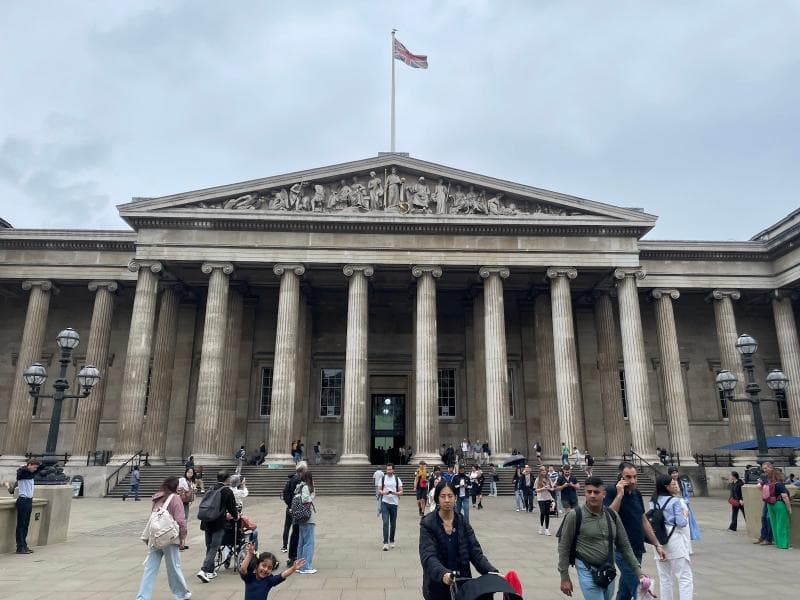
Explore the British Museum in London, United Kingdom, home to eight million artifacts spanning two million years of human history and culture.
Overview
The British Museum, nestled in the heart of London, United Kingdom, stands as a global beacon of human history, art, and culture. Established in 1753, it proudly holds the distinction of being the world's first public national museum, opening its doors to the public in 1759. Housing an astounding collection of approximately eight million objects, it meticulously chronicles the vast narrative of human civilization from its earliest beginnings to the present day. Annually, millions of visitors from across the globe traverse its halls, drawn by its unparalleled treasures and its monumental architectural presence.
At the architectural core of the museum lies the magnificent Queen Elizabeth II Great Court, a spectacular covered public square. This space, with its striking glass roof, serves as a central hub, surrounded by the myriad galleries that invite exploration into diverse cultures and epochs.
History & Cultural Background
The genesis of the British Museum dates back to 1753 with the acquisition of Sir Hans Sloane's extraordinary collection of over 80,000 'natural and artificial rarities,' alongside a vast library of books and manuscripts. This foundational collection, combined with others, led to the creation of this groundbreaking public institution. It initially occupied Montagu House, a 17th-century mansion, which was later replaced by the grand Greek Revival structure we see today, designed by Sir Robert Smirke and completed by 1852. The Enlightenment Gallery, originally King George III's library, was among the first sections to be built.
Over more than 260 years, the museum's collections have expanded dramatically. Many objects entered the museum through various routes, including excavations, purchases, donations, and bequests. However, it is also important to acknowledge that a significant portion of the collection, particularly from earlier centuries, was acquired during periods of British colonial expansion. The museum actively engages in researching the provenance of these objects and fosters dialogues with countries worldwide regarding their complex histories and potential repatriation.
What Makes It Special
What truly sets the British Museum apart is the sheer scope and significance of its holdings, representing two million years of human endeavor across every continent. Its collection is one of the largest and most comprehensive globally, making it an indispensable resource for understanding the human story.
Among its most celebrated artifacts is the Rosetta Stone, an ancient granodiorite slab that provided the key to deciphering Egyptian hieroglyphs, unlocking centuries of ancient Egyptian history.
Another iconic exhibit consists of the Parthenon Sculptures, also known as the Elgin Marbles, which once adorned the Parthenon temple on the Athenian Acropolis. These ancient Greek sculptures are considered masterpieces of classical art.
Visitors can also marvel at the colossal Bust of Ramesses the Great, a massive granite statue of the Egyptian pharaoh, and an extensive collection of Egyptian mummies, offering profound insights into ancient funerary practices.
The museum's iconic Great Court, designed by Lord Norman Foster, is Europe's largest covered public square, featuring a striking tessellated glass roof with 1,656 uniquely shaped panes. This architectural marvel encapsulates the museum's commitment to both historical preservation and modern innovation.
Stories, Fun Facts & Local Details
Beyond its grand displays, the British Museum holds a wealth of fascinating stories. The Rosetta Stone, discovered in 1799, became instrumental in 1822 when Jean-François Champollion, using its trilingual inscription (hieroglyphic, Demotic, and Ancient Greek), finally cracked the code of hieroglyphs.
The Parthenon Sculptures, while magnificent, have a long-standing history of controversy surrounding their removal from Athens by Lord Elgin in the early 19th century, a debate that continues to this day.
For a touch of whimsy, it's said that a cat named Mike guarded the main gate between 1909 and 1929, even earning an obituary in the 'Evening Standard' and 'TIME' magazine upon his passing. The museum also once housed Britain's first stuffed giraffes.
The Enlightenment Gallery, housed in the museum's oldest part, was originally designed for King George III's Library and offers a glimpse into 18th-century collecting and scholarship, providing a unique historical atmosphere.
Visitor Perspective
General admission to the British Museum's permanent collection is free, making its vast treasures accessible to everyone. While walk-in visits are possible, especially during off-peak times, it is highly recommended to book a free timed-entry ticket in advance, particularly during busy seasons or on weekends, to guarantee entry and manage visitor flow.
The museum is typically open daily from 10:00 AM to 5:00 PM, with extended hours until 8:30 PM on Fridays. To avoid crowds, visiting early in the morning shortly after opening or in the late afternoon on weekdays is often advised. While special exhibitions usually require a paid ticket, the sheer volume of the free permanent collection means visitors can easily spend several hours, or even a full day, exploring. Photography for personal use is generally permitted in most galleries, though flash photography and tripods are prohibited to protect the artifacts.
Coordinates: -0.1269566, 51.5194133
View on Google Maps💬 How Travelers Describe This Place
Based on community votes
Must See
795Unique
536Beautiful
489Interesting
251Photogenic
88
Traveler Stories
Discover memorable experiences shared by travelers who have visited this place.
No traveler stories yet.
Be the first traveler to share what made this place memorable.
Things to see at British Museum



Tour
By
Spot
Discover amazing places around the world. Your journey starts here.
Explore
© 2026 TourBySpot. All rights reserved.