Bernardine Church Complex
Vilnius, Lithuania
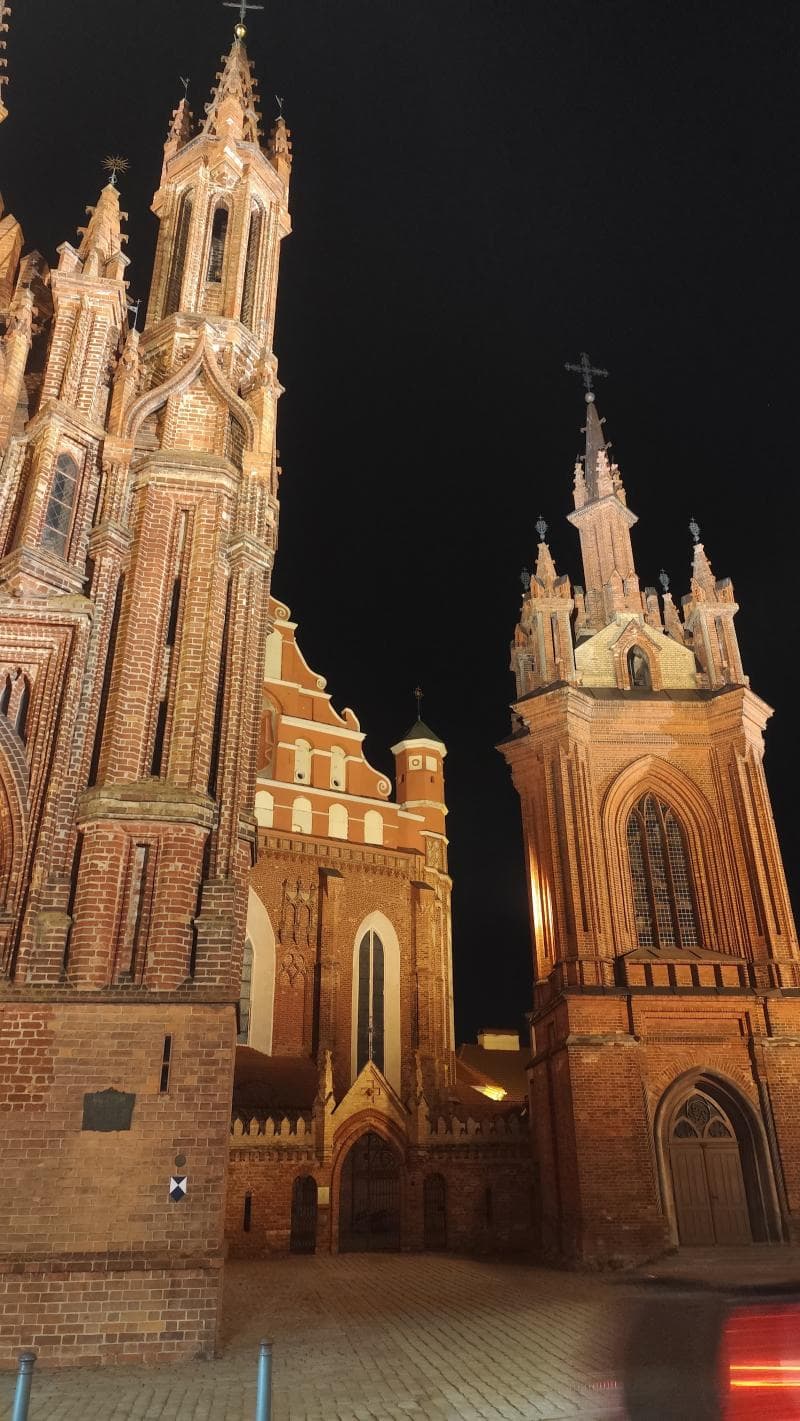
Discover the Bernardine Church Complex in Vilnius, Lithuania – a magnificent Gothic architectural ensemble next to St. Anne's Church, rich in history and unique art.
Overview
Nestled within the enchanting Old Town of Vilnius, Lithuania, the Bernardine Church Complex, formally known as the Church of Saints Francis and Bernard, stands as a testament to Gothic architectural prowess. This impressive complex forms an inseparable ensemble with the delicate St. Anne's Church, creating a striking contrast and a captivating sight for any visitor. Dedicated to Saints Francis of Assisi and Bernardino of Siena, the Bernardine Church is not merely a single edifice but a historical-architectural monument encompassing the grand church itself and the adjacent Bernardine Monastery. It is recognized as one of the largest and most significant Gothic religious structures in Lithuania and is a proud component of the UNESCO-listed Vilnius Old Town.
History & Cultural Background
The journey of the Bernardine Church Complex began in the mid-15th century when Bernardine monks arrived in Vilnius. Their initial wooden church was soon replaced by a brick structure by the late 15th century. A significant reconstruction took place in the early 16th century, during which the church was ingeniously integrated into Vilnius' defensive walls, a historical detail still visible today through surviving archers' holes. Over the 16th, 17th, and 18th centuries, the church underwent further renovations, acquiring Renaissance and Baroque elements that layered its predominantly Gothic character. The adjoining monastery, built concurrently with the church, was a vibrant center of learning, housing a novitiate, seminary, a scriptorium, and accumulating a rich library. However, political turmoil led to its closure by the Tsarist government after the 19th-century uprisings. In the Soviet era, the complex faced a different fate, being repurposed as an art institute and even a warehouse. It wasn't until 1994 that the Franciscans re-consecrated the church, allowing it to reopen for worship and reclaim its spiritual purpose.
What Makes It Special
What truly sets the Bernardine Church Complex apart is its extraordinary blend of architectural styles and its enduring historical integrity. It is celebrated as one of Lithuania's most vital examples of Gothic architecture, particularly noteworthy for its sheer scale, making it one of the country's largest religious Gothic structures. The monastery's Gothic layout has remarkably survived to this day, preserving many authentic facades, interior elements, and forms. Inside, visitors are treated to rare 16th-century mural paintings that uniquely combine Renaissance compositional techniques with Gothic stylistics, a treasure that is considered unique in the world. The church's exterior showcases striking Gothic features, including pointed-arch windows, robust buttresses, and a distinctive pediment flanked by twin octagonal towers. The interior is equally impressive, featuring eight towering pillars that divide the space into three naves, crowned by captivating crystal, cross, and star vaulted ceilings. The Bernardine Complex's relationship with St. Anne's Church is also unique, offering a compelling study in architectural contrast – the Bernardine's monastic solidity next to St. Anne's flamboyant elegance.
Stories, Fun Facts & Local Details
The Bernardine Church Complex is steeped in fascinating stories and local lore. One popular legend explains its impressive size: it is said that the Bernardine monks' sermons were so captivating that they attracted massive crowds, necessitating a larger church than its neighbor, St. Anne's. Its past as a defensive stronghold is evidenced by the visible archers' holes in its walls, remnants of its integration into Vilnius' fortifications. The complex bore witness to severe hardship, particularly during the 1655-1661 war with Moscow, when Cossacks ravaged the church, tragically killing monks and citizens who had sought refuge within its walls. Beyond its architectural grandeur, the monastery was a hub of intellectual and artisanal activity; the Bernardines were not only renowned preachers but also skilled tradesmen. Within the Church, specifically in the Chapel of St. Florian, lies Lithuania's oldest known sculpture of the Crucified Jesus, dating back to the 15th century. The interior walls are adorned with Gothic polychrome frescoes, some uncovered in 1981, depicting vibrant biblical and hagiographic themes alongside floral ornaments and heraldic insignia. Visitors can also admire a 16th-century Renaissance portal in the sacristy and ornate 15th-century forged metal doors.
Visitor Perspective
Today, the Bernardine Church Complex, often explored in conjunction with St. Anne's Church, offers an enriching experience for travelers in Vilnius. Its location within the pedestrian-friendly UNESCO World Heritage Old Town makes it easily accessible. Visitors can wander through the church, marveling at its towering Gothic architecture, the intricate details of its frescoes, and the unique vaulted ceilings. The church is open for worship, and Roman Catholic mass is celebrated, sometimes even in English. To fully appreciate its historical and artistic significance, planning a visit during daylight hours is recommended, as natural light enhances the beauty of the interior and its vibrant frescoes. As with any sacred site, visitors are encouraged to dress modestly and maintain a respectful demeanor to preserve the sanctity of this revered place. Exploring the Bernardine Church Complex provides a tangible connection to centuries of Lithuanian history, faith, and architectural evolution, inviting a profound and reflective experience.
Coordinates: 25.29389, 54.68306
View on Google Maps💬 How Travelers Describe This Place
Based on community votes
Photogenic
1.0kUnique
869Must See
416Interesting
309Beautiful
33
Traveler Stories
Discover memorable experiences shared by travelers who have visited this place.
No traveler stories yet.
Be the first traveler to share what made this place memorable.

Tour
By
Spot
Discover amazing places around the world. Your journey starts here.
Explore
© 2026 TourBySpot. All rights reserved.