Astronomical Clock
Prague, Czech Republic
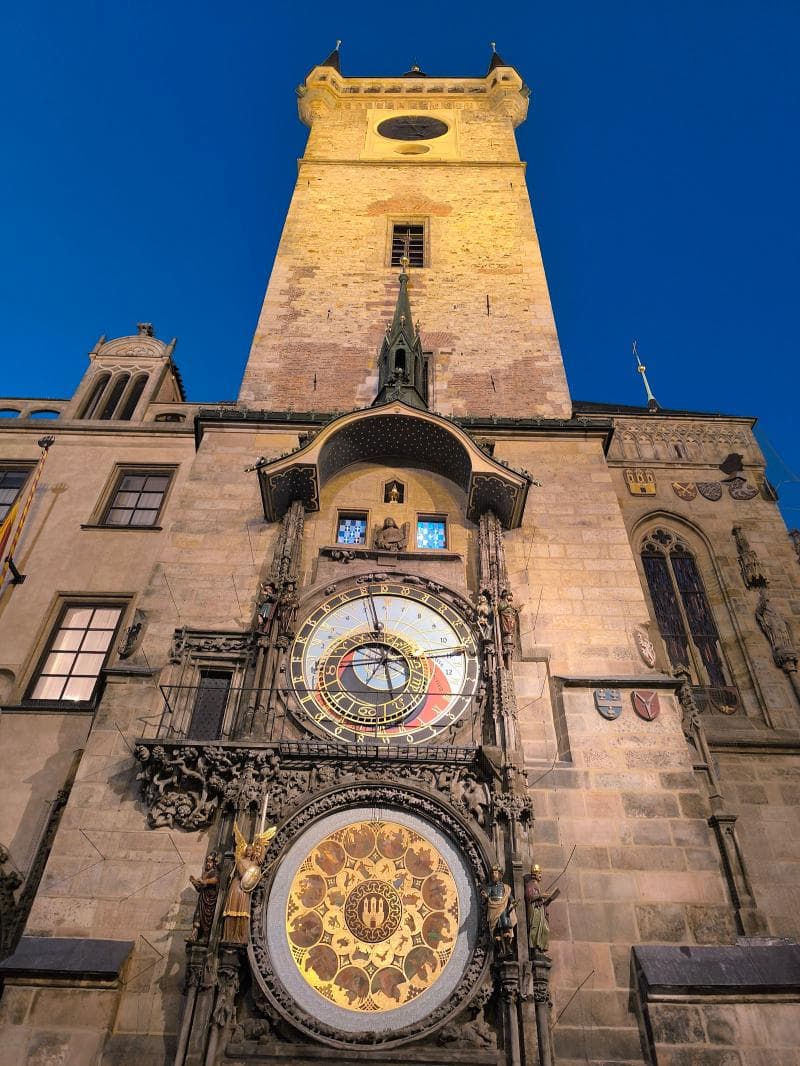
Discover the Prague Astronomical Clock (Orloj) in Old Town Square, Czech Republic. Explore its medieval history, intricate dials, and hourly show.
Overview
Nestled in the heart of Prague's Old Town Square, on the southern wall of the Old Town Hall, stands the magnificent Astronomical Clock, locally known as the Orloj. This captivating medieval marvel is not just a timepiece; it's a profound display of ancient astronomical understanding and intricate engineering. Constructed in 1410, it holds the distinguished title of being the world's third-oldest astronomical clock and the oldest still in operation today. The Orloj comprises three main components: a mesmerizing astronomical dial depicting the cosmos, a 'Walk of the Apostles' with moving figures that emerge on the hour, and a calendar dial illustrating the months of the year.
Crowds gather daily, eagerly awaiting the hourly spectacle as the clock springs to life. More than simply telling the time, the Astronomical Clock provides a visual narrative of the universe as understood in the Middle Ages, tracking the positions of the Sun and Moon, along with zodiacal information.
History & Cultural Background
The origins of the Prague Astronomical Clock trace back to October 9, 1410. The oldest part, including the mechanical clock and the astronomical dial, was meticulously crafted by the clockmaker Mikuláš of Kadaň, in collaboration with Jan Šindel, a professor of mathematics and astronomy at Charles University. Around 1490, the calendar dial was added, enhancing its functionality, and Gothic sculptures began to adorn its facade. Over the centuries, the clock has undergone several significant repairs and additions. Wooden statues were integrated in the late 17th century, and the beloved figures of the Apostles were introduced during a major restoration between 1787 and 1791.
A notable addition was the golden crowing rooster in 1865. For many years, it was mistakenly believed that the clock was built by a master craftsman named Hanuš in 1490. This historical error, corrected in 1961 with the discovery of old documents, gave rise to a powerful local legend. The clock has endured a tumultuous history, including significant damage during the Nazi occupation in 1945, when much of the Old Town Hall burned. Yet, through collective efforts, it was repaired and restored, a testament to Prague's resilience and dedication to its heritage.
What Makes It Special
The Prague Astronomical Clock stands out as a masterpiece of medieval technology and artistry. Its astronomical dial is a sophisticated representation of a geocentric universe, featuring a stationary Earth at its center, with the Sun and Moon orbiting around it. This dial displays not one, but multiple types of time: local Prague time, Old Czech time (where the day began at sunset), and Babylonian time (where daylight hours are divided into 12 parts). The movement of the Sun and Moon indicators across this dial also charts their positions within the zodiac.
Every hour, between 9 AM and 11 PM, the clock transforms into a theatrical performance. Small trap doors open, and the twelve Apostles parade past, bowing to the square below. Below the main astronomical dial, allegorical figures representing Vanity (looking in a mirror), Greed (holding a bag of money), Death (a skeleton ringing a bell), and a Turk (representing lust or pleasure) animate with the Apostles' procession. The golden crowing rooster signals the end of the hourly show. This combination of astronomical precision, mechanical ingenuity, and religious allegory makes the Orloj a unique and deeply symbolic creation.
Stories, Fun Facts & Local Details
Perhaps the most famous tale associated with the Orloj is the tragic legend of Master Hanuš. According to popular lore, after he completed the clock, the Prague councillors blinded him to prevent him from replicating his magnificent work elsewhere. In a desperate act of revenge, Hanuš is said to have sabotaged the clock's mechanism, causing it to stop for many years, and allegedly cursing anyone who tried to repair it. While historians have since credited Mikuláš of Kadaň and Jan Šindel as the original creators, this dramatic legend has been passed down through generations, adding a layer of mystery and intrigue to the clock's already rich history.
Another fascinating aspect is its survival. The clock has witnessed centuries of change, war, and political upheaval. Its restoration after the devastation of World War II is a testament to its cultural significance to the people of Prague. It's a reminder of human ingenuity and artistic spirit enduring through difficult times. Visitors can sometimes gain access to the clock's interior to witness the intricate mechanisms that power this medieval computer.
Visitor Perspective
A visit to the Astronomical Clock is an essential Prague experience, and watching the hourly show from the Old Town Square is free for all. To get the best view of the 'Walk of the Apostles,' it's advisable to arrive about 10-15 minutes before the hour, especially during peak tourist seasons, as the square can become very crowded. For a deeper understanding and a unique perspective, consider visiting the Old Town Hall Tower. Here, you can ascend to a viewing gallery for panoramic city views and even glimpse the inner workings of the clock mechanism from behind, an experience that truly highlights the medieval engineering marvel. This unique landmark offers more than just a passing glance; it invites contemplation on history, astronomy, and the enduring human quest to understand our place in the cosmos.
Coordinates: 14.4209167, 50.0870083
View on Google Maps💬 How Travelers Describe This Place
Based on community votes
Beautiful
623Interesting
545Unique
343Must See
302Photogenic
20
Traveler Stories
Discover memorable experiences shared by travelers who have visited this place.
No traveler stories yet.
Be the first traveler to share what made this place memorable.

Tour
By
Spot
Discover amazing places around the world. Your journey starts here.
Explore
© 2026 TourBySpot. All rights reserved.