Armenian Cathedral
Lviv, Ukraine
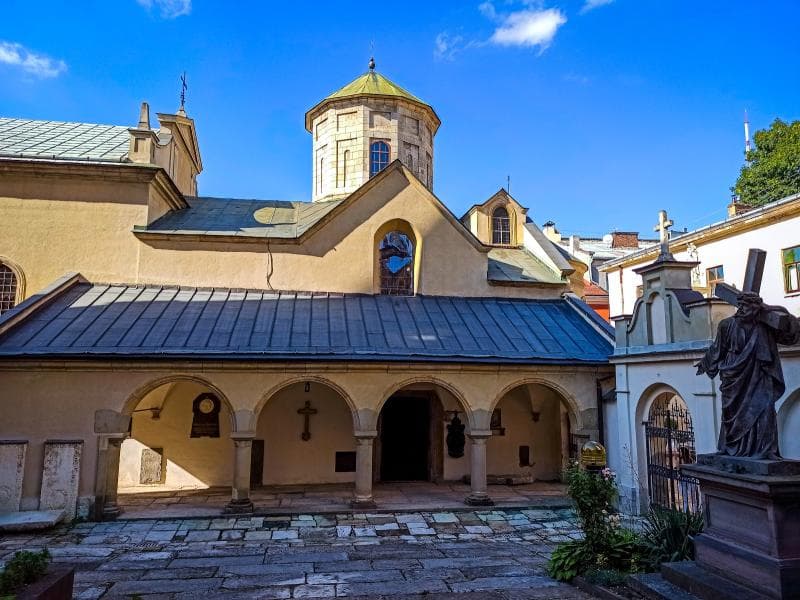
Explore the Armenian Cathedral in Lviv, Ukraine, a UNESCO World Heritage site blending Armenian, Gothic, and Baroque styles. Discover its rich history and art.
Overview
Tucked away within the historic embrace of Lviv Old Town, the Armenian Cathedral of the Assumption of Mary stands as a profound testament to Lviv's rich multicultural heritage and the enduring spirit of its Armenian community. This architectural gem, consecrated in the late 14th century, is not merely a church but a complex of buildings that forms a unique ensemble, recognized as a UNESCO World Heritage Site. Its distinctive blend of Armenian, Romanesque-Gothic, Byzantine, and later Baroque and Art Nouveau styles immediately captivates any curious traveler. More than just a place of worship, the cathedral offers a journey through centuries of history, artistry, and the vibrant life of one of Lviv's oldest diasporas.
History & Cultural Background
The Armenian presence in Lviv dates back to the 13th century, with the foundation of the Armenian Cathedral itself laid between 1363 and 1370. Commissioned by wealthy Armenian merchants like Jacob of Caffa and Panos of Kayseri, and designed by the Silesian architect Doring, the original structure drew inspiration from the Cathedral of Ani, the ancient Armenian capital. This foundational church was built with thick stone walls and a dome featuring hollow ribs made from earthenware jugs, a distinctive acoustic element. Over the centuries, the cathedral underwent numerous transformations, with additions in the 15th, 17th, 18th, and early 20th centuries. These included the construction of arcades, a bell tower by Petro Krasovsky in 1571, sacristies, and the main nave's extension. These continuous expansions and stylistic updates reflect the changing fortunes and artistic trends experienced by the Armenian community in Lviv. The cathedral served as the spiritual heart of the Armenian Catholic Archdiocese of Lviv until 1945. During the Soviet era, it was closed and repurposed, notably used as a storage facility for art. However, in a significant cultural and spiritual restoration, the cathedral was returned to the Armenian community in 2000 and re-consecrated in 2003, once again becoming the cathedral of the Armenian Diocese of Ukraine.
What Makes It Special
The Armenian Cathedral's allure lies in its unique architectural synthesis and the atmospheric complex it inhabits. Its oldest parts, including the apse and a section under the dome, showcase the original stone construction, with walls reaching one and a half meters in thickness. The interior is a feast for the eyes, adorned with stunning frescoes from the early 20th century by the renowned artist Jan Henryk Rosen, known for their expressive colors and dramatic symbolism. The golden mosaic in the dome and the carved wooden ceiling with Oriental motifs further enhance the unique atmosphere. The cathedral complex extends beyond the main church itself, encompassing a picturesque courtyard that feels like a step back in time. Here, visitors can discover ancient tombstones with inscriptions, some in Armenian, relocated from old cemeteries, and a Romanesque arcade. Notable features within the courtyard include the unique wooden 'Golgotha' chapel with its carved altar and the elegant 18th-century St. Christopher Column. The entire ensemble, including the bell tower, the former Armenian Archbishop's Palace, and the Armenian Benedictine Monastery, forms a cohesive and historically rich quarter.
Stories, Fun Facts & Local Details
The Armenian Cathedral is steeped in stories that bring Lviv's past to life. The Armenians were influential merchants in medieval Lviv, controlling much of the eastern trade and contributing significantly to the city's wealth and cultural fabric. The decision to model the cathedral after the one in Ani was a conscious effort to preserve and recreate their cultural heritage in a new homeland, a poignant detail for the Armenian diaspora. A particularly interesting architectural detail is the use of earthenware jugs within the dome's ribs, a technique designed to improve acoustics, hinting at ancient engineering ingenuity. The artists who worked on the cathedral's frescoes, like Jan Henryk Rosen, sometimes invited local celebrities and actors to pose for figures in their religious scenes, adding a touch of local flavor to the sacred art. Walking through the courtyard, one might even spot dates carved into the ancient cobblestones, such as '1667', a small, tangible link to centuries past. Nearby, a modern monument to the Armenian alphabet celebrates the unique Armenian script and their rich cultural legacy, underscoring the deep roots of this community in Lviv.
Visitor Perspective
Visiting the Armenian Cathedral is an immersive experience that transports you away from the bustling city streets into a realm of quiet contemplation and historical depth. It's often recommended to start your exploration in the inner courtyards, where the ancient tombstones and the 'Golgotha' chapel create a serene, almost mystical atmosphere. Inside the cathedral, the intricate frescoes, the golden dome mosaic, and the carved wooden ceiling command attention, revealing layers of artistry and spiritual devotion. Though an active place of worship for the Armenian Apostolic Church, visitors are welcome to explore and appreciate its beauty. The cathedral's location within the heart of Lviv's Old Town makes it easily accessible, just a short walk from Rynok Square. A typical visit, allowing time to absorb the details of both the exterior complex and the interior, usually takes between 1 to 1.5 hours. It's a journey not just through architecture, but through the enduring legacy of a community that has shaped Lviv's unique identity.
Coordinates: 24.03083, 49.84333
View on Google Maps💬 How Travelers Describe This Place
Based on community votes
Photogenic
931Unique
692Interesting
491Beautiful
261Must See
49
Traveler Stories
Discover memorable experiences shared by travelers who have visited this place.
No traveler stories yet.
Be the first traveler to share what made this place memorable.

Tour
By
Spot
Discover amazing places around the world. Your journey starts here.
Explore
© 2026 TourBySpot. All rights reserved.