Arch of Peace
Milan, Italy
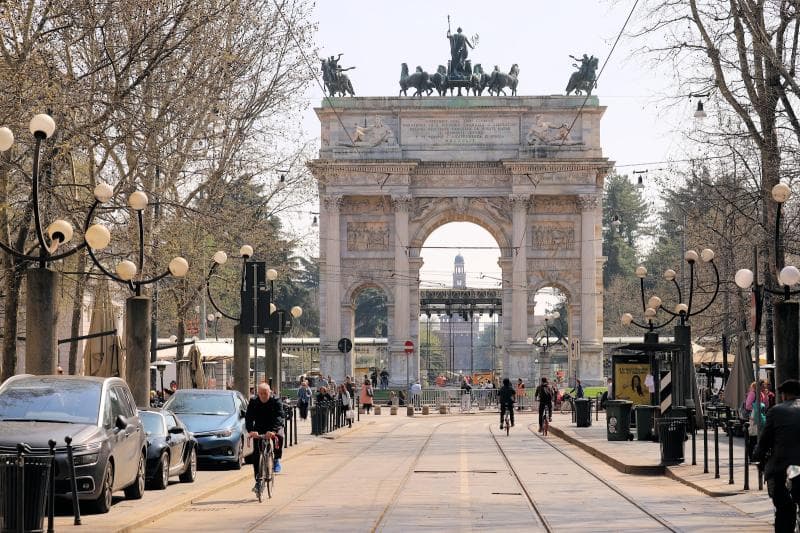
Discover Milan's Arch of Peace (Arco della Pace) in Parco Sempione, Italy. Explore its rich history, neoclassical architecture, and unique stories.
Overview
Standing majestically at the edge of Parco Sempione in Milan, Italy, the Arch of Peace, locally known as the Arco della Pace, is a neoclassical triumphal arch that beautifully embodies the city's rich history and enduring spirit. It serves not only as an impressive architectural landmark but also as a powerful symbol of European peace and unity. This grand monument, located at the heart of Piazza Sempione, draws visitors to admire its intricate details and reflect on its profound historical significance.
With a towering height of approximately 25 meters, the Arch of Peace commands attention, marking a ceremonial gateway that once connected Milan to destinations beyond the Alps. Its prominent position and majestic design make it an unforgettable sight within the vibrant landscape of Milan, offering a blend of artistic grandeur and historical narrative.
History & Cultural Background
The story of the Arch of Peace began in 1806 with Napoleon Bonaparte's vision for a grand ceremonial entrance to Milan. Initially conceived as a temporary structure made of wood, plaster, and canvas, it was built to welcome Eugène de Beauharnais, Napoleon's stepson and Viceroy of Italy, and Augusta of Bavaria. The success of this temporary arch led the Milanese city council to commission a more permanent, monumental marble structure.
Work on the definitive arch, designed by architect Luigi Cagnola, commenced in 1807. It was originally intended as the 'Arch of Victory' (Arco delle Vittorie) to celebrate Napoleon's triumphs, particularly the French victory at the Battle of Jena. However, construction was halted in 1814 with the fall of the Kingdom of Italy and Napoleon's defeat. Roughly two-thirds of the arch had been completed by this time.
The project lay dormant until 1826 when Francis I, the Austrian Emperor, ordered its completion, transforming its purpose from an emblem of victory to a dedication to the peace achieved by the Congress of Vienna in 1815. This pivotal shift saw the monument renamed the 'Arch of Peace.' Luigi Cagnola passed away before its completion, with Carlo Giuseppe Londonio taking over the direction of the works. The arch was finally inaugurated on September 10, 1838, in the presence of Emperor Ferdinand I of Austria. Later, after Milan's liberation from Austrian rule, the arch was rededicated to unified Italy following the victory of Magenta in 1859, a moment celebrated by Napoleon III and Victor Emmanuel II passing beneath it.
What Makes It Special
The Arch of Peace is a magnificent example of Neoclassical architecture, characterized by its three arches, supported by eight fluted Corinthian columns. Crafted primarily from Baveno granite and clad in Crevoladossola stone and Crevola marble, its facade measures 25 meters high by 24 meters wide.
Its most striking feature is the sculptural group crowning the arch: the 'Sestiga della Pace' (Chariot of Peace), a monumental bronze sculpture by Abbondio Sangiorgio. This depicts the Goddess of Peace (often identified as Minerva or Eirene) riding a six-horse chariot, flanked by four mounted Victories by Giovanni Putti. These sculptures, along with numerous bas-reliefs, adorn both the interior and exterior facades, depicting allegorical figures, historical events from the Napoleonic era, and the subsequent period of European Restoration. Notably, four large statues represent allegories of the rivers flowing through the former Kingdom of Lombardy-Veneto: the Adige, Po, Ticino, and Tagliamento.
Stories, Fun Facts & Local Details
The Arch of Peace holds several captivating stories and fun facts that add to its allure. One popular anecdote involves the bronze chariot atop the arch. It is said that Franz Josef I of Austria, a sworn enemy of Napoleon, orchestrated the turning of the six horses to face away from France after Napoleon's final defeat. This subtle yet powerful gesture was a deliberate mockery of the French emperor, symbolizing a shift in power and sentiment.
Interestingly, the Arch's location is far from random. It aligns with the Simplon Road (Corso Sempione), a strategic route through the Alps that Napoleon envisioned as a grand thoroughfare connecting Milan to Paris. Today, the Arch of Peace serves as a vibrant focal point for Milanese life, not just a historical monument. It is a popular meeting place, a backdrop for cultural events, concerts, and Sunday picnics, reflecting its integration into the city's social fabric.
Visitor Perspective
Visiting the Arch of Peace offers a breathtaking experience, allowing one to literally walk through a piece of Milan's dynamic past. Situated in the tranquil and expansive Parco Sempione, it provides a perfect counterpoint to the bustling city center. Travelers can approach the arch from the park, enjoying leisurely strolls through its avenues and green spaces, or from Piazza Sempione, where its grandeur is immediately apparent.
The arch's open public square setting means it is accessible for outdoor viewing 24 hours a day, year-round, making it a flexible addition to any itinerary. Getting there is convenient, with the nearest metro stations (Cadorna on M1 and M2, and Lanza on M2) providing easy access. The surrounding area offers a relaxing atmosphere, inviting visitors to pause, appreciate the architectural marvel, and soak in the historical aura before or after exploring the nearby Sforza Castle or other attractions within Parco Sempione.
Coordinates: 9.1724514, 45.47586947
View on Google Maps💬 How Travelers Describe This Place
Based on community votes
Must See
795Unique
536Beautiful
489Interesting
251Photogenic
88
Traveler Stories
Discover memorable experiences shared by travelers who have visited this place.
No traveler stories yet.
Be the first traveler to share what made this place memorable.

Tour
By
Spot
Discover amazing places around the world. Your journey starts here.
Explore
© 2026 TourBySpot. All rights reserved.